Business & Markets · · Team LATENT
Anthropic's IPO: Japan's retail order deadlines and pricing rules, six-times demand and the revenue forecasts
In Anthropic's IPO, online retail orders in Japan close at 10:00 a.m. on November 18 at Mizuho Securities, 10:59 a.m. at SBI Securities and 2:00 a.m. on November 19 at Rakuten Securities (all Japan time, all planned). The offer price is published 7 to 23 hours later and can fall outside the price range. We checked the Japanese, EEA, UK and Australian filings with the SEC and the brokers' notices for deadlines, price limits, currency and the share counts by region, and worked back from reported demand and revenue forecasts to an implied October–December quarter.
At 10 a.m. on November 18, Japan time, Mizuho Securities closes its online lottery for Anthropic shares. SBI Securities closes 59 minutes later. The price per share is set in the US about a day after that. Applicants order without knowing the price and receive the price and their lottery result on the morning of the 19th.
On November 10, Anthropic filed the second amendment to its registration statement (S-1/A) and set a price range of $70 to $78 a share. By November 12 it had also filed with the SEC, as free writing prospectuses (FWPs), the contents of its IPO website, its retail documents for Japan, the EEA, the UK and Australia, and its Canadian prospectus. The Japanese FWP is an English translation of the amended securities registration statement filed with the Kanto Local Finance Bureau on November 11, and it sets out how each of six firms takes orders and when they close.
This article uses those filings and the brokers' notices to check the terms for retail investors applying in Japan. We calculated the gap between deadlines and pricing, the limits on pricing outside the price range, dollar settlement and the exchange rate, and the share counts by country and region. From reported demand and revenue forecasts, we worked back to October–December revenue. The retracted terms and the first S-1/A are covered in our November 10 article, and the figures in the second S-1/A in our November 12 article.
We read the SEC filings and the brokers' pages on November 15. All deadlines are planned times and may change. Yen amounts, time gaps and ratios are LATENT's calculations. This article does not recommend buying or selling shares and makes no forecast of share prices.
Anthropic: Japan offering FWP / Anthropic: S-1/A
Key takeaways
- Online retail orders in Japan close at 10:00 a.m. on November 18 at Mizuho, 10:59 a.m. at SBI and 2:00 a.m. on November 19 at Rakuten (planned, Japan time). That is 7 to 23 hours before the price publication SBI expects at about 9 a.m. on the 19th. At all three, applicants can see the price and their result and decline until 12:59 p.m. on the 19th.
- The price can be set outside the range. The floor in the Japanese filing is a total of $51.612 billion, or $54.40 a share if the share count is unchanged. If the share count is not increased, the cap is $218 a share. The EEA filing says the company expects any increase not to exceed $120.
- Japan's offering is 38.5 million to 50 million shares, 4.1% to 5.3% of the total. Reuters reported the book was six times covered by the end of the 12th. Backing out from the sell-side 2026 revenue forecast gives October–December revenue of $18.8 billion to $19.8 billion, 1.11 to 1.17 times July–September. Some buy-side forecasts imply $24.0 billion to $27.7 billion.
US pricing and Japan's deadlines
According to the IPO website Anthropic launched on November 10, pricing is expected on November 18, US Eastern time, and trading on Nasdaq on the 19th. The ticker will be "ANT". Both dates depend on regulatory clearance. The Japanese website gives the price determination as November 19, Japan time. Pricing on the 18th in the US falls on the morning of the 19th in Japan.
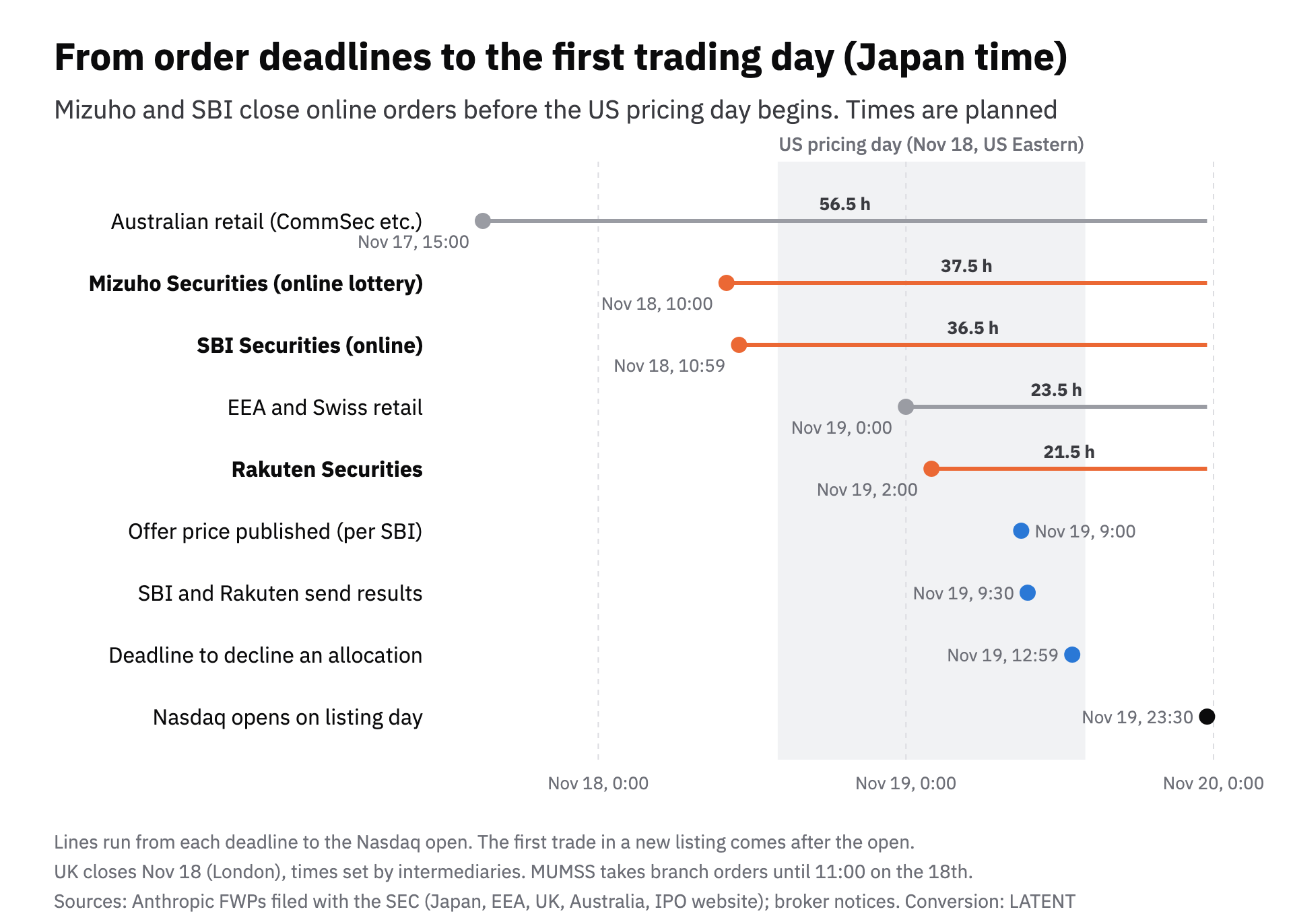
Retail orders in Japan close before that. According to the brokers' notices, Mizuho's online orders close at 10:00 a.m. on the 18th, SBI's at 10:59 a.m. on the 18th, Mitsubishi UFJ Morgan Stanley Securities' branch orders at 11:00 a.m. on the 18th, and Rakuten's at 2:00 a.m. on the 19th. SBI expects to publish the offer price at about 9 a.m. on the 19th. From deadline to that time is 23 hours at Mizuho, 22 hours at SBI and Mitsubishi UFJ Morgan Stanley, and 7 hours at Rakuten.
We also lined up the retail deadlines elsewhere. Australia closes at 5 p.m. on the 17th local time, which is 3 p.m. on the 17th in Japan. The EEA and Switzerland close at 4 p.m. on the 18th Central European Time, or midnight on the 19th in Japan. The UK closes on the 18th, London time, with cut-off times set by each intermediary.
We also counted the hours from each deadline to the Nasdaq open on the first trading day (11:30 p.m. on the 19th, Japan time): 37.5 hours at Mizuho, 36.5 at SBI and 21.5 at Rakuten, against 23.5 for the EEA and Switzerland and 56.5 for Australia. The 18th in US Eastern time begins at 2 p.m. on the 18th in Japan, so Mizuho and SBI close their online orders before the US pricing day has begun.
Anthropic: IPO website FWP / Anthropic: Japanese IPO website / Anthropic: EEA prospectus FWP / Anthropic: Australia and Canada FWP
Order terms at each broker
Six firms handle the Japanese offering. There is no underwriting in Japan; the six act as handlers entrusted with sales by the US underwriters. Goldman Sachs Japan and Morgan Stanley MUFG sell only to institutional investors. Retail investors can apply at four firms: Mizuho Securities, SBI Securities, Rakuten Securities and Mitsubishi UFJ Morgan Stanley Securities. The Japanese filing says the demand survey in Japan is not "book-building" as defined in the Japan Securities Dealers Association's rules. SBI also says the allocation is outside the association's allocation rules.
The four brokers differ in order size, settlement currency and how the exchange rate is set.
| Item | Mizuho (online) | SBI | Rakuten | Mitsubishi UFJ Morgan Stanley |
|---|---|---|---|---|
| Order period | Nov 12 to 10:00 a.m. Nov 18 | Nov 11 to 10:59 a.m. Nov 18 | Nov 12 to 2:00 a.m. Nov 19 | Nov 11 to 11:00 a.m. Nov 18 (branches only) |
| Order size | 100 shares only | 1-share units | 1-share units (fact sheet) | 1-share units |
| Settlement currency | Yen only | Dollars only | Yen or dollars | Not stated |
| Funding deadline | Business day before pricing | 3:00 p.m. Nov 18 | 2:00 a.m. Nov 19 | Not stated |
| Exchange rate | Broker's rate at 9:05 a.m. on the 19th | Dollars funded in advance | Broker's rate at about 10 a.m. on the 19th | Rate set by the broker |
| NISA | Separate procedure after winning | Yes | Yes, growth investment quota | Not stated |
| Results | About 10 a.m. on the 19th | About 9:30 a.m. on the 19th | From 9:30 a.m. on the 19th | Not stated |
| Decline deadline | 12:59 p.m. on the 19th | 12:59 p.m. on the 19th | 12:59 p.m. on the 19th | Not stated |
Mizuho's online service limits each applicant to 100 shares and plans to allocate to up to 10,000 people. If all of them receive 100 shares, that is 1 million shares, or 2.0% to 2.6% of the Japanese offering. At Mizuho Bank's November 13 mid-rate of ¥159.93, 100 shares cost ¥1.1195 million to ¥1.2475 million. Mizuho says it may cut the number of recipients depending on demand.
SBI enters into the lottery up to the number of shares that the applicant's dollar buying power at 3 p.m. on the 18th covers at the top of the range, $78. To apply for 100 shares, an investor must deposit $7,800 in advance. Rakuten requires no funds at the time of ordering. Those paying in yen must have, by 2 a.m. on the 19th, the number of shares times the price times the exchange rate times 1.05. Rakuten has set its currency conversion fee for yen settlement in this offering at zero.
Mitsubishi UFJ Morgan Stanley takes orders only at branches, not online. It says opening an account usually takes about a week.
Mizuho Securities: Anthropic notice / SBI Securities: Anthropic notice / Rakuten Securities: Anthropic notice / Mitsubishi UFJ Morgan Stanley: Anthropic notice / Mizuho Bank: foreign exchange quotations
Rules for pricing outside the range
The Japanese filing says pricing in this offering differs from a typical Japanese IPO in two ways. First, the preliminary price range can be revised before pricing with no limit on the top or bottom. Second, in line with US practice, the price can be set above or below the range. Revisions and prices outside the range can be set without prior notice or an amendment to the filing.
The filing also gives numerical limits. The floor is set on the total: the price times the total share count cannot fall below the total at the bottom of the range minus 20% of the total at the top of the range. At the current range and the total of 948.75 million shares, that is $51.612 billion. With the share count unchanged, it is $54.40 a share, 77.7% of the bottom of the range.
The cap depends on whether the share count rises. If it does not, the price can rise as far as the top of the range plus twice the bottom. That is $218 a share, for a total of more than $206.8 billion. If the share count rises, the total cannot exceed 120% of the total at the top of the range, $88.803 billion. Divided by the original share count that is $93.6 a share, and the per-share cap falls below that as the share count rises.
The EEA prospectus gives a tighter cap. The maximum price for EEA and Swiss retail investors is $120, and the company says it expects any increase in the US price not to exceed that. That is 1.54 times the top of the range. It also says retail orders limited below $70, the bottom of the US range, should not expect an allocation.
The brokers describe what happens when the price lands outside the range in different ways. Mizuho says an application stays valid even if the price is set outside the range unless the investor declines. Rakuten says an order counts as a purchase application when placed and the purchase is completed if the investor wins the lottery. According to the Japanese filing, SBI's online orders are executed after 1 p.m. on pricing day within the price set times the number of shares applied for. At all three, applicants can see the price and their result and decline until 12:59 p.m. on the 19th. The Australian prospectus says investors are bound to take any allocation whether the final price is above, below or within the range. To the extent permitted by law an application is irrevocable, and in most circumstances it cannot be withdrawn once accepted.
Anthropic: Japan offering FWP / Anthropic: EEA prospectus FWP / Mizuho Securities: Anthropic notice / Rakuten Securities: Anthropic notice
Dollar settlement and the exchange rate
Trading and dividends are in dollars. Applicants need a foreign securities account with the handling broker. The application deposit equals the issue price and earns no interest. The shares are not expected to be listed on a Japanese exchange. Delivery is two business days after pricing in Tokyo. Buyers can trade from the listing date through the broker they applied with.
The filing converts dollars to yen at Mizuho Bank's October 1 mid-rate of ¥157.97 to the dollar. The $70 to $78 range is ¥11,058 to ¥12,322 a share. At the November 13 mid-rate of ¥159.93 it is ¥11,195 to ¥12,475, or ¥137 to ¥153 a share more than at the October 1 rate. Each ¥1 fall in the yen adds ¥70 to ¥78 a share, or ¥7,000 to ¥7,800 for 100 shares.
For yen settlement, the time the rate is fixed differs by broker. Mizuho uses its rate at 9:05 a.m. on the 19th and Rakuten its rate at about 10 a.m. on the 19th. Both come after the price publication SBI expects at about 9 a.m. SBI settles only in dollars, so applicants convert yen to dollars themselves in advance. Rakuten says yen-settled trades after listing carry its usual currency fee of 25 sen per dollar.
Anthropic: Japan offering FWP / Mizuho Bank: foreign exchange quotations / Rakuten Securities: Anthropic notice
Retail share counts by country and region
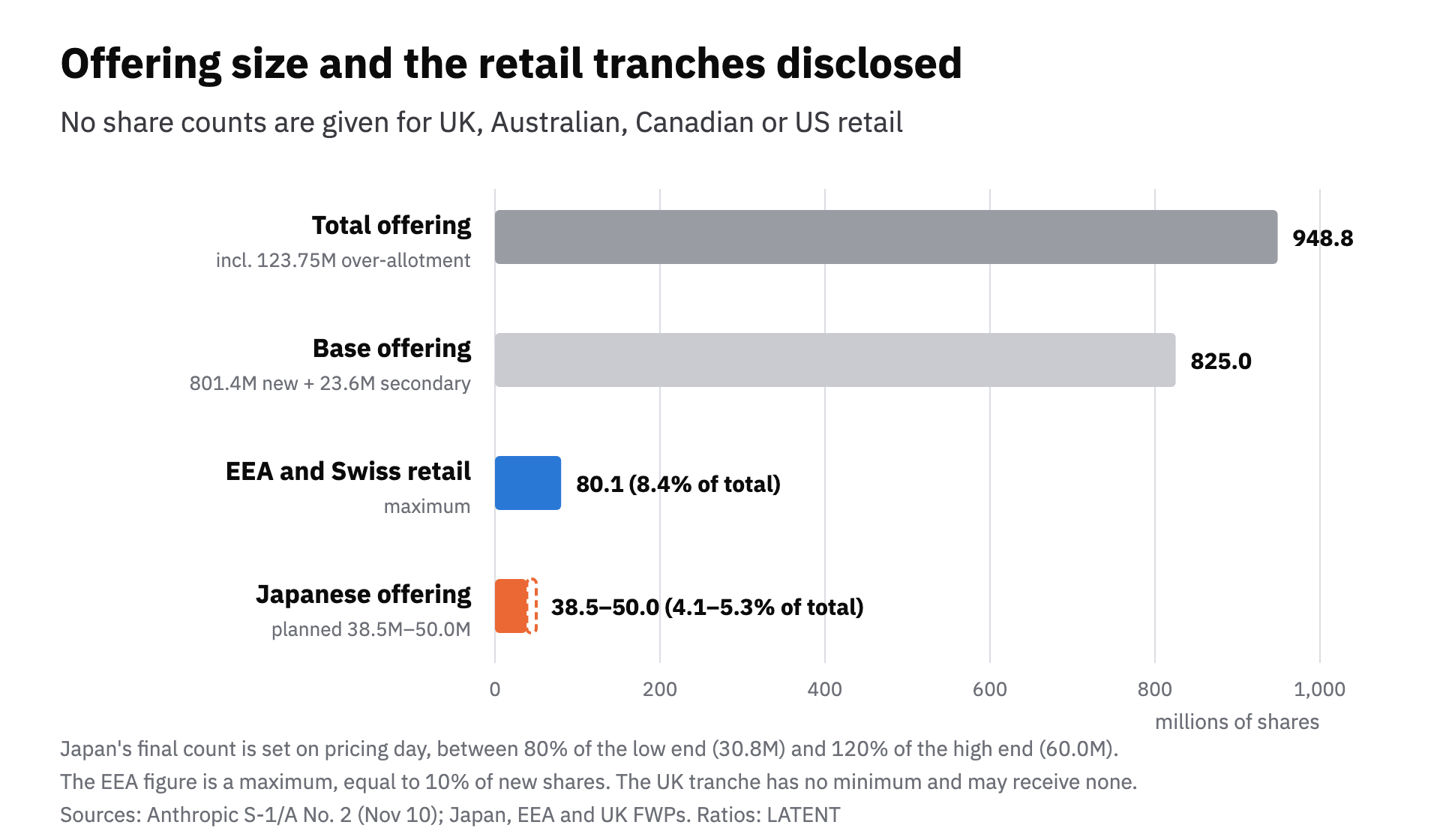
The EEA prospectus divides the offering into eight parts: a US public offering, EEA retail, Swiss retail, public offerings in Australia, certain Canadian provinces, Japan and the UK, and private placements. The total is 948.75 million shares: 801.35 million new shares, 23.65 million shares sold by existing holders and 123.75 million new shares for over-allotment.
Only Japan and the EEA have share counts. Japan's is 38.46 million to 50 million shares, 4.1% to 5.3% of the total. The final count is set on pricing day between 80% of the low end (30.77 million) and 120% of the high end (60 million). In dollars it is $3.0 billion to $3.5 billion, 1.37 to 1.60 times the $2.185 billion SpaceX raised in Japan, as reported by Nikkei.
The EEA and Swiss retail tranche is up to 80.14 million shares, exactly 10% of the new shares and 8.4% of the total. At the price range that is $5.61 billion to $6.25 billion. Japan's maximum and the EEA's maximum together are 130.14 million shares, 13.7% of the total.
The UK retail offer has no minimum allocation. The company may allocate none to it, and applications are scaled back if they exceed the allocation. Each person may make one application, including through a Junior ISA or Junior SIPP. Australia's allocation is set by the company and the underwriters after the Australian offer closes. In the US, online brokers including Charles Schwab, Fidelity, Robinhood, SoFi and E*TRADE are expected to join as selling group members.
Among its risk factors, the S-1/A lists the possibility that retail investors are allocated a minority of the shares sold. It also lists retail investor interest after the listing as a factor that may move the share price.
Anthropic: EEA prospectus FWP / Anthropic: UK FWP / Anthropic: S-1/A / Nikkei: SpaceX's Japanese offering
Six-times demand and allocation
On the morning of November 13, Japan time, Bloomberg reported, citing people familiar with the matter, that orders had reached about six times the shares available. On the 13th, US time, Reuters gave the progression from other people: about two times by the end of the first roadshow day, the 10th, and six times by the end of the 12th. Reuters wrote that SpaceX had been two times covered by the end of its second roadshow day.
Six times the base offering of 825 million shares is $346.5 billion to $386.1 billion at the price range. Reuters wrote that a single-digit subscription rate would be considered modest for many highly anticipated IPOs, then reported bankers' and investors' view that demand was impressive given the size of the deal.
On allocation, Bloomberg reported that banks had told investors existing backers would receive priority. Some new investors may receive smaller allocations than expected. We confirmed this through Reuters and Investing.com articles citing Bloomberg.
The FT reported on the 11th that the banks were weighing a higher offer price, with a valuation of $1.5 trillion or more. As of November 15, no new S-1/A had been filed with the SEC, and the three Japanese brokers' notices still showed the $70 to $78 range. Dividing $1.5 trillion by the fully diluted share count we backed out in our November 12 article (about 18 billion) gives about $83 a share.
We found no report on retail demand in Japan in the major outlets we searched. In SpaceX's June listing, Nikkei reported Japanese purchase requests of more than ¥1 trillion against about ¥347 billion raised in Japan.
Bloomberg: about six times oversubscribed / Reuters: order book progression and revenue forecasts / Reuters: priority for existing backers / FT: a higher offer price under consideration / Nikkei: Japanese demand for SpaceX
Investors in mainland China and Hong Kong
Early on November 14, Japan time, Bloomberg reported that institutional investors in mainland China and Hong Kong had been excluded from placing orders. Several banks refused those orders or expect allocations to be difficult, partly because of the US International Traffic in Arms Regulations (ITAR). We could not confirm the report in other major outlets.
We also compared the selling restrictions in the prospectuses. The S-1/A's selling restrictions section has entries for more than 20 countries and regions, including Taiwan, South Korea and Singapore, but none for Hong Kong or mainland China. The words "Hong Kong" do not appear anywhere in the document. The same is true of SpaceX's June prospectus. Arm's 2023 prospectus had a Hong Kong entry, worded to allow sales to professional investors in Hong Kong.
In its export control risk factor, the S-1/A says that in certain contexts providing its models may constitute an export of defense articles or defense services subject to ITAR. In June 2026, the Commerce Department imposed worldwide export restrictions on Fable 5 and Mythos 5. Anthropic disabled both models for all customers and redeployed them after updating its safeguards and after the restrictions were lifted. The company has not explained how the reasons for refusing the orders relate to these disclosures.
Bloomberg: orders from China / SpaceX: prospectus / Arm: prospectus (2023)
October–December implied by revenue forecasts
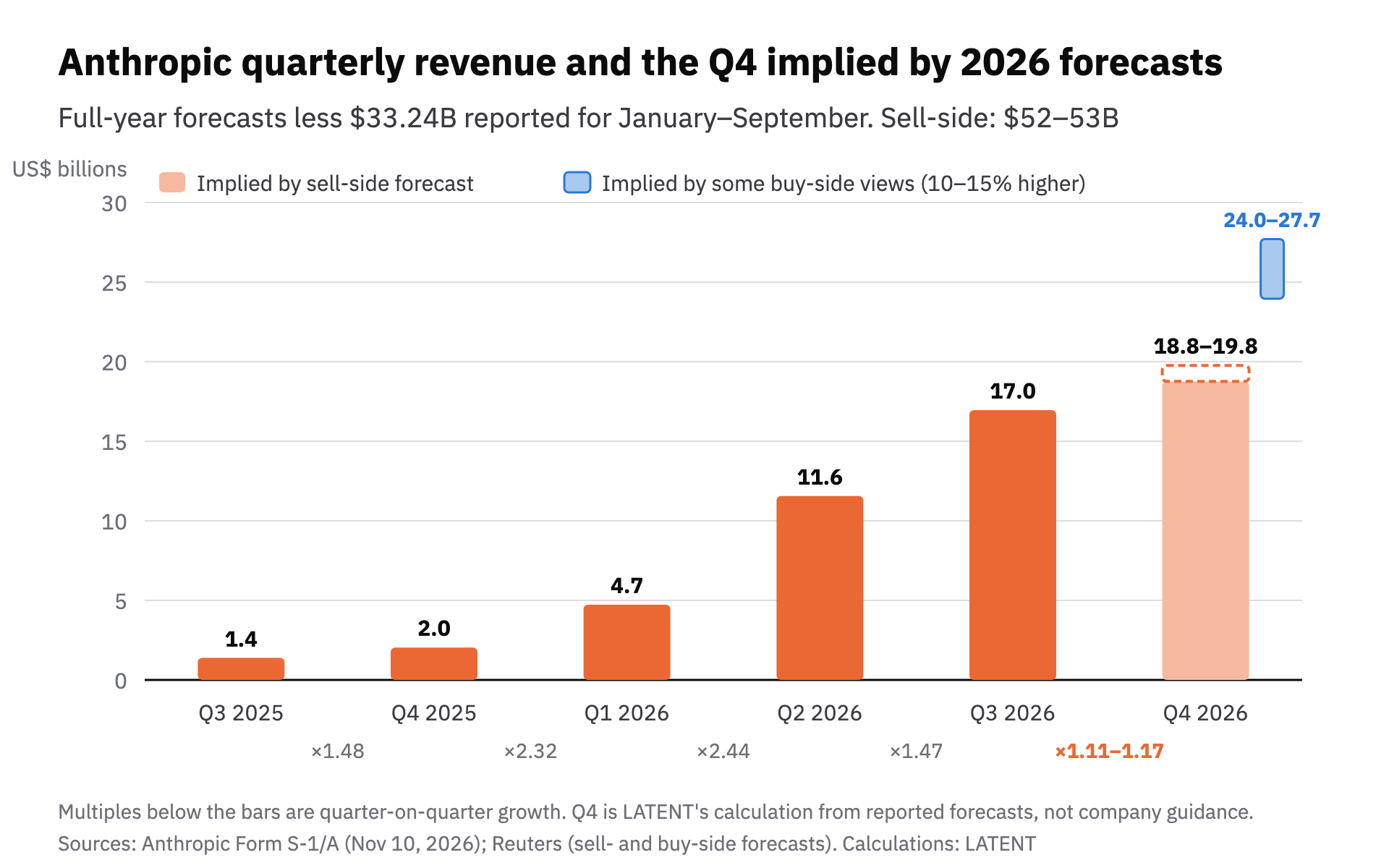
According to Reuters, the underwriting banks (the sell side) forecast 2026 revenue of $52 billion to $53 billion and 2027 revenue of $135 billion to $137 billion. The 2028 estimate is $270 billion to $280 billion, and valuations are calculated by applying multiples to that year's revenue. One investor who placed an order said certain buy-side projections are 10% to 15% higher than the sell side for 2026 and 2027, and that buy-side forecasts vary significantly. One investor who passed puts 2028 about 30% below the sell-side estimate.
The S-1/A shows January–September 2026 revenue of $33.242 billion. Reuters does not state the accounting basis of the forecasts, so we subtracted on the assumption that it matches the S-1/A. From the sell-side 2026 forecast, October–December comes to $18.76 billion to $19.76 billion. That is 1.11 to 1.17 times July–September's $16.956 billion, slower than the 1.47 times from April–June to July–September. The same subtraction from some buy-side forecasts gives $23.96 billion to $27.71 billion, 1.41 to 1.63 times July–September.
Because January–September is fixed, the gap between the full-year forecasts carries straight into October–December. The gap between the sell side and the buy side is $5.2 billion to $8.0 billion for the quarter, 30% to 50% of July–September revenue. The first earnings report after the listing will show which view is closer.
We also compared the S-1/A's run-rate revenue. Run-rate revenue at October 31 was about $81 billion; divided by four, it is about $20.3 billion. The figure implied by the sell side is 2% to 7% below that. Run-rate revenue extends the latest 28 days and other short periods to a full year, so it is on a different basis from quarterly revenue.
We compared with 2027 as well. The sell side's $135 billion to $137 billion for 2027 averages about $34 billion a quarter, 1.7 to 1.8 times the implied October–December figure. That means growth of 2.55 to 2.63 times from 2026 to 2027 and about two times from 2027 to 2028.
We divided valuations by 2028 revenue. At the fully diluted valuation of about $1.4 trillion reported by Bloomberg, it is 5.0 to 5.2 times the sell-side 2028 estimate. At the FT's $1.5 trillion it is 5.4 to 5.6 times. If 2028 is 30% lower, as the cautious investor expects, even $1.4 trillion is 7.1 to 7.4 times. According to Reuters, SpaceX's valuation relied on projected 2029 revenue, which some investors saw as particularly aggressive, while Anthropic's is anchored in a year closer to its listing.
Reuters: order book progression and revenue forecasts / Investing.com: valuation and proceeds / Anthropic: S-1/A
Lock-ups and the private placement shares
Selling restrictions on existing shareholders do not simply end after 180 days. They differ by type of holder, and the share that can be sold rises in stages. The base expiry is the earlier of two trading days after the release of results for January–March 2027 or the 180th day after pricing. If pricing is on November 18, the 180th day is May 17, 2027.
Non-founder directors, officers and employees can sell up to 10% of the group's combined lock-up shares from the first trading day, and up to a further 35% from two trading days after the release of full-year 2026 results. The rest is released at the base expiry.
Certain stockholders can sell in stages: up to 6.0% at 27 and 48 days after pricing, up to 7.0% at 62 and 76 days, 12.5% after the full-year results, and 9.5% on each of five dates from 13 to 69 days after those results. Applying each percentage on each date as the filing is worded, up to 86% can be sold before the base expiry. With pricing on November 18, the 27th day is December 15 and the 48th day is January 5, 2027.
Certain holders of more than 0.5% of fully diluted shares before the offering, and the founders, are locked up longer: until the release of results for July–September 2027 or the 365th day after pricing. The 0.5% holders also receive smaller releases on the same dates and after 2027 earnings releases; applied to each date, up to 90.9% is released before expiry. Each founder can sell up to 29% from the base expiry. The underwriters' representatives can release any of these restrictions at any time.
The private placement is treated differently. Seven companies, Google, NVIDIA, AMD, Broadcom, Micron, Microsoft and TSMC, are buying a total of $26 billion of Class N stock at the IPO price. At the $74 midpoint that is 351.35 million shares, 37% of the total offering. The shares are unregistered restricted securities and can be resold under an effective registration statement or an exemption such as Rule 144. Some buyers have registration rights. The filing says these shares are not subject to market standoff agreements with the company or lock-up agreements with the underwriters.
Directors and affiliated entities have indicated interest in buying up to $303 million at the IPO price. The indications are not binding, and any shares bought are subject to lock-up.
What to check next
We are watching four things. The first is pricing on November 18, US Eastern time: whether the price is inside or outside $70 to $78 and whether the share count changes, and where in the 30.77 million to 60 million range Japan's count lands. The second is the start of trading on the 19th and the first trade against the offer price. The third is the first earnings report after the listing, where October–December revenue can be set against $18.8 billion to $19.8 billion implied by the sell side and $24.0 billion to $27.7 billion implied by some buy-side forecasts. The fourth is the staged lock-up releases starting on December 15 and the treatment of the private placement shares.
Sources and scope
We checked the pricing and trading dates, the Japanese share count and amount, the six firms' order methods and deadlines, the price floor and cap provisions, the staged lock-up releases, the EEA, UK and Australian terms, retail sales and risk factors, the selling restrictions sections, the ITAR disclosure and the private placement in the SEC filings themselves on November 15, 2026. We checked the Hong Kong references in the SpaceX and Arm prospectuses in the SEC filings the same day.
We read the brokers' order periods, share counts, currencies, funding deadlines, exchange rates, NISA treatment, result times and decline deadlines on their notice pages on November 15. Mizuho's page is marked "as of November 12, 2026", Mitsubishi UFJ Morgan Stanley's "as of November 11, 2026", and Rakuten's page is dated November 12. SBI's page carries no date. Rakuten's order unit is not on its notice page; we confirmed it in the fact sheet it posted. For SBI's final allocation display, SBI's page says after 8 p.m. and the Japanese filing says after 10 p.m. The exchange rate is Mizuho Bank's quotation for November 13.
The demand multiple and priority for existing backers, the China and Hong Kong orders, the revenue forecasts and the valuations are from reports. We read the Reuters article as republished by Investing.com and only the first two paragraphs of the two Bloomberg articles. We confirmed priority for existing backers through articles citing Bloomberg. We read only the headline and opening of the FT article, and the Nikkei SpaceX articles through headlines and excerpts. The Reuters article gives no number for the multiple applied to 2028 revenue. Time gaps, yen amounts, ratios, the implied October–December revenue, the run-rate comparison, valuation multiples, release dates and cumulative release percentages are LATENT's calculations from the figures in these sources. Cumulative releases assume each percentage applies on each date, as we read the filing. We counted the selling restriction entries from the document text. The interpretation of the numbers is LATENT's.
- Anthropic, PBC, Free Writing Prospectus (Japan Amendment, dated November 11, 2026)
- Anthropic, PBC, Free Writing Prospectus (EEA Prospectus, dated November 11, 2026)
- Anthropic, PBC, Free Writing Prospectus (UK Materials, dated November 10, 2026)
- Anthropic, PBC, Free Writing Prospectus (AUS Wrap, CA Prospectus, dated November 10, 2026)
- Anthropic, PBC, Free Writing Prospectus (IPO Website, dated November 10, 2026)
- Anthropic, PBC, Form S-1/A (filed November 10, 2026)
- Anthropic: Japanese IPO website
- Space Exploration Technologies Corp., Prospectus (424B4, filed June 12, 2026)
- Arm Holdings plc, Prospectus (424B4, filed September 14, 2023)
- Mizuho Securities: Anthropic, PBC IPO
- SBI Securities: Anthropic IPO
- Rakuten Securities: Anthropic, PBC book-building orders
- Mitsubishi UFJ Morgan Stanley Securities: US IPO
- Mizuho Bank: foreign exchange quotations
- Reuters, "Investors flock to Anthropic IPO but question durability of AI lead" (via Investing.com)
- Bloomberg, "Anthropic's IPO Is Said to Be About Six Times Oversubscribed"
- Bloomberg, "Anthropic IPO Share Orders From China Are Said to Be Rebuffed"
- Reuters, "Anthropic's IPO is about six times oversubscribed, Bloomberg News reports" (via The Standard)
- Investing.com, "Anthropic IPO demand jumps to six times available shares"
- FT, "Anthropic bankers prepare to increase IPO valuation to $1.5tn or more"
- Nikkei, SpaceX raises ¥347 billion in Japan (Japanese)
- Nikkei, retail investors rush to SpaceX IPO (Japanese)