Business & Markets · · Team LATENT
OpenAI and Anthropic in the third quarter: $10 billion versus $17 billion of revenue, compared on matched accounting and per dollar of revenue
The Information and the WSJ reported on November 10 that OpenAI's July–September 2026 revenue was about $10 billion, with an operating loss excluding stock pay of about $10.9 billion. Anthropic's second amended S-1, filed the same day, shows revenue of $16.956 billion and an operating loss of $567 million for the same quarter. We compare the two after aligning how cloud-channel sales are counted in both directions, and calculate results per dollar of revenue, run-rate and valuation multiples, the IPO terms and placement, and OpenAI's 2026 plan.
On November 10, numbers for the same three months arrived from both companies on the same day. At 6:29 a.m. Eastern, Anthropic filed its second amended registration statement (S-1/A) with the SEC. It sets a price range of $70 to $78 a share and shows July–September revenue of $16.956 billion. The same day, The Information reported that OpenAI's revenue for the quarter was about $10 billion. The WSJ, citing internal documents, reported an adjusted operating loss excluding stock-based compensation of about $10.9 billion.
Side by side, Anthropic's revenue is 1.7 times OpenAI's. But the two companies count sales through cloud providers differently, and the losses are on different bases: Anthropic's is as filed, OpenAI's is adjusted to exclude stock pay. This article aligns how revenue is counted, in both directions, and puts the results on the same basis. It then calculates run-rate revenue, valuation multiples, the IPO terms and the gap with OpenAI's 2026 plan.
OpenAI is private and does not publish its numbers. All OpenAI figures are reports or LATENT estimates based on reports. Anthropic's figures were checked in the November 10 S-1/A. Aligned figures, ratios and multiples are LATENT's calculations. This article does not recommend buying or selling shares and makes no forecast of share prices.
Anthropic: S-1/A (Nov 10) / Forbes: summary of the WSJ report
Key takeaways
- OpenAI had more quarterly revenue through January–March 2026; Anthropic overtook it in April–June. For July–September it is $16.956 billion against about $10 billion. Whether Anthropic's revenue is restated net or OpenAI's is grossed up, Anthropic's is 1.2 to 1.6 times OpenAI's.
- Per dollar of revenue, the operating result excluding stock pay for July–September was +$0.03 at Anthropic and -$1.09 at OpenAI, a gap of about $11.4 billion for the quarter. Anthropic's figure includes $5 billion of compute bought under short-term commitments and a $2 billion non-cash donation-matching charge.
- Anthropic's price range implies a fully diluted valuation of about $1.26 trillion to $1.41 trillion, close to OpenAI's $1.25 trillion in its current raise. Measured against September run-rate revenue on a gross basis, both are valued at about 18 to 20 times. Anthropic's revenue for January–September, $33.2 billion, is more than 90% of OpenAI's full-year 2026 outlook.
The two sets of numbers from November 10
The Information was first to report OpenAI's July–September numbers. The WSJ reviewed internal documents, and Bloomberg reported the same revenue citing a person familiar. The Information and WSJ articles are paywalled; we checked them through summaries by Forbes, Reuters and others.
| Item | Anthropic | OpenAI |
|---|---|---|
| July–September revenue | $16.956B | about $10B |
| Growth from prior quarter | 46.7% | about 50% (from $6.7B) |
| Operating result | -$567M (as filed) | about -$10.9B (adjusted, excluding stock pay) |
| Operating result excluding stock pay | +$533M (LATENT calculation) | about -$10.9B |
| Source | S-1/A filed with the SEC | Reports by The Information, WSJ, Bloomberg |
Anthropic's S-1/A gives quarterly stock-based compensation, included in personnel costs: $1.1 billion for July–September. Adding it back to the filed operating loss of $567 million gives a profit of $533 million. TipRanks, citing the WSJ, put Anthropic's adjusted operating profit at $2.5 billion. Excluding the $2 billion donation-matching charge as well as stock pay gives $2.533 billion, which matches. Some reports put OpenAI's stock pay for the quarter at $2.6 billion, but we could not confirm that elsewhere.
Anthropic: S-1/A quarterly table / Bloomberg: OpenAI revenue (republished) / TipRanks: summary of the WSJ report
Quarterly revenue over time
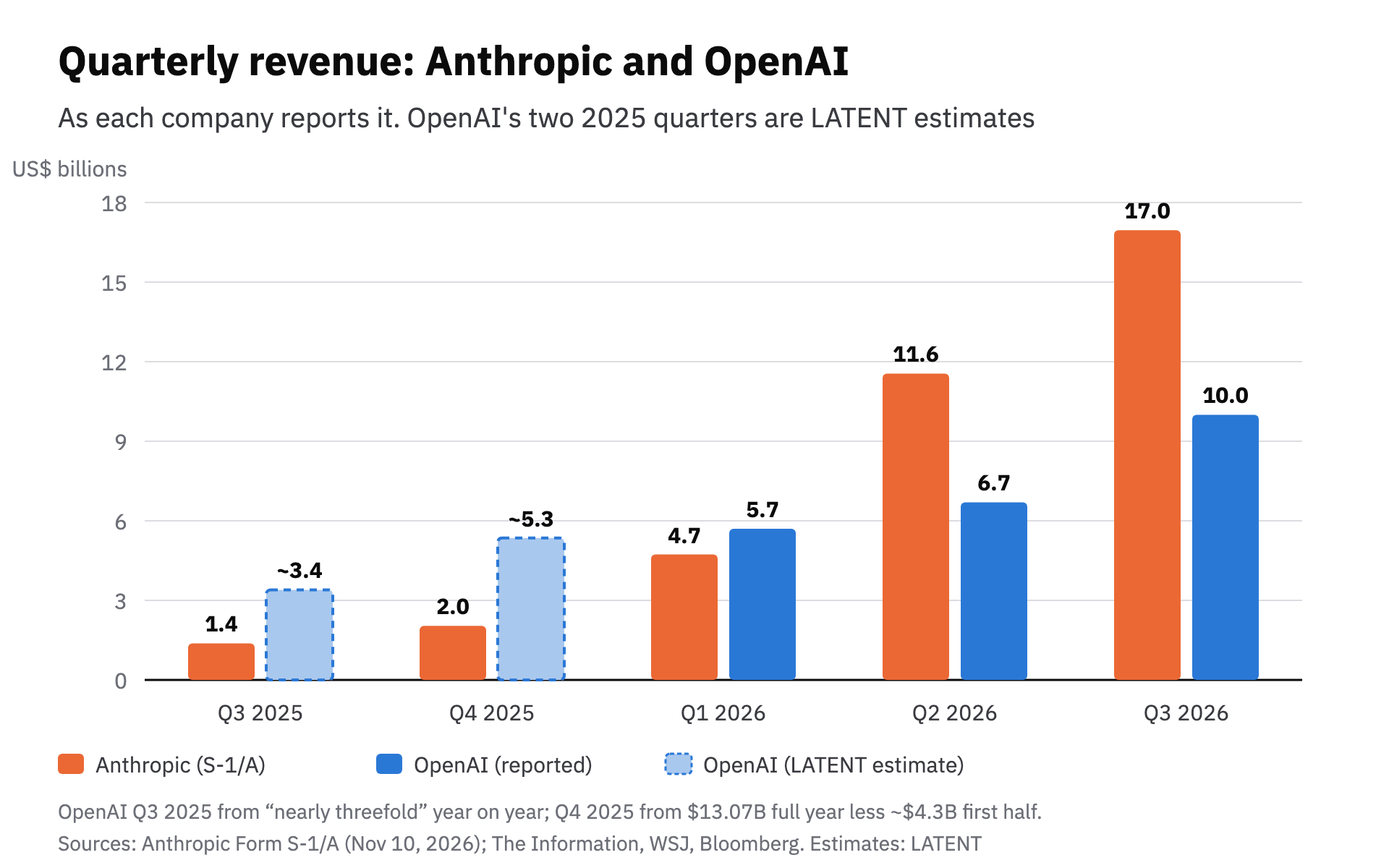
| Quarter | Anthropic | OpenAI | Anthropic ÷ OpenAI |
|---|---|---|---|
| Jan–Mar 2026 | $4.731B | $5.7B | 0.83x |
| Apr–Jun | $11.555B | $6.7B | 1.72x |
| Jul–Sep | $16.956B | about $10B | 1.70x |
| Jan–Sep total | $33.242B | about $22.4B | 1.48x |
The $5.7 billion for January–March was reported by The Information in June, and the $6.7 billion for April–June by the WSJ in August. The order flipped in April–June, when Anthropic's revenue grew 2.44 times in a single quarter. OpenAI's growth slowed to about 18% in April–June and returned to about 50% in July–September.
OpenAI's 2025 quarterly revenue has not been reported. We worked back from reports of $13.07 billion for the full year and about $4.3 billion for the first half, and Bloomberg's statement that July–September 2026 revenue was nearly three times the year before. That gives about $3.3 billion to $3.5 billion for July–September 2025 and about $5.3 billion to $5.4 billion for October–December. If the estimate holds, OpenAI's revenue in the last quarter of 2025 was about 2.6 times Anthropic's, and the order reversed within three quarters.
The Decoder: summary of the Q1 report / Outlook Business: summary of the Q2 report
How cloud-channel sales are counted
Part of the revenue gap comes from how it is counted. Businesses can buy Anthropic's Claude through AWS and Google Cloud marketplaces. The cloud provider bills the customer, collects payment, deducts its fees and remits the rest to Anthropic. According to the S-1/A, Anthropic is the principal providing the service, so it records the full amount the customer pays as revenue. According to Reuters, the fees are recorded in sales, marketing and partnerships expenses.
The S-1/A says marketplace sales were about 11% of revenue in 2023, about 32% in 2024 and about 47% in 2025, and about 44% for January–September 2026. In September Reuters, working from the confidentially filed registration statement, reported 2025 fees of about $351 million and calculated that this was about 16 cents per dollar of marketplace sales.
OpenAI counts the other way. According to Axios and Bloomberg, OpenAI records only its own share of certain sales through partners. In April Semafor wrote that when a customer pays a dollar through a cloud provider, OpenAI books only its cut of about 20 cents, while Anthropic books the whole dollar. According to Axios, both methods comply with US accounting rules; the difference comes down to who is judged the principal and who the agent.
The Microsoft relationship has also changed this year. On April 27 Microsoft said it would stop paying OpenAI a revenue share, and that OpenAI's payments to Microsoft would continue through 2030 at the same percentage, subject to a total cap. The Information reported the cap as $38 billion. In the same revision OpenAI gained the right to sell its products through any cloud provider. We found no report on how OpenAI has recorded sales through Azure since then.
Axios: OpenAI run-rate and accounting / Semafor: the 20-cent cut / Reuters: marketplace fees / Microsoft: revised agreement
Revenue on matched bases
We adjusted for the difference in two directions: restating Anthropic net, and grossing OpenAI up.
For Anthropic on a net basis, Axios reported an estimate from people familiar with its finances that revenue would fall by 6% to 10%. Multiplying the S-1/A's 44% marketplace share by the 16% fee Reuters calculated gives 7.0%, within that range. July–September revenue of $16.956 billion becomes $15.26 billion to $15.94 billion.
The gross-up factor for OpenAI comes from two reports. According to Axios, the run-rate OpenAI showed investors for the end of September was about $50 billion, and a reference figure aligned with Anthropic's method was about $70 billion, a ratio of 1.40. Semafor put the difference in April at up to $8 billion of annualized revenue, 1.32 times the roughly $25 billion run-rate then. No report says explicitly that the quarterly $10 billion is net, but we assumed it is on the same basis as the run-rate and applied 1.32 to 1.40. That gives $13.2 billion to $14.0 billion gross.
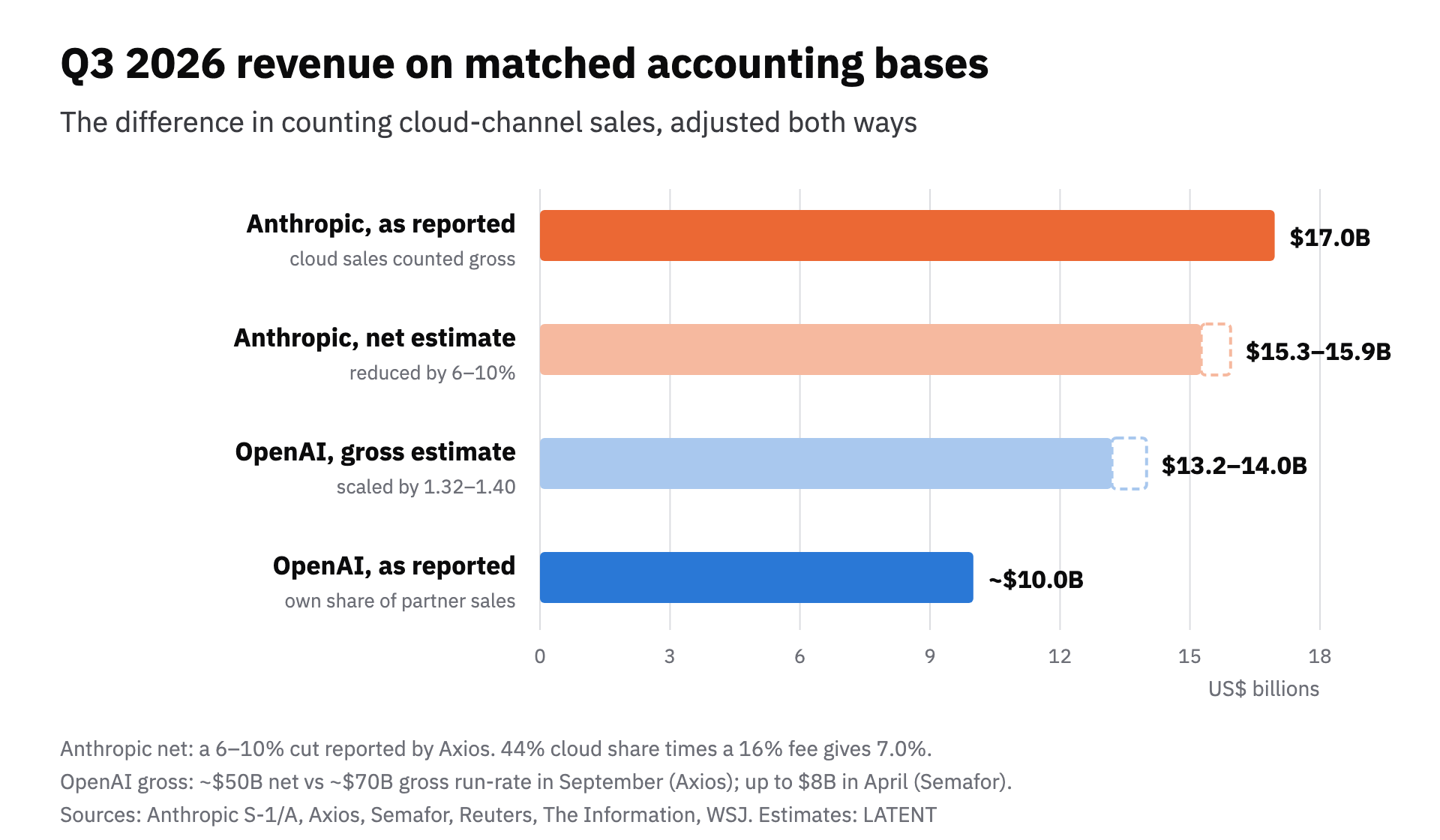
| Basis | Anthropic | OpenAI | Anthropic ÷ OpenAI |
|---|---|---|---|
| As each reports | $16.956B | about $10B | 1.70x |
| Both net | $15.26B–$15.94B | about $10B | 1.53x–1.59x |
| Both gross | $16.956B | $13.2B–$14.0B | 1.21x–1.28x |
On either basis, Anthropic had more revenue in July–September. How much more ranges from 1.2 to 1.6 times depending on the basis. The same calculation for April–June gives 1.23 to 1.62 times, so the order holds. In January–March, against Anthropic's $4.731 billion, OpenAI would be about $7.5 billion to $8.0 billion gross; OpenAI was ahead on either basis.
Axios: the effect of restating net / Axios: the gross reference figure
Operating result per dollar of revenue
We compared results excluding stock pay. The reports do not say what OpenAI's adjusted figure excludes besides stock pay, so the comparison is a guide.
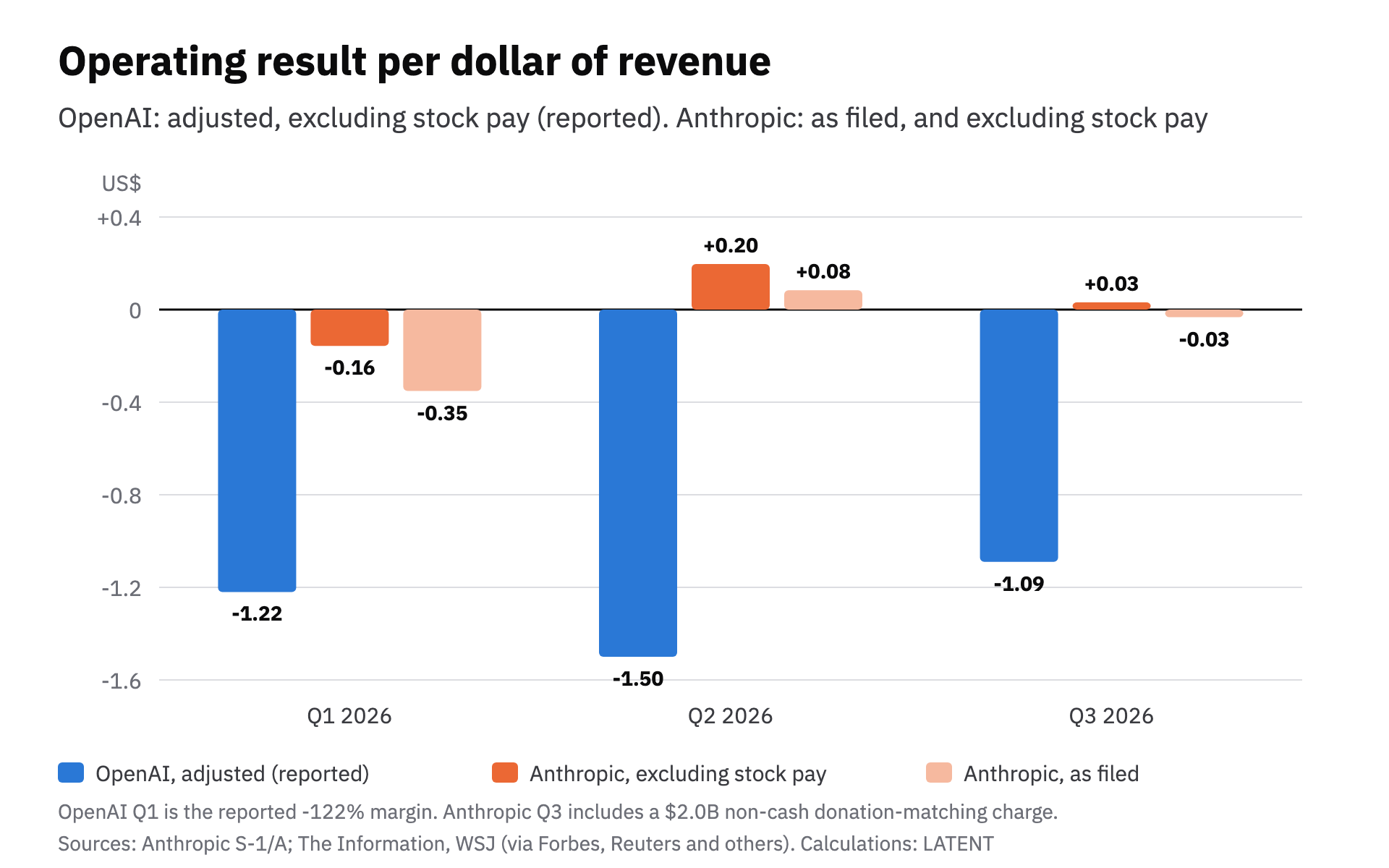
| Quarter | OpenAI adjusted operating result | Per dollar | Anthropic excluding stock pay | Per dollar |
|---|---|---|---|---|
| Jan–Mar | about -$7.0B (estimate) | -$1.22 | -$743M | -$0.16 |
| Apr–Jun | -$10.1B | -$1.50 | +$2.274B | +$0.20 |
| Jul–Sep | -$10.9B | -$1.09 | +$533M | +$0.03 |
For July–September the gap, excluding stock pay, is about $11.4 billion. Even with OpenAI's revenue grossed up to $13.2 billion to $14.0 billion, its loss per dollar is $0.78 to $0.83. Grossing up adds the same amount to costs as to revenue, so the size of the loss does not change.
OpenAI's loss per dollar narrowed from $1.50 in April–June to $1.09 in July–September. Anthropic moved the other way, from +$0.20 to +$0.03. Anthropic's July–September figure includes $5 billion of compute bought under short-term commitments and the $2 billion donation-matching charge, which involves no cash outlay. Excluding that $2 billion too gives +$0.15 per dollar.
Results including stock pay can also be compared. In August the WSJ reported OpenAI's April–June operating loss including stock pay as $12.3 billion, a loss of $1.84 per dollar of revenue; Anthropic's filed figure for that quarter was +$0.08. If OpenAI's July–September stock pay was the $2.6 billion some reports cite, its loss including stock pay would be about $13.5 billion, or $1.35 per dollar. Anthropic's filed figure was -$0.03.
Forbes: loss per dollar / The Decoder: the Q1 -122% / Related: Anthropic's third-quarter operating loss
Added revenue and the change in results
From April–June to July–September, OpenAI's revenue rose by about $3.3 billion and its adjusted loss by about $0.8 billion: about 24 cents of extra loss per extra dollar of revenue, the same calculation Forbes made. The Forbes writer attributes most of the loss to compute bought ahead of revenue. That is his reading; OpenAI has published no breakdown of its costs.
Over the same period Anthropic's revenue rose by about $5.4 billion, and its operating result excluding stock pay fell by about $1.74 billion. Compute and infrastructure costs rose from $5.558 billion to $9.863 billion, up $4.3 billion, and from 48% to 58% of revenue. The S-1/A says compute is contracted 12 to 18 months before it becomes available, so the cost is hard to change in the short term.
Price cuts also held back revenue growth. According to the S-1/A, price reductions on new model versions and contractual discounts reduced revenue by about $600 million from April–June to July–September, more than offset by higher usage. The same effect from July–September to October–December 2025 was about $70 million, so the impact of price cuts grew about ninefold in a year.
Forbes: added revenue and loss / Anthropic: S-1/A quarterly trends
Customers, products and Microsoft
What makes up the revenue also differs. OpenAI CFO Sarah Friar told CNBC that the enterprise business doubled in July–September from the prior quarter and that consumer grew about 20%. President Greg Brockman said enterprise overtook consumer to become the largest source of revenue. ChatGPT has about 1.2 billion weekly users, and according to the WSJ about 100 million paying subscribers.
Anthropic's S-1/A gives the number of customers paying $100,000 or more over the trailing 12 months. It rose from more than 950 at the end of September 2025 to more than 11,900 at the end of September 2026, about 12.5 times in a year.
| Item | Anthropic | OpenAI |
|---|---|---|
| Customer scale | More than 11,900 customers paying $100K+ a year | About 1.2B ChatGPT weekly users; about 100M paying subscribers |
| Enterprise | No enterprise share given in the filing | Enterprise doubled quarter on quarter; now the largest source |
| Cloud-channel sales | About 44% of Jan–Sep 2026 | Some recorded as own share only |
Microsoft's 10-Q also offers a gauge of OpenAI's scale. For July–September Microsoft recorded $10.0 billion of revenue from commercial arrangements with OpenAI, including revenue-sharing payments, almost the same as OpenAI's reported revenue for the quarter. There is no breakdown, so it is unclear how much is OpenAI paying for compute on Azure. Microsoft's stake is about 24% on an as-converted basis, and its receivables from OpenAI were $7.2 billion at the end of September.
Microsoft: 10-Q for the quarter ended September 30, 2026 / PYMNTS: users and subscribers
Run-rate revenue
Anthropic's S-1/A puts run-rate revenue at about $81 billion as of October 31, up $10 billion from September 30. By the filing's definition, consumption fees for the trailing 28 days are multiplied by 13 and monthly subscription fees by 12, and the two are added. Because it stretches a short period to a year, the filing itself warns that it can vary significantly with the season.
| Point | Anthropic | OpenAI |
|---|---|---|
| End of September | about $71B | about $50B (own basis); about $70B (gross reference) |
| End of October | about $81B | not reported |
| Year-end target | not in the filing | $70B or more (reported) |
Aligned on a gross basis, the two were nearly level at the end of September, about $70 billion and about $71 billion. That gap is smaller than the 1.21 to 1.28 times for July–September quarterly revenue. Comparing four times quarterly revenue with the end-of-September run-rate gives 0.96 for Anthropic and 0.80 for OpenAI, which suggests more of OpenAI's growth came late in the quarter. Anthropic then added $10 billion of run-rate in October alone. OpenAI's October figure has not been reported.
Anthropic: S-1/A definition of run-rate revenue / Axios: OpenAI's September run-rate
Valuation multiples
According to CNBC, Anthropic's valuation at the $78 top of the range is up to about $1.405 trillion fully diluted. At the $70 bottom the same proportion gives about $1.26 trillion, matching the FT's $1.26 trillion to $1.41 trillion. Bloomberg reported that OpenAI received a first close of about $11 billion on November 6 at a $1.25 trillion valuation. According to the FT, that valuation is post-money.
| Company and valuation | Revenue measure | Multiple |
|---|---|---|
| Anthropic, about $1.26T–$1.41T | Jul–Sep × 4 ($67.8B) | 18.6x–20.7x |
| Anthropic, same | End-September run-rate ($71B) | 17.8x–19.8x |
| Anthropic, same | End-October run-rate ($81B) | 15.6x–17.3x |
| OpenAI, $1.25T | Jul–Sep × 4 ($40B) | 31.2x |
| OpenAI, same | End-September run-rate (about $50B) | 25.0x |
| OpenAI, same | Gross-aligned end-September run-rate (about $70B) | 17.9x |
On each company's own figures, OpenAI's multiple looks about 1.5 times Anthropic's. On the gross-basis end-September run-rate, OpenAI is at 17.9 times and Anthropic at 17.8 to 19.8 times, nearly the same. The valuations are close because aligning how revenue is counted also narrows the difference in scale. These multiples compare revenue only and leave out the difference in results.
CNBC: price range and valuation / Bloomberg: OpenAI's first close (summary)
IPO terms and the placement
The second S-1/A filled in the IPO terms left blank in the first amendment of November 2. Compared with the terms sent to banks and retracted on November 9, the share count fell 4.8%, from 866.7 million to 825 million, and the top of the range dropped from $80 to $78.
| Item | Second S-1/A |
|---|---|
| Shares offered | 825 million (801.35M by the company, 23.65M by selling stockholders) |
| Price range | $70 to $78 a share |
| Proceeds | $57.75B to $64.35B |
| Underwriters' option | 123.75 million shares; about $74.0B in total if fully used at $78 |
| Concurrent private placement | Seven companies buy $26B of Class N shares at the IPO price |
| Company net proceeds | About $84.6B at the $74 midpoint (IPO and placement combined) |
| Shares outstanding after the IPO and placement | About 13.09 billion (before full dilution) |
The placement amounts per company were also given for the first time. At the $74 midpoint, Google and Nvidia each buy 135.14 million shares, about $10 billion. AMD buys about $2.5 billion; Broadcom, Micron and Microsoft about $1 billion each; TSMC about $500 million. Google's portion goes toward investment it had already committed. LATENT's November 10 article said the S-1/A did not name the placement buyers or amounts; the second S-1/A now does.
Bloomberg reported on November 11 that orders were several times the shares on offer. The FT reported that the banks were aiming for a valuation above $1.5 trillion, possibly pricing above the range. Dividing $1.5 trillion by the fully diluted share count implied by CNBC's valuation (about 18 billion) gives about $83 a share, about 7% above the top of the range. Pricing is expected on November 18 and Nasdaq trading on the 19th.
The S-1/A also updates the total of compute and other commitments, from $895.4 billion in the first amendment to about $900.9 billion, with about $70.7 billion due in the 12 months after September 30. The roughly $84.6 billion of net proceeds from the IPO and placement is about 1.2 times those 12 months of payments.
Anthropic: S-1/A cover and placement section / Bloomberg: oversubscription / Related: Anthropic's retracted IPO terms and amended S-1
OpenAI's fundraising and 2026 plan
OpenAI's fundraising continues with a lowered target. On October 30 the FT reported that OpenAI had cut its target from $30 billion to $20 billion and its valuation from $1.4 trillion to $1.25 trillion. According to Bloomberg, the first roughly $11 billion was paid in on November 6, and the remaining roughly $9 billion is being raised over the coming weeks. According to the WSJ, the amount raised is less than half the original target, and OpenAI is still looking for investors.
The gap with its revenue plan can be calculated. The full-year 2026 revenue outlook is about $35 billion according to Bloomberg and $36 billion in an internal plan reported by the FT. With about $22.4 billion for January–September, October–December needs $12.6 billion to $13.6 billion, 26% to 36% more than the roughly $10 billion of July–September. That is within reach if July–September's growth of about 50% continues.
Compute spending can be compared too. According to the FT report cited in LATENT's November 1 article, OpenAI's internal plan has it spending about $856 billion on compute and infrastructure in 2026–2030, against planned revenue of about $840 billion over the same five years. In Anthropic's S-1/A, about $451.6 billion of its roughly $900.9 billion of commitments is expected to be incurred by the end of 2030. Through 2030, OpenAI's plan is about 1.9 times Anthropic's commitments. A plan and contractual commitments are different things, and OpenAI's numbers come from internal documents the FT reported in September.
| Item | Amount |
|---|---|
| Full-year 2026 outlook | about $35B–$36B |
| Jan–Sep total | about $22.4B |
| Revenue needed in Oct–Dec | about $12.6B–$13.6B (1.26x–1.36x Jul–Sep) |
| Anthropic's Jan–Sep revenue | $33.242B (92%–95% of OpenAI's full-year outlook) |
CNBC reported that Friar told employees in August that OpenAI would be a public company in 2027. If OpenAI files a registration statement, its revenue accounting and results can be checked in a filing for the first time. Friar also told CNBC that OpenAI had been held back by its Azure contract, and that being able to sell through more clouds would be a tailwind in 2027.
TNW: summary of the FT report / TipRanks: summary of the WSJ report / Related: where AI investment money comes from
What LATENT is watching
LATENT is watching four things. First, Anthropic's pricing on November 18: whether it lands inside the range, and at what valuation. Second, OpenAI's October–December quarter: whether revenue exceeds $12.6 billion and the year-end run-rate reaches $70 billion. Third, revenue accounting: how OpenAI records partner sales if it files to go public. Fourth, Microsoft's next 10-Q: how revenue from OpenAI moves from $10 billion.
Sources and scope
We checked Anthropic's revenue, results, stock pay, compute costs, marketplace share, run-rate revenue, IPO terms, placement breakdown and total commitments in the body of the second S-1/A at the SEC on November 12, 2026. Microsoft's 10-Q statements were checked in the relevant sections of the filing.
OpenAI's figures come from reports. For July–September revenue and loss we read two Forbes articles in full and checked Bloomberg, Reuters and TipRanks through summaries. We did not read The Information, WSJ or FT articles themselves. January–March and April–June figures were checked through articles summarizing the reports. Full-year and first-half 2025 revenue were checked in search summaries. The $2.6 billion of July–September stock pay appeared in only one outlet. It is unclear what OpenAI's adjusted figure excludes besides stock pay. No report says whether the roughly $10 billion for July–September is net or gross.
The net and gross adjustments are LATENT estimates using figures from Axios, Semafor and Reuters. The 16% fee rate is Reuters' calculation from 2025 figures; the 2026 rate is unknown. OpenAI's 2025 quarterly revenue, grossed-up revenue, results per dollar, valuation multiples and the gap with its plan were calculated by LATENT from reported and filed figures. The reading of the numbers is LATENT's interpretation.
- Anthropic, PBC, Form S-1/A (filed November 10, 2026)
- Anthropic, PBC, Form S-1/A (filed November 2, 2026)
- Microsoft, Form 10-Q (quarter ended September 30, 2026)
- Microsoft, "The next phase of the Microsoft-OpenAI partnership"
- Forbes, "OpenAI Revenue Hits $10 Billion As Losses Reach $10.9 Billion"
- Forbes, "OpenAI Revenue Hits $10 Billion In Q3 As Loss Per Dollar Falls To $1.09"
- The Information, "OpenAI Revenue Jumps to $10 Billion in Third Quarter"
- Bloomberg, "OpenAI third-quarter revenue soars nearly 50%" (republished)
- Reuters, "OpenAI posts steep losses even as quarterly revenue rises"
- TipRanks (November 11)
- PYMNTS (November 11)
- The Decoder (June 20)
- The Decoder (Q1 margin)
- Outlook Business (August 19)
- Axios (October 8)
- Axios (September 3)
- Semafor (April 10)
- Reuters, "Anthropic IPO prospectus lays bare deep dependence on Big Tech partners" (republished)
- CNBC (November 10)
- Bloomberg (November 11)
- AI Weekly, "OpenAI wires $11B first close" (Bloomberg summary)
- TNW (October 31, FT summary)
- Related: Anthropic's retracted IPO terms and amended S-1
- Related: where AI investment money comes from
- Related: Nvidia's board inquiry into Jensen Huang and the ouster reports