Business & Markets · · Team LATENT
Nvidia reinstates Huang: the part of the 31% jump peers can't explain, reports of the administration's role, and seven companies added to the Entity List
Nvidia's board voted unanimously on November 22 to reinstate Jensen Huang, 10 days after his resignation was announced, faster than any of six past cases with a CFO as interim CEO. The stock rose 31.5% on November 23, adding about $952 billion in market value. Peers implied a 3.8–4.6% gain, leaving at least 26.9 points specific to Nvidia, more than three times the stock-specific drop of November 20. The same day the U.S. added seven companies, including Megaspeed affiliates, to the Entity List.
At 8:57 a.m. U.S. Eastern Time on November 23, Nvidia filed a Form 8-K with the SEC. The day before, November 22, the board had voted unanimously to reinstate Jensen Huang as president, CEO and director, 10 days after his resignation was announced on November 12. Before the market opened, at 8:55, the stock was 8.3% above its November 20 close; in the five minutes spanning the 8-K filing it rose to 27.4% above. It closed at $165.05, up 31.5% from the previous trading day.
Later on the 23rd, the U.S. Commerce Department filed a rule for public inspection in the Federal Register adding seven companies, including Megaspeed affiliates, to the Entity List. Megaspeed is the Singapore data center company that has come up in reporting about Huang. On November 24, Nvidia's stock fell 5.9%.
This article calculates how much of the November 23 gain peers' moves can't explain, using the same method as our November 22 article. We compare the reinstatement press release with the resignation release and put reports on the administration's role in date order. We compare the interim CEO period with the precedents in our November 13 article, and check the Entity List rule and the December schedule.
U.S. stock figures run through the November 24 close; we pulled CNBC market data at 13:13 Japan time on November 25. Tokyo figures are November 25 closing values. Ratios and estimates are LATENT's calculations. This article does not recommend buying or selling any stock and does not forecast prices.
Nvidia: reinstatement press release (8-K exhibit) / Federal Register: Additions to the Entity List
Key takeaways
- Nvidia rose 31.5% on November 23, far above the 10.7% average of four peers. Past relationships imply a gain of 3.8–4.6%, leaving at least 26.9 points specific to Nvidia. That is more than three times the 7.4–8.4-point stock-specific drop on November 20. It was the third-largest close-to-close gain since the 1999 listing. The roughly $952 billion one-day gain in market value was reported as a record, about 2.1 times Microsoft's roughly $450 billion on July 30.
- The reinstatement release says the board was satisfied with Huang's candor and received input from senior levels of the U.S. government. It does not name the president. According to reports, Vice President Vance led the push for about 72 hours and the president joined the board's November 22 meeting by phone. It was 10 days from the resignation announcement to the reinstatement vote, shorter than the 48–224 days it took to name a permanent CEO in six past cases where a CFO served as interim CEO.
- The seven companies added to the Entity List are in Malaysia, Singapore and Thailand. All items subject to U.S. export rules now need a license, reviewed under a presumption of denial. Alibaba called the addition of its subsidiary Apex erroneous. House interviews follow on December 1 and 2, a public Senate Banking Committee hearing on December 3, and the 10-Q is due December 4.
The November 23 gain against peers
Nvidia's 31.5% gain on November 23 beat the 10.7% average of four peers by 20.7 points. As in our November 22 article, the comparison is with the average of four companies that excludes Nvidia. The SOX rose 14.0%, the Nasdaq 100 6.9% and the S&P 500 4.7%.
| Stock / index | Nov 20 close | Nov 23 | Nov 24 |
|---|---|---|---|
| Nvidia | $125.53 | $165.05 (+31.5%) | $155.38 (−5.9%) |
| AMD | $424.39 | +6.8% | −8.9% |
| Broadcom | $304.41 | +3.0% | −4.0% |
| TSMC (ADR) | $318.71 | +14.1% | −4.0% |
| Micron | $594.51 | +19.0% | −11.0% |
| Four-peer average | +10.7% | −7.0% | |
| SOX | 8,408.59 | +14.0% | −7.9% |
| Nasdaq 100 | 25,028.98 | +6.9% | −2.0% |
| S&P 500 | 6,910.39 | +4.7% | −0.5% |
Based on past relationships, a day when the peer average rises 10.7% implies an Nvidia gain of 3.8–4.6%. A regression over the 250 trading days to November 19 gives 4.6%, and 60 days gives 4.4%. A line through the origin fitted only to the 32 days since October 2025 when the peer average rose 4% or more gives 3.8%. The gap to the actual 31.5%, 26.9–27.7 points, is the gain peers' moves can't explain. The stock-specific drop we calculated the same way for November 20 was 7.4–8.4 points, so the November 23 stock-specific gain is more than three times as large.
In the 250-day regression, the day-to-day gap between actual and expected moves has a standard deviation of 1.95 points; the largest gap in the period was 8.3 points. The 26.9 points on November 23 is about 14 times that standard deviation; the 8.4-point drop on November 20 was about 4 times. On the 32 days when peers rose 4% or more, Nvidia rose more than the peer average only three times. Nvidia's largest gain on those 32 days was 7.9%.
Peers may also have risen on the Nvidia news on November 23. In the five minutes spanning the 8-K filing, the peer average went from 4.8% up to 9.0% up. If part of the peers' gain came from the Nvidia news, the Nvidia-specific gain is larger than this range. That is why we treat 26.9 points as a lower bound.
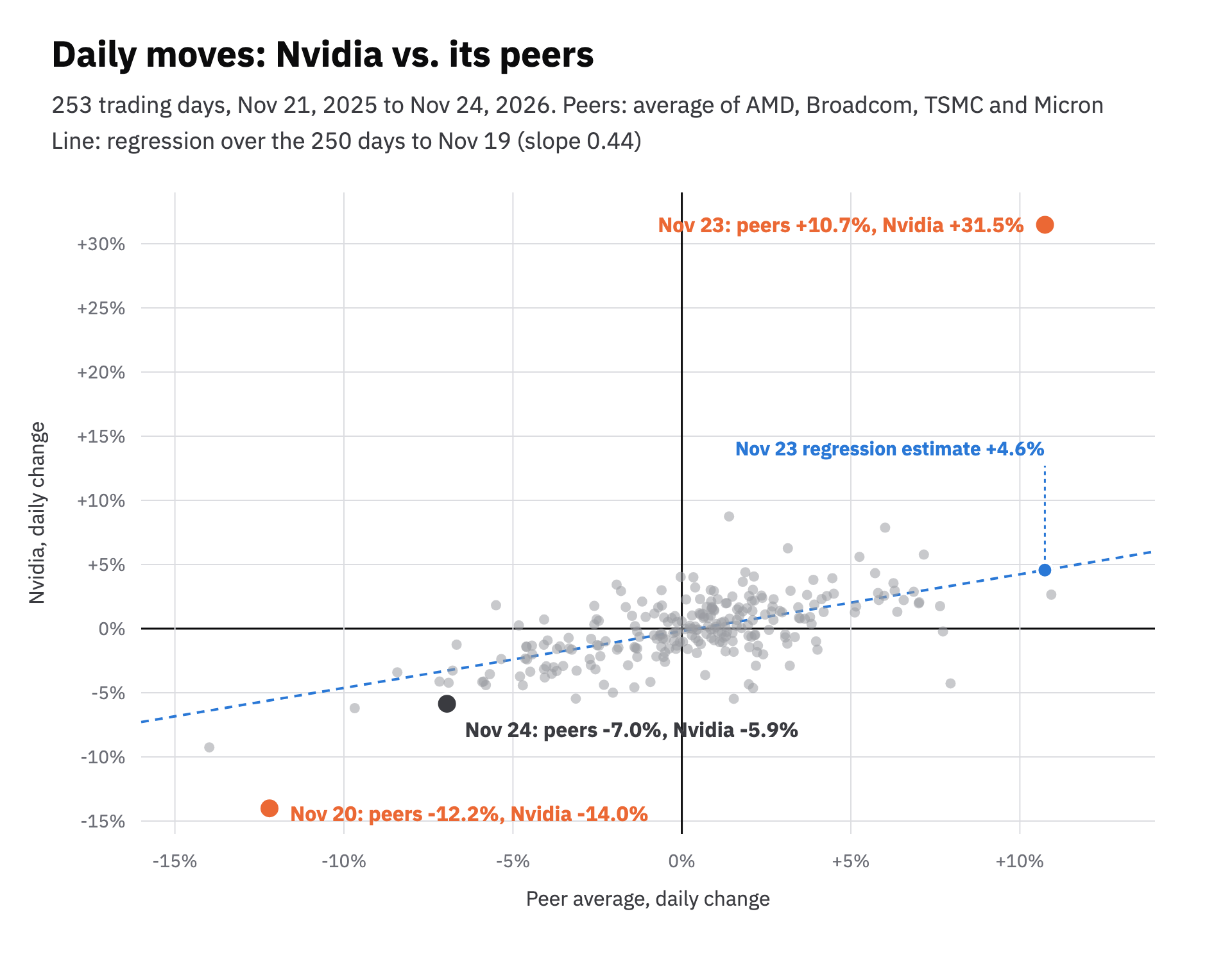
The 31.5% gain is the third-largest close-to-close gain since Nvidia listed in January 1999. Only March 7, 2000 (42.4%) and May 9, 2003 (33.1%) were larger, making it the biggest since May 2003.
On November 24 the stock fell 5.9%. The peer average fell 7.0%, the expected drop was 3.3–3.7%, and the gap was 2.2–2.6 points. On 38 of the 250 days the gap was at least that large, so November 24 was within the usual range.
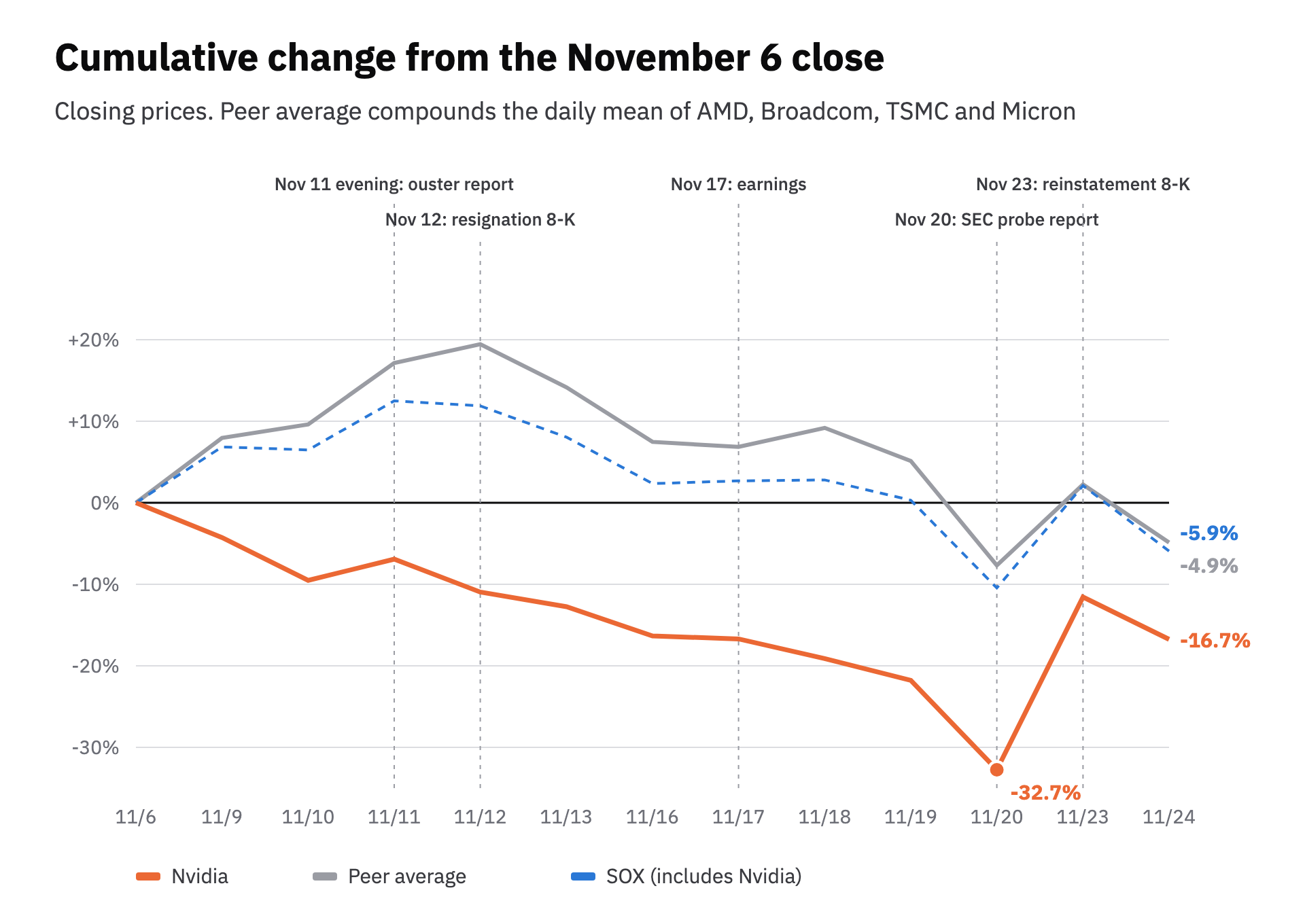
Measured from the November 6 close, before the board began its independent investigation on November 8, Nvidia was 16.7% lower on November 24. The peer average was 4.9% lower, a gap of 11.9 points. On November 20, Nvidia was down 32.7% against the peers' 7.7%, a gap of 25.0 points. In two days that gap roughly halved. Of the drop from the November 11 close to November 20, 61.9% had been recovered by November 24.
CNBC: NVDA quote / LATENT: November 22 article
Trading around the 8-K and the market value
Most of the November 23 move happened before the market opened. CNBC's five-minute bars include extended-hours trading. At 4:05 a.m., Nvidia was 8.7% above its November 20 close and the peer average 6.9% above. At 8:55 Nvidia was still up 8.3%, only 3.5 points more than the peer average's 4.8%.
The 8-K was accepted at 8:57:54. In the five minutes from 8:55, Nvidia went from $136.00 to $159.97, up 27.4% from the November 20 close. Volume in those five minutes was about 12.75 million shares, more than 40 times the roughly 300,000 shares in the previous five minutes. The 9:30 open was $167.04 (up 33.1%); the high was $171.50 (up 36.6%) and the low $156.93 (up 25.0%). The $165.05 close was below the open.
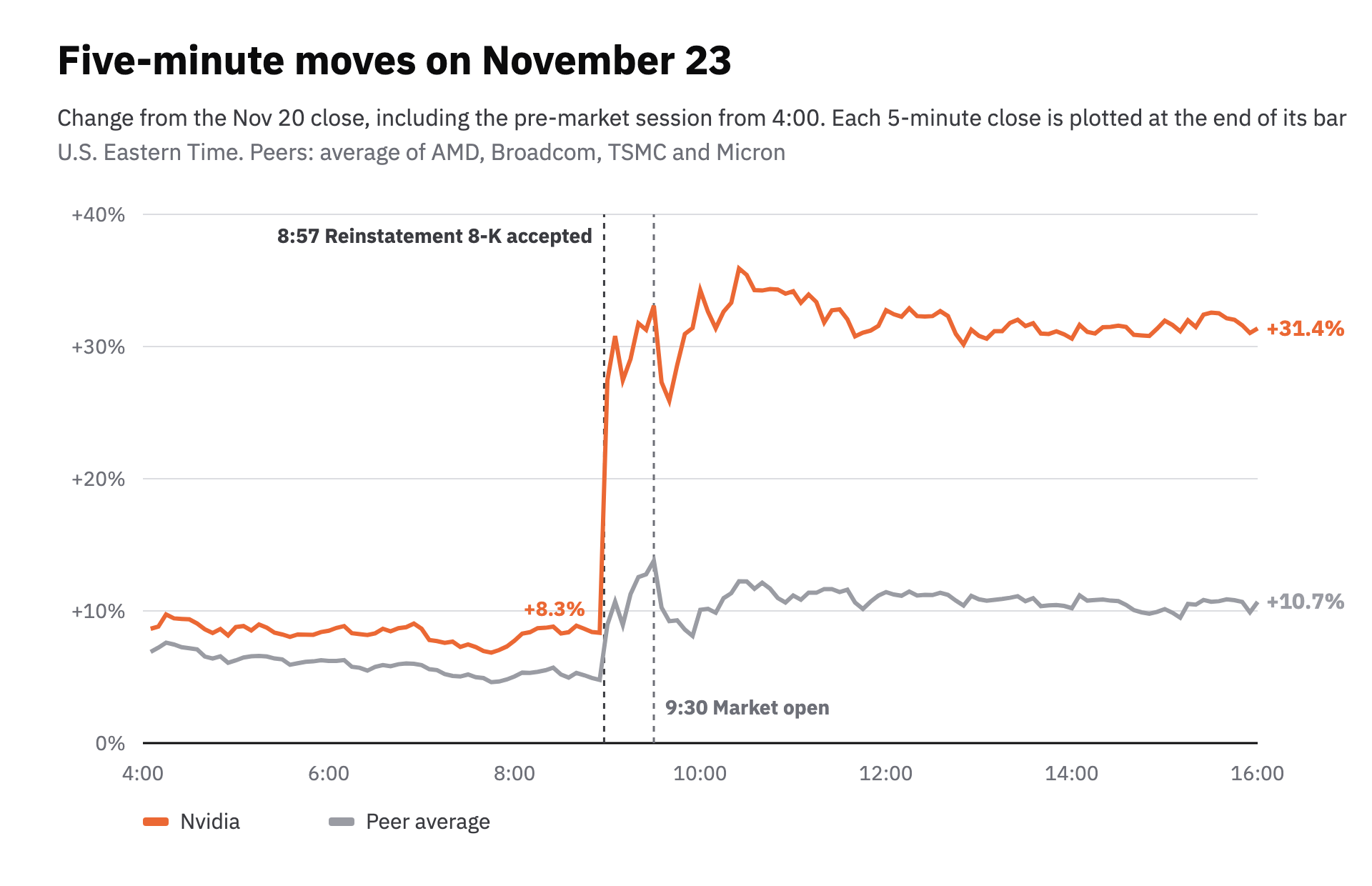
According to Reuters, at 7:00 that morning Arm announced it had extended CEO Rene Haas's contract to 2033. Nvidia's board had reportedly approached Haas as a successor candidate. Nvidia's announcement came within two hours.
Volume on November 23 was about 783 million shares, the most since September 2025 and 6.7 times the roughly 118 million average of the 20 trading days to November 6. According to CNBC, more than 11 million Nvidia options changed hands, a one-day record for the stock.
As in our November 22 article, we calculated market value from the 24.1 billion shares outstanding on the cover of the second-quarter 10-Q. It went from $3.025 trillion on November 20 to $3.978 trillion on November 23, a one-day gain of about $952 billion. Reuters had estimated Microsoft's gain on July 30, 2026 at about $450 billion and reported, during trading, that it was set to be a one-day record (LSEG data). The November 23 gain is about 2.1 times that. On November 24 about $233 billion came off.
Huang's own stake moved by the same proportion. As noted in our November 13 article, the 2026 proxy statement shows Huang holding 870.6 million shares. Assuming no trades since, the stake was worth about $109.3 billion on November 20 and about $143.7 billion on November 23, a one-day gain of about $34.4 billion. That is still about $18.8 billion below the roughly $162.5 billion at the November 6 close.
Reuters (via Investing.com): timing of Arm's and Nvidia's announcements / Reuters (via The Star): Microsoft's record / CNBC: options record
The reinstatement and resignation releases
The November 23 release is short. After a series of discussions and meetings with Huang, it says, the board was satisfied with his candor and his ability to lead the company. In reaching its decision the board received input from senior levels of the U.S. government and, based on that input, is confident that the reinstatement poses no national security risk. Harvey Jones remains chair, and Colette Kress returns to being CFO.
The release lists three measures. The investigation by a committee of independent directors, opened after reports that Huang was the target of a foreign intelligence effort, will proceed to its conclusion. A new National Security and Export Control Committee made up only of independent directors will oversee trade compliance and national security risks. A new chief compliance officer position is being created and filled, reporting to the nominating and corporate governance committee.
The November 12 resignation release said the board would search for a permanent CEO and consider internal and external candidates. Neither the resignation release nor the reinstatement release gives the reason for the resignation or any finding of the investigation. The reinstatement release also says nothing about the president, about whether Huang breached the code of conduct, or about how far the investigation has gone.
Reports describe a board conclusion the release leaves out. According to two Korean outlets that carried the WSJ's reporting, the board concluded that Huang violated the code of conduct both through the relationship itself and by not being candid about it. At the November 22 meeting, Huang reportedly disclosed more relationships than the two already reported. The release's "satisfied with candor" reads as a judgment made after those disclosures. The board has not explained this, however, and it is LATENT's interpretation. We could not read the WSJ original.
Chair Jones had said on the November 17 earnings call that the board did not intend to bring Huang back (CNBC). Five days later, on the 22nd, the board voted unanimously to reinstate him.
Nvidia: 8-K (event of November 22) / Nvidia: resignation release / Korea JoongAng Daily (carrying WSJ reporting) / Financial News (carrying WSJ reporting)
Reports on the administration's role
On the release's "input from senior levels of the U.S. government", reports describe the administration's push in detail. In date order, they look like this. All of it comes from reporting; neither the administration nor the board has officially explained the process.
| Date and time (ET) | Event | Source |
|---|---|---|
| Fri Nov 20, evening | A senior administration official told the board Huang had not violated national security laws | CNBC |
| Sat Nov 21 | Attorney General Blanche told the president and vice president that Huang was not a target of a Justice Department investigation | WSJ via reprints |
| Nov 21 and 22 | The board held two meetings with Huang | CNBC |
| About 72 hours over the weekend | Vice President Vance coordinated the push on the board | CNN |
| Sun Nov 22 | The president joined the board meeting by phone; late that night the board voted unanimously to reinstate | Semafor |
| Mon Nov 23, 7:00 | Arm announced the extension of Haas's contract | Reuters |
| Nov 23, 8:57 | Nvidia filed the 8-K | SEC |
| Nov 23 | The president told CNBC he had spoken to the board directly and indirectly and made the deal | CNBC |
| Tue Nov 24, midday | Attorney General Blanche called Nvidia a "good corporate citizen" at a news conference and declined to discuss investigations | MS NOW |
| Nov 24 | Huang apologized at an all-hands meeting and rejected the view that he owed his return to the president | TechCrunch, HuffPost |
| Nov 24 | The president told the New York Post a pardon was an option but probably unnecessary, and said he had considered a government stake in Nvidia | NBC, Investing.com |
According to Reuters, Director of National Intelligence Clayton was also involved in the judgment that Huang posed no security risk. Semafor reported that what worked in the administration's persuasion was the view of Huang as someone on the side of open models who keeps closed-model companies in check.
At the November 24 all-hands meeting, Huang apologized and admitted breaching a code of conduct he had largely written himself. He said he is in therapy. He rejected the view that his return was thanks to the president and said the board had assessed the whole situation. He did thank the administration for providing quick access to intelligence. According to CNBC, he also said Nvidia does not need a succession plan.
The reaction in Congress crosses party lines. Republican Senator Cornyn asked what the no-national-security-risk judgment was based on, and Democratic Senator Warren called the reinstatement reckless. New York City's comptroller said the board had shown it is not independent (Reuters).
CNBC: the president's remarks / CNN: the administration's push / Semafor: the board meeting / MS NOW: the attorney general's remarks / TechCrunch: the all-hands meeting / NBC: the pardon remarks
An interim CEO period that ended in 10 days
In our November 13 article we counted, for six precedents in which a CEO left suddenly and the CFO served as interim CEO, how long it took to name a permanent CEO: 48 to 224 days, with a median of 110. Nvidia ended its interim period 10 days after the November 12 resignation announcement, by bringing back the previous CEO. That is about one-fifth of the shortest precedent and about one-eleventh of the median.
In all six precedents the permanent CEO was someone other than the departed CEO; none involved the departed CEO returning. On the successor search, reports say few executives were both able and willing to take the job (WSJ via reprints). Haas, reported as the leading candidate, extended his contract with Arm on the morning of the reinstatement announcement.
The board's makeup has not changed. Jones became Nvidia's first board chair on November 11 and remains chair after the reinstatement. The release does not say how the new committee and the chief compliance officer will oversee Huang's conduct.
LATENT: November 13 article / Reuters (via Investing.com): board independence
The seven companies added to the Entity List
The Commerce Department's Bureau of Industry and Security (BIS) filed the rule for public inspection at 4:15 p.m. on November 23. It was published in the Federal Register on November 25 and takes effect from the date of public inspection. According to Reuters, it is the first addition to the Entity List since October 2025.
| Country | Company |
|---|---|
| Malaysia | MSFusion Sdn. Bhd., PT Megaspeed International, Speedmatrix Sdn Bhd. |
| Singapore | Apex Enterprise Solutions (Singapore) Private Limited, Megaspeed International Pte. Ltd., Swiftdata Pte. Ltd. |
| Thailand | Megaspeed (Thailand) Co., Ltd. |
The reason the rule gives is a significant risk that the seven will divert advanced computing commodities to unauthorized end uses or end users. All items subject to the Export Administration Regulations (EAR) now need a license, reviewed under a presumption of denial. Shipments already in transit can go through on the previous terms if completed within 30 days of public inspection, that is, by December 23. The rule's text does not mention China, Nvidia, Alibaba or Huang.
Alibaba itself acknowledges that Apex is its subsidiary. It called the addition erroneous, said Apex has never diverted chips subject to U.S. controls, and said it would explore all legal avenues (Reuters, Bloomberg, WSJ). According to Reuters, Apex had paid about $4.2 billion to Megaspeed and others in advance to rent computing capacity in Southeast Asia.
Malaysia's Ministry of Investment, Trade and Industry said on November 24 that it would advise the country's data center operators not to provide space or services to the seven. It said only two of the seven, Speedmatrix and MSFusion, are Malaysian companies.
We found no reporting that puts a number on the impact on Nvidia's revenue. According to Reuters, Nvidia put Megaspeed on an internal no-sell list in June 2025. If direct sales had already stopped, the effect of this addition would fall on those renting compute through Megaspeed.
Federal Register: rule text (PDF) / Reuters (via Investing.com): the addition and Apex / The Star: Malaysia's notice
December hearings and the 10-Q deadline
The reinstatement has not changed the congressional calendar. In a November 23 statement, the chairs of the House Select Committee on China, the Intelligence Committee and the Foreign Affairs Committee said a short internal review and the reinstatement do not erase the national security threats, and that the interviews would go ahead as planned.
| Date | Schedule |
|---|---|
| December 1 | Huang sits for interviews with the three House committees (transcribed) |
| December 2 | General counsel Timothy Teter sits for interviews with the same three committees |
| December 3 | Public Senate Banking Committee hearing on export control oversight, with Huang as the sole witness |
| December 4 | Deadline for the third-quarter 10-Q |
| December 23 | End of the in-transit grace period under the Entity List rule |
The December 1 interview is reported as closed-door, but the committees' statement describes the format only as transcribed interviews. The title of the Senate hearing is as reported by MS NOW.
The investigations continue. We found no follow-up after November 21 to Reuters' November 20 report of an SEC accounting investigation. California's attorney general's office said it would continue its subpoena-based investigation after the reinstatement (NBC). The independent directors' committee investigation named in the release has not reached a conclusion either.
House Select Committee on the CCP: statement on the reinstatement / MS NOW: the Senate hearing / NBC: California's investigation
Tokyo on November 24 and 25
Tokyo was closed for a holiday on November 23, so the reinstatement news showed up in trading on the 24th. The Nikkei average rose ¥2,207.98 that day, with Advantest and Tokyo Electron together adding about ¥973 (Zaikei Shimbun).
On the 25th it fell after the U.S. decline on the 24th. The Nikkei average closed down ¥1,633.01 (2.78%) at ¥57,011.62, giving back 74% of the 24th's gain. Advantest closed down 12.94% at ¥23,745, Tokyo Electron down 12.53% at ¥7,825 and SoftBank Group down 14.83% at ¥2,696.5. All three fell more on the 25th than they had gained on the 24th. In the U.S., Nvidia's drop on the 24th was about a quarter of its gain on the 23rd.
Tokyo's close on the 20th and its close on the 25th bracket three U.S. sessions: the 20th, 23rd and 24th. Set against the U.S. period from the close on the 19th to the close on the 24th, the moves were as follows.
| Stock or index | Period | Change |
|---|---|---|
| Nvidia | U.S., Nov 19–24 | +6.4% |
| Four-peer average | U.S., Nov 19–24 | −9.5% |
| SOX | U.S., Nov 19–24 | −6.2% |
| Advantest | Tokyo, Nov 20–25 | −2.1% |
| Tokyo Electron | Tokyo, Nov 20–25 | −5.8% |
| SoftBank Group | Tokyo, Nov 20–25 | −10.9% |
| Nikkei average | Tokyo, Nov 20–25 | +1.0% |
Nvidia ended the 24th 6.4% above its close on the 19th, before the probe report. Over the matching period, Advantest and Tokyo Electron finished below their closes on the 20th. Unlike Nvidia, the two Japanese chip stocks fell, moving in the same direction as its peers and the SOX. According to CNBC, Rolf Bulk of The Futurum Group said doubts about AI spending beyond 2027 had surfaced and that Japanese chip equipment makers are sensitive to the business cycle.
Zaikei Shimbun: Tokyo on November 24 / CNBC: Asian markets on November 25 / Kabutan: Nikkei average daily prices
What LATENT is watching
First, the hearings from December 1 to 3. The Senate hearing is public, and we will see how Huang answers questions about his dealings with the administration and suspected leaks to China.
Second, the 10-Q due December 4. We will read how it describes the reinstatement, the independent directors' investigation, and the SEC and California investigations in the legal proceedings and risk sections.
Third, the stock against peers. The stock-specific gain on November 23 was more than three times the stock-specific drop on November 20. We will use the same calculation to see how much of that gap remains.
Fourth, the new committee and the chief compliance officer. We will watch whether the committee members become public, and who evaluates Huang's conduct and reports to the board.
Sources and scope
We pulled CNBC daily and five-minute market data at 13:13 Japan time on November 25. The five-minute bars include pre-market trading. The ranking of gains since listing compares close-to-close gains in the same data's daily bars from January 1999; it excludes the first-day gain from the IPO price. We checked volume against CNBC daily bars and Nasdaq historical data. The peer average and regression method are the same as in our November 22 article, and November 23 and 24 are not in the regression window. The range of the stock-specific gain is LATENT's estimate; a different window or peer set would give different values.
We read the 8-Ks and press releases from the SEC filing index and the Entity List rule from the Federal Register public inspection PDF, and confirmed its November 25 publication through the Federal Register API. The administration's role, the board's conclusion, the all-hands meeting and lawmakers' remarks come from news reports. We could not read the WSJ, NYT, New York Post, Bloomberg or FT originals; we checked the WSJ reporting through reprints by Korea JoongAng Daily and Financial News, the NYT's all-hands reporting through HuffPost, and the president's New York Post remarks through NBC and Investing.com. That the president joined the board meeting by phone rests on Semafor's reporting alone. We checked Tokyo's November 25 closing values on Kabutan's daily price pages at 15:48 Japan time on the 25th.
- Nvidia, Form 8-K (event of November 22, 2026, filed November 23)
- Nvidia, "NVIDIA Board Reinstates Jensen Huang as President, CEO and Board Director"
- Nvidia, Form 8-K (event of November 11, 2026, filed November 12)
- Nvidia, "NVIDIA Announces CEO Transition"
- Federal Register 2026-23999, "Additions to the Entity List"
- Same (public inspection PDF)
- CNBC, the reinstatement and the board meetings
- CNBC, the president's remarks and the administration's contacts
- CNBC, options trading record
- CNBC, live market coverage for November 23 and 24
- CNBC, Asian markets on November 25
- CNN, the administration's push
- Semafor, the board meeting and the president's call
- Reuters, "At AI speed, Nvidia's Jensen Huang finds exoneration" (via Investing.com)
- Reuters, "Nvidia board's Huang reversal raises doubts about independence, critics say" (via Investing.com)
- Reuters, Megaspeed's addition to the Entity List (via Investing.com)
- Reuters, Microsoft's one-day market value record (via The Star)
- Korea JoongAng Daily, carrying WSJ reporting
- Financial News, carrying WSJ reporting
- MS NOW, Attorney General Blanche's remarks
- MS NOW, the reinstatement and the Senate hearing
- TechCrunch, the all-hands meeting
- HuffPost (via Yahoo), the all-hands meeting
- NBC, the pardon remarks
- Investing.com, remarks on a government stake
- NBC, the reinstatement, Congress and California's investigation
- House Select Committee on the CCP, "Statement on Jensen Huang's Reinstatement at NVIDIA"
- The Star, notice from Malaysia's Ministry of Investment, Trade and Industry
- Zaikei Shimbun, Tokyo market on November 24
- Kabutan, Nikkei average daily prices
- Kabutan, Advantest daily prices
- Kabutan, Tokyo Electron daily prices
- Kabutan, SoftBank Group daily prices
- CNBC, NVDA quote