Business & Markets · · Team LATENT
Jensen Huang resigns and Colette Kress becomes Nvidia's interim CEO: the share reaction, six cases of a CFO as interim CEO, and the first board chair
On November 12 Nvidia announced that Jensen Huang had resigned as president, CEO and director, and that CFO Colette Kress would serve as interim CEO while remaining CFO. Director Harvey Jones became the company's first-ever board chair. The 8-K gives no reason for the resignation and no findings from the board's inquiry. In six past cases where a CFO served as interim CEO, a permanent CEO was named 48 to 224 days later, with a median of 110 days. We go through the 8-K, the share reaction, why Nvidia had no chair, and Huang's stake and exit terms.
At 8:52 a.m. Eastern on November 12, Nvidia filed a Form 8-K with the SEC. The board had accepted Jensen Huang's resignation the previous day. Huang left his posts as president, CEO and director, effective immediately. CFO Colette Kress became interim CEO and remains CFO. Harvey C. Jones, a director since 1993, became Nvidia's first-ever board chair. Huang had been the company's only CEO for the 33 years since its founding in 1993.
The shares fell before the open: at 9:29 a.m. they traded at $151.00, 13.1% below the previous close. The drop narrowed once regular trading began, and at 9:50 a.m. the price was $160.32, down 7.7%. This article separates what the 8-K and the press release say from what they leave out. It then compares the share reaction with past CEO exits and counts how long it took to name a permanent CEO in past cases where the CFO served as interim CEO. We also look at the first board chair, the board's makeup, Huang's stake and his exit terms.
The inquiry and the reporting that led up to the resignation are covered in our previous article, "Nvidia's board inquiry into Jensen Huang and the ouster reports". We separate facts confirmed in company filings from reports based on anonymous sources. Share prices are as of 9:50 a.m. Eastern on November 12 (11:50 p.m. Japan time) and do not include later moves. Reporting was checked up to about 9:50 a.m. Eastern (11:50 p.m. Japan time). This article does not recommend buying or selling any stock.
Nvidia: Form 8-K (Nov 12) / Nvidia: NVIDIA Announces CEO Transition
Key takeaways
- The 8-K reports Huang's resignation, Kress's appointment as interim CEO and Jones's appointment as chair. It gives no reason for the resignation, no findings from the inquiry and no exit terms. Nor does it contain the disclosure required when a director resigns over a disagreement with the company or is removed for cause. November 11 was an SEC holiday, so the filing deadline was the 17th, but Nvidia filed on the 12th, 38 minutes before the market opened.
- In six cases where a CEO left suddenly and the CFO served as interim CEO, a permanent CEO was named 48 to 224 days later, with a median of 110 days. 110 days after November 12 is March 2, 2027. The four cases where someone other than the interim CEO got the job were settled within 120 days; the two where the interim CFO got the job took 127 and 224 days.
- Until now Nvidia had no board chair, saying a lead independent director gave every director an equal voice. Huang remains a 3.58% shareholder. Nvidia has no severance agreements with its executives. Huang's unvested equity as counted on January 25, 2026 is worth about $226 million at the 9:50 a.m. price on November 12, or 0.2% of the value of his stake.
What the 8-K and the press release say
Item 5.02 of the 8-K states three facts. First, on November 11 the board accepted Huang's resignation. He left all three posts, president, CEO and director, effective immediately. Second, while it searches for a new CEO, the board appointed CFO Colette Kress, 59, as interim CEO. Kress has been CFO since 2013 and will remain CFO while serving as interim CEO. Third, on the same day the board appointed Jones, 73, as chair.
The press release says the board will consider internal and external candidates for a permanent CEO. Jones said he expects operations, customer commitments and the product roadmap to continue without interruption. Kress said she would build on what Huang created over 33 years. The company thanked Huang for his contributions. Third-quarter results and the earnings call on November 17 will go ahead as scheduled.
Much is left out. The filing does not give a reason for the resignation, the conclusions of the independent directors' inquiry, or whether the inquiry continues. It says nothing about severance, the treatment of unvested equity, or whether Huang stays on as an adviser. It also does not say whether Kress's pay will change.
The form itself offers one clue. Under the SEC's Form 8-K, when a director resigns because of a disagreement with the company, or is removed for cause, the company must describe the circumstances under Item 5.02(a) and file any letter from the director. It must give the director a copy of the disclosure and file any letter of disagreement the director sends. This 8-K has no such disclosure. Nvidia did not report Huang's departure from the board as a resignation over a disagreement or as a removal for cause.
Nvidia: press release (8-K exhibit) / SEC: Form 8-K
The filing deadline and the filing time
An 8-K on a CEO's departure is generally due within four business days of the event. If the event falls on a weekend or a day the SEC is closed, the count starts on the next business day. November 11 was Veterans Day, a federal holiday. The stock market was open, but EDGAR did not accept filings. The deadline, counting four business days from the 12th, was November 17, the day of the earnings release.
Nvidia filed at 8:52 a.m. on the first day, 38 minutes before trading opened. It released the filing and the press release together on the morning after the decision, before the market opened. As our previous article noted, the board's statements of November 8 and 10 were not filed on Form 8-K and appeared only on the company's news page. This time the news was a change of officers, which Item 5.02 requires the company to report.
Share reaction and market value
We checked prices against Nasdaq trade data. The shares closed at $173.73 on November 11 and fell to $158.76 after hours following reports that the board was preparing to remove Huang. Before the open on the 12th, the decline widened after the 8-K came out, and the price was $151.00 at 9:29 a.m. The day's low shown by Nasdaq was $148.80, 14.3% below the previous close. By 9:50 a.m. the shares had recovered to $160.32, down 7.7%. That is above the last after-hours trade of the previous evening, $158.76, but below the 52-week low of $164.27.
At 9:48 a.m., the SOX semiconductor index was down 1.6% from the previous day. Measured from the previous close, Nvidia fell about 6 points more than the SOX. Measured from November 6, the last close before the board announced its inquiry, the gap is wider.
| Period | Nvidia | SOX |
|---|---|---|
| Nov 6 close to Nov 12, about 9:50 a.m. | -14.1% | +10.8% |
| Nov 11 close to Nov 12, about 9:50 a.m. | -7.7% | -1.6% |
| Nov 11 close to the Nov 12 low | -14.3% | n/a |
We calculate market value on 24.1 billion shares outstanding. It was $4.498 trillion at the November 6 close and $3.864 trillion at the 9:50 a.m. price, a fall of about $634 billion. Anthropic's IPO would raise $64.35 billion at the top of its price range. The fall in Nvidia's market value is about 10 times that.
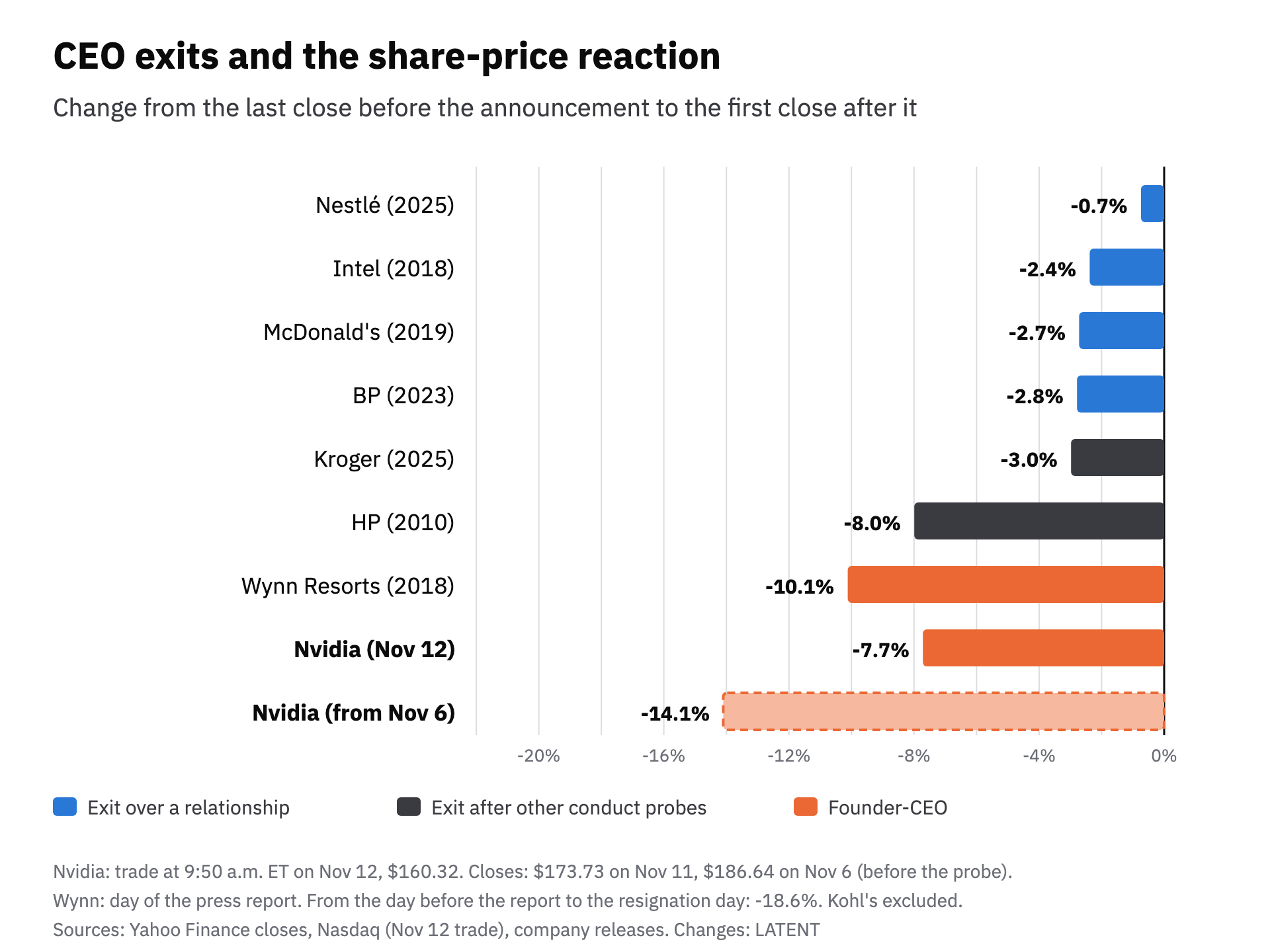
Compare past cases. As calculated in our previous article, in six cases where a hired CEO left over a relationship with an employee or another conduct inquiry, the next close moved -0.7% to -8.0%. On the day of the press report about founder Steve Wynn, Wynn Resorts fell 10.1%. Nvidia's drop on the 12th exceeded Wynn's 10.1% before the open and at the day's low, but by 9:50 a.m. it had narrowed to near HP's 8.0%. Including the decline during the reporting, Nvidia fell 14.1% from the November 6 close. Wynn Resorts fell 18.6% from the close before the report to the close on the day its CEO resigned, so Nvidia's fall is smaller.
Analysts moved too. According to CNBC, Bernstein's Stacy Rasgon downgraded the stock and cut his price target from $400 to $200. According to Yahoo Finance, Oppenheimer also downgraded and removed its target. Raymond James kept its top rating.
Nasdaq: NVDA / CNBC: shares and analysts
Six cases of a CFO as interim CEO
From company announcements and press reports, we collected six cases where a CEO left suddenly and the CFO served as interim CEO during the search. We count days from the announcement of the exit to the announcement of a permanent CEO.
| Company (year) | Departing CEO and reason | Interim CEO | Permanent CEO named | Days | Permanent CEO |
|---|---|---|---|---|---|
| HP (2005) | Fiorina. Board asked her to leave | CFO Wayman | Mar 29, 2005 | 48 | Outsider (Hurd, CEO of NCR) |
| HP (2010) | Hurd. Expense-report violations | CFO Lesjak | Sep 30, 2010 | 55 | Outsider (Apotheker, former SAP CEO) |
| Intel (2024) | Gelsinger. Announced retirement | CFO Zinsner and a co-CEO | Mar 12, 2025 | 100 | Tan, a former director |
| Yahoo (2011) | Bartz. Fired | CFO Morse | Jan 4, 2012 | 120 | Outsider (Thompson of PayPal) |
| BP (2023) | Looney. Did not fully disclose past relationships | CFO Auchincloss | Jan 17, 2024 | 127 | Interim CEO Auchincloss |
| Intel (2018) | Krzanich. Past relationship with an employee violated policy | CFO Swan | Jan 31, 2019 | 224 | Interim CEO Swan |
The six cases ran from 48 to 224 days, with a median of 110 days and a mean of 112. 110 days after November 12 is March 2, 2027. The four cases where someone other than the interim CEO got the job were settled in 48 to 120 days. The two where the interim CFO became permanent CEO took 127 and 224 days. Searches that ended with the interim CEO keeping the job took longer.
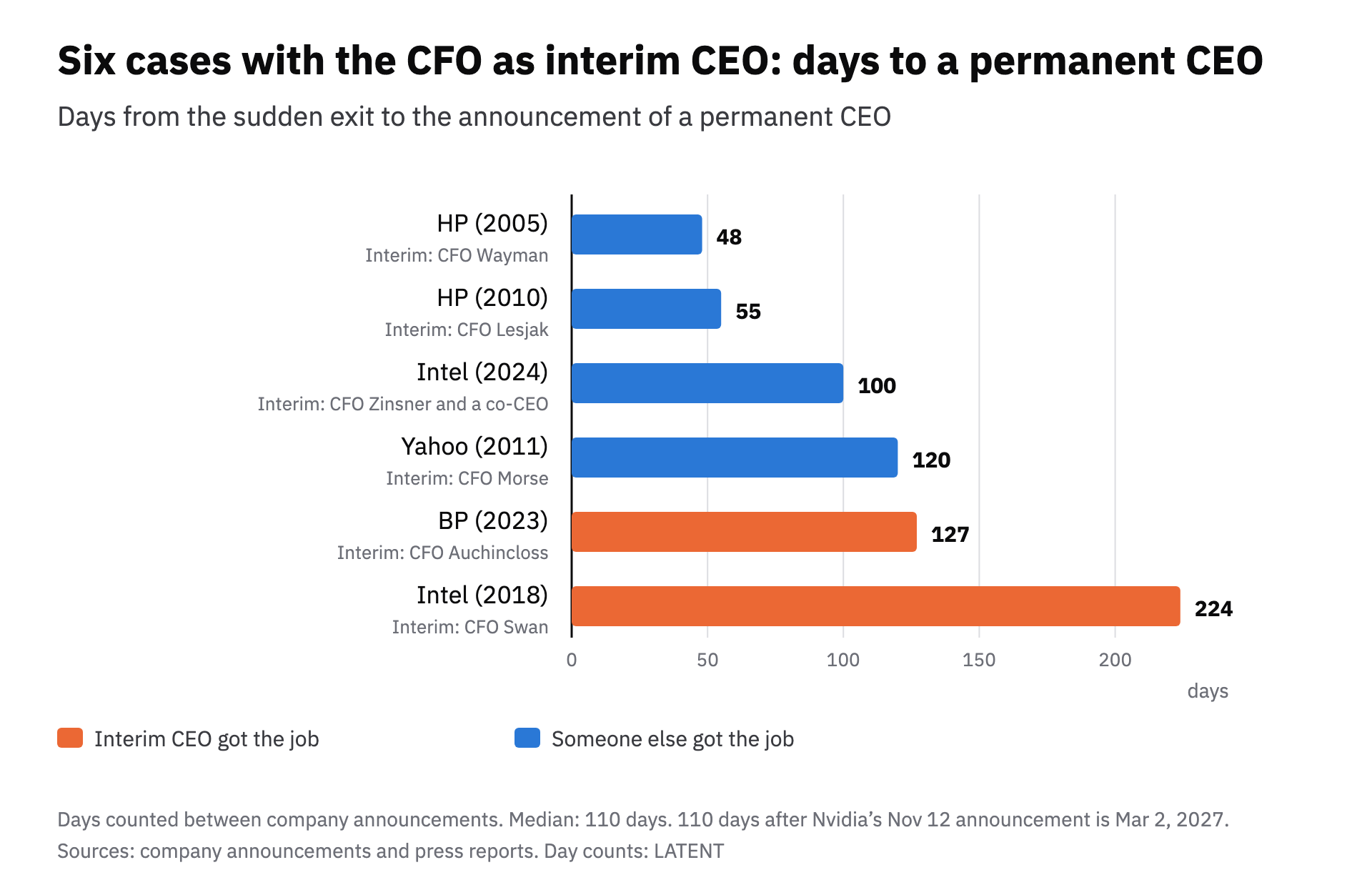
In most of the six cases, the interim CEO also kept the CFO job. For HP in 2005 and 2010 and Intel in 2024, the announcements state this explicitly. At HP in 2010, Lesjak said she would not be a candidate for the permanent job. According to Bloomberg, Intel's Swan had said several times that he did not want the permanent job, but he was named CEO seven months later.
Cases where someone other than the CFO served as interim include longer searches. In March 2025 Kroger named its lead director as chair and interim CEO, and it took 343 days to name a permanent CEO. When founder Travis Kalanick left Uber in 2017, there was no interim CEO; a committee of 14 executives ran the company, and about 70 days later Uber chose Dara Khosrowshahi from outside.
Intel: Krzanich resigns (2018) / BP: Auchincloss appointed CEO (2024) / Intel: Gelsinger retires (2024)
Successor candidates and the November 17 results
The company has named no candidates. Bloomberg reported that the board is working with an outside search firm. Neither the firm nor a timeline has been reported. Reuters listed candidates named by analysts and industry sources, including Ian Buck, who led the development of CUDA, Kress, and Rene Haas, Arm's CEO and a former Nvidia executive. None of these reports confirms that the board is considering them.
On November 17, five days after the announcement, Kress will present results as both CEO and CFO. For the second quarter in August, the 8-K carried a commentary on results written by Kress as CFO, and the press release carried a quote from Huang. In the same release, Nvidia guided third-quarter revenue to $108.0 billion, plus or minus 2%, and assumed no data center compute revenue from China. The company has not said who will host the call. In the HP case of 2010, the company reported results on August 19, 13 days after Hurd left, and interim CEO Lesjak led the call.
Reuters: successor candidates / Nvidia: second-quarter 8-K / The Register: HP results (2010)
The first board chair
Until now Nvidia had no board chair. The 2026 proxy statement said that having an independent lead director rather than a chair gave every director an equal voice. The lead director was Stephen Neal, 77, a director since 2019. The proxy also said the independent directors review this structure every year. Appointing a chair changes the structure the proxy described. The 8-K does not say whether Neal remains lead director.
The new chair, Jones, has been a director since 1993, the same 33 years that Huang served as CEO. He co-founded Daisy Systems, a design-automation company, in 1981, and led Synopsys from 1987 to 1998. The proxy lists him as an independent director who sits on the audit committee and the nominating and corporate governance committee, and as a financial expert. He held about 7 million shares as of March 23, 2026.
Without Huang, the board has 10 members, all independent. Based on the years they joined, as listed in the proxy, their average tenure is about 15 years. Jones and Tench Coxe have both served since 1993.
Separating the chair and CEO roles is the majority practice at large US companies. Spencer Stuart's 2025 survey found that 61% of S&P 500 boards split the roles and 42% have an independent chair. In the HP precedent of 2005, the board named a director as non-executive chair on the day Fiorina left. In 2010, HP again named a non-executive chair at the same time as it appointed Apotheker.
Nvidia: 2026 proxy statement / Harvard Law School Forum: 2025 U.S. Board Index
Huang's stake and exit terms
Huang has left every post but remains a shareholder. The 2026 proxy lists his beneficial ownership at 870.6 million shares, or 3.58% of shares outstanding. Sales after March 23 are not counted. That is about half the stakes of the largest holders, BlackRock at 7.43% and Vanguard at 7.31%. At the 9:50 a.m. price, the stake is worth about $139.6 billion, about $22.9 billion less than at the November 6 close.
The 8-K gives no exit terms. According to the proxy, Nvidia has no employment, severance or change-in-control agreements with its executive officers. They are employed "at will", and no severance is set by contract. Most equity awards vest only with continued service.
As of January 25, 2026, Huang held 1.41 million unvested performance stock units, worth $264.93 million at the time. At the 9:50 a.m. price they are worth about $226.3 million, or 0.2% of the value of his stake. How the resignation affects these awards has not been reported. If Nvidia enters into a material compensation arrangement in connection with his exit, Item 5.02(e) requires it to report the terms and amounts. The company's compensation recovery policy reclaims incentive pay after a restatement of financial statements, which is a different trigger from a resignation.
The reason for the resignation and the inquiry
The company says Huang resigned and does not say whether the board asked him to. Bloomberg's headline said he was ousted by the board. The night before, the WSJ reported that the board was preparing to remove him, and Reuters reported that the board met to consider his ouster. We found no report describing a vote, or whether he was given a choice between resigning and being removed.
As of about 9:50 a.m. Eastern on November 12, the findings of the independent directors' inquiry had not been released. It is not known whether the inquiry will continue or whether its results will be published. According to the WSJ, the Justice Department is leading several investigations involving Alice Huang, an executive at Megaspeed, and Megaspeed has been under Commerce Department investigation since late 2024. Huang has made no statement since resigning.
Three House committees had asked Huang for a closed briefing on November 18. It is not known whether Huang, who is no longer an officer of the company, will appear. Nvidia plans to invest about $10 billion in the private placement alongside Anthropic's IPO. That commitment belongs to the company, not to Huang personally. Yahoo Finance wrote that the change in leadership could affect the investment, but neither Nvidia nor Anthropic has announced any change.
WSJ: Huang resigns (republished) / Reuters: Huang to step down / NBC News: Huang resigns
What LATENT will track
We will track four things. First, the November 17 results: whether Kress hosts the call as both CEO and CFO, and how data center revenue and the share of revenue from customers in China compare with the table in our previous article. Second, the exit terms: an Item 5.02(e) filing or next year's proxy should show how Huang's unvested equity was treated. Third, the CEO search: we will compare the time it takes with the 48 to 224 days in past cases. Fourth, the board's inquiry: whether the board publishes its conclusions.
Sources and scope
We read the 8-K and the press release in the SEC's filing index and on Nvidia's news page at about 11:20 p.m. Japan time on November 12. We checked the Form 8-K instructions in the PDF the SEC publishes, and EDGAR's holidays in the SEC's calendar. The board's makeup, the lead director structure, the absence of employment and severance agreements, the unvested equity and the shareholdings come from the original text of the 2026 proxy statement.
Share prices are from Nasdaq data: trades from 9:22 to 9:50 a.m. Eastern on November 12, and the day's low as shown by Nasdaq. We did not confirm whether that low includes pre-market trading. Reporting was checked up to about 9:50 a.m. Eastern. The SOX value is from Nasdaq's index data and is two minutes earlier than the Nvidia trade. Later moves are not included. The moves after past CEO exits were calculated by LATENT from Yahoo Finance closing prices in our previous article.
The six interim-CEO cases are those whose dates we could confirm in company announcements, SEC filings and press reports; the list is not exhaustive. We did not look at cases such as Boeing, Nike or Disney. The 110-day median and the March 2, 2027 date are calculated from these six cases. Swan's remarks were checked through a search summary of a Bloomberg article. The 2010 HP earnings call was checked in The Register, and its date was inferred from the article's publication time.
We did not read the full text of reports by Bloomberg, the NYT, the FT, AP, Axios or The Information. Bloomberg's "ousted" wording was checked in its headline. The WSJ article was read in a republication. The successor candidates, analyst ratings and the hiring of a search firm were checked in reports by Reuters, CNBC and Yahoo Finance. Market value, the value of the stake and the unvested equity, the median and mean day counts and the filing deadline were calculated by LATENT from the figures in these sources.
- Nvidia, Form 8-K (filed November 12, 2026)
- Nvidia, "NVIDIA Announces CEO Transition"
- Nvidia, 2026 proxy statement (DEF 14A)
- SEC, "Form 8-K"
- SEC, "EDGAR Calendar"
- Nasdaq, "NVDA"
- Intel, "Intel CEO Brian Krzanich Resigns; Board Appoints Bob Swan as Interim CEO" (2018)
- Intel, press release on Swan's appointment as CEO (2019)
- Intel, announcement of Gelsinger's retirement (2024)
- Intel, announcement of Tan's appointment as CEO (2025)
- BP, Auchincloss appointed CEO (2024)
- TechCrunch, Hurd resigns (2010)
- TechCrunch, Apotheker named (2010)
- Redmond Channel Partner, Fiorina out (2005)
- Taipei Times, Hurd named HP CEO (2005)
- VentureBeat, Bartz fired (2011)
- InfoWorld, Thompson named (2012)
- Grocery Dive, Kroger names Foran (2026)
- The Register, HP third-quarter fiscal 2010 results
- Nvidia, Form 8-K (August 26, 2026, second-quarter results)
- Harvard Law School Forum, "2025 U.S. Board Index"
- WSJ, "Nvidia CEO Jensen Huang Resigns" (republished)
- Reuters, "Nvidia CEO Jensen Huang to step down" (republished)
- Reuters, "Who's next CEO at Nvidia?" (republished)
- CNBC (November 12)
- NBC News (November 12)
- Yahoo Finance (November 12)