Business & Markets · · Team LATENT
Nvidia's 14% drop and the report of an SEC accounting probe: a fall larger than its peers', the change in its regional revenue basis, and the value of its listed stakes
Nvidia's shares fell 14.0% on November 20, cutting about $493 billion from its market value. Four chip peers fell 12.2% on average, but on the 31 days of the past year when the peers fell 4% or more, Nvidia always fell less or rose. The past relationship implies a 5.6% to 6.6% fall, leaving at least 7 points specific to Nvidia. The target of the SEC accounting probe Reuters reported is unknown. From SEC filings we checked the two background points Reuters raised: the change in how Nvidia reports revenue by region and the value of its listed equity stakes.
At 2:09 p.m. Eastern on November 20, Reuters reported that staff in the SEC's enforcement division were examining potential accounting issues at Nvidia. At 2:05 p.m. Nvidia's shares were 7.1% below the previous close, and the selling accelerated in the next five minutes. The stock closed at $125.53, down 14.0% on the day. About $493 billion of market value disappeared in a single day.
It was also a day when the whole market fell hard. The S&P 500 lost 3.7% and the Nasdaq 100 5.6%, and the average of AMD, Broadcom, TSMC and Micron fell 12.2%. This article separates the part of Nvidia's fall that its peers' moves can explain from the part specific to Nvidia. It checks what the Reuters report said and did not say, and uses figures from SEC filings to examine the two points the report gave as background: the change in how Nvidia presents revenue by region, and concern about money flowing through its investments. It also lists the dates of the investigations and hearings and the 10-Q deadline.
Nvidia's third-quarter results are covered in "Nvidia's third-quarter results". Share-price figures run to the November 20 close; we took CNBC's market data at 4:56 a.m. Japan time on November 22. Ratios and estimates are LATENT's calculations. This article does not recommend buying or selling shares and does not forecast prices.
Reuters (via WHTC): SEC probe / CNBC: the market on November 20
Key takeaways
- Nvidia fell 14.0% on November 20, more than the 12.2% average of four peers. On the 31 days since October 2025 when the peer average fell 4% or more, Nvidia always fell less than the peers or rose, and was down 3.0% on average. The past relationship implies a fall of 5.6% to 6.6%, so at least 7.4 points of the drop were specific to Nvidia. At 2:05 p.m. it was down 7.1%, 3.5 points less than the peers.
- Reuters did not identify which accounting issues the SEC is examining. Among the background points it cited, the change in the regional revenue basis makes China (including Hong Kong) revenue 1.20 to 1.75 times larger for the same periods on a customer-headquarters basis than on a billing-location basis. Singapore, which accounted for 18% to 22% of revenue by billing location, disappeared from the breakdown. So did the note that shipments to Singapore were less than 2% of revenue.
- The eight listed stocks in Nvidia's 13F for September 30 were worth $48.3 billion. Valued at November 20 closing prices with the same share counts, they come to $30.6 billion, 37% less, and $5.2 billion less than at the November 11 close. Nvidia's market value has fallen by $1.162 trillion since November 11. The 10-Q is due on December 4, and congressional hearings start on December 1.
The November 20 fall compared with peers
Lining up the November 20 declines, Nvidia's 14.0% is 1.8 points more than the 12.2% average of four peers. The SOX semiconductor index fell 10.7% and the Nasdaq 100 5.6%. Because both indexes include Nvidia, we compared it with the average of four peers that exclude it.
| Stock or index | Nov 19 close | Nov 20 close | Change |
|---|---|---|---|
| Nvidia | $145.98 | $125.53 | −14.0% |
| AMD | $489.19 | $424.39 | −13.3% |
| Broadcom | $346.65 | $304.41 | −12.2% |
| TSMC (ADR) | $352.09 | $318.71 | −9.5% |
| Micron | $690.44 | $594.51 | −13.9% |
| Average of the four peers | −12.2% | ||
| SOX | 9,419.72 | 8,408.59 | −10.7% |
| Nasdaq 100 | 26,517.05 | 25,028.98 | −5.6% |
| S&P 500 | 7,175.83 | 6,910.39 | −3.7% |
A 1.8-point gap looks small. But on days when its peers fall sharply, Nvidia usually falls less than they do. In the 286 trading days from October 2, 2025 to November 19, 2026, the peer average fell 4% or more on 31 days. On all 31, Nvidia fell less than the peer average or rose; on three of them Nvidia rose. On average Nvidia was down 3.0% against the peers' 5.7%. On November 5 the peer average fell 14.0% and Nvidia 9.3%. November 20 was the first day in more than a year on which the peers fell 4% or more and Nvidia fell more than they did. It was Nvidia's largest one-day fall since the 17.0% drop on January 27, 2025.
Using past daily moves, a day on which the peer average falls 12.2% implies a fall of 5.6% to 6.6% for Nvidia. A regression over the 250 trading days to November 19 shows Nvidia moving 0.44% for each 1% move in the peer average, implying a 5.6% fall. Over 60 trading days the estimate is 6.1%, and a line through the origin fitted only to days when the peers fell 4% or more gives 6.6%. The gap of 7.4 to 8.4 points to the actual 14.0% is the part of the fall the peers' moves do not explain. The peers' shares may also have been affected by the reports about Nvidia and by China export rules, so we regard this range as the minimum for the part specific to Nvidia.
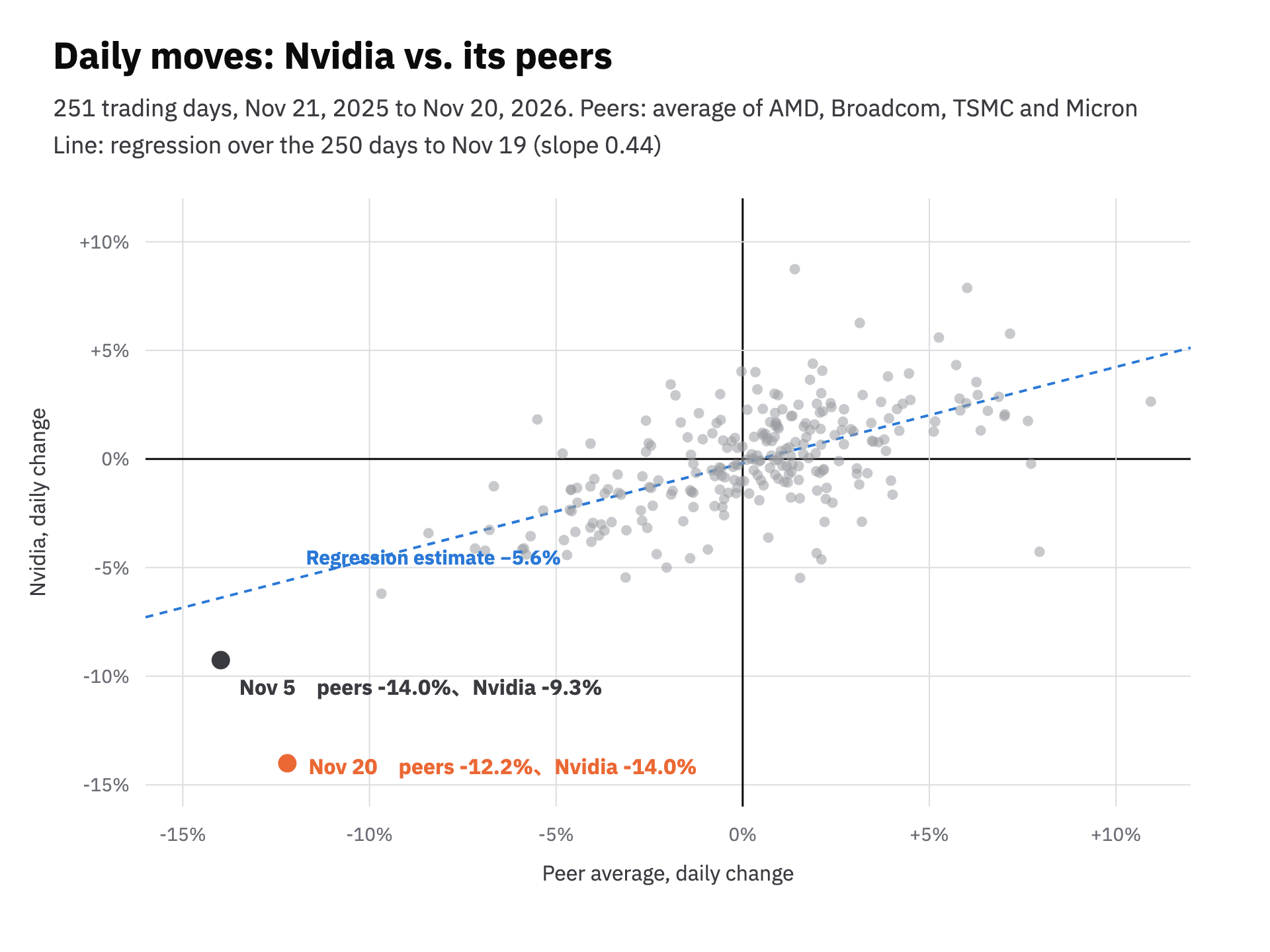
Over the seven trading days from the November 11 close, Nvidia fell 27.7%, more than the peer average's 21.2%, the SOX's 20.4% and the Nasdaq 100's 11.8%. Summing the daily gaps against the same 250-day relationship gives 19.7 points over the seven days. The period includes the announcement of the board's inquiry, Huang's resignation and the results. On weekly closes the shares have fallen for seven straight weeks since the week of October 9, and they are 46.3% below the October 2 close of $233.95 and 47.5% below the record close of $239.24 on October 6.
We calculated market value using the 24.1 billion shares outstanding on August 21, as shown on the cover of the second-quarter 10-Q. It went from $4.187 trillion on November 11 to $3.638 trillion on November 18 and $3.025 trillion on November 20. That is a fall of $1.162 trillion since November 11, and $493 billion on November 20 alone.
CNBC: NVDA / CNBC: seven-week losing streak / Nvidia: Q2 10-Q
Intraday moves and the timing of the report
On five-minute data, Nvidia was falling less than its peers until 2 p.m. At 2:05 p.m. Nvidia was down 7.1% on the day and the peer average 10.6%. In the five minutes from 2:05 to 2:10 p.m. Nvidia's fall accelerated, and by 2:35 p.m. it was down 11.7%. Over the same 30 minutes the peer average went from down 10.6% to down 12.2%. Five-minute volume rose from about 1.76 million shares in the bar from 2:00 p.m. to about 5.81 million in the bar from 2:05 p.m. and about 8.78 million in the bar from 2:10 p.m.
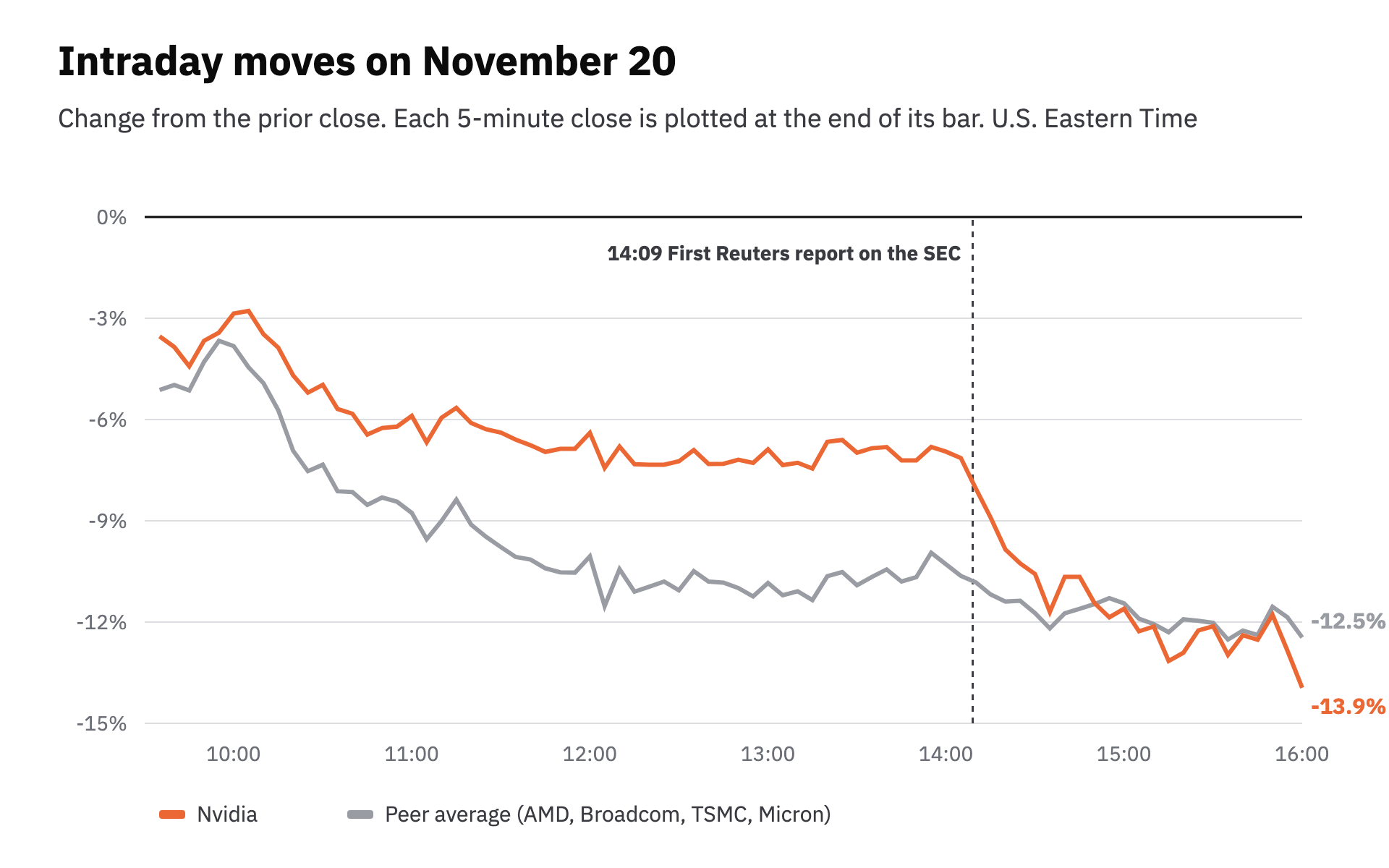
The first Reuters story moved at 19:09:14 UTC according to TradingView, or 2:09 p.m. Eastern. That falls inside the five minutes in which the selling accelerated. The expanded Reuters story said the shares were already down more than 6% before the report.
There were other factors that day. At a press conference, President Trump said U.S. companies that build data centers abroad would face a heavy tax. According to Newsquawk, the remark came at 1:36 p.m. Eastern, about 30 minutes before the first Reuters story. On five-minute closes from 1:30 to 2:00 p.m., Nvidia was down between 6.8% and 7.2%. Anthropic, which listed the previous day, closed down 8.5%. Nikkei Asia reported that at least two of Nvidia's server partners had halted shipments to customers in Southeast Asia after the new export controls. It was also the day November options expired.
Reports described the causes differently. A Reuters market story mainly cited the failure of Anthropic's listing and Nvidia's results to ease worries about AI. AP cited concerns about AI valuations and the midterm election results; neither mentioned the SEC report. CNBC included the SEC report as one of five reasons. The five-minute data show that the report and the price move coincided in time, but they cannot divide the fall among the factors.
Reuters (TradingView): first story / Newsquawk: market wrap / Reuters (via Yahoo): market story / AP (via WHEC) / CNBC: five forces behind the sell-off
What the Reuters report said
Citing two people familiar with the matter, Reuters reported that SEC enforcement staff were examining potential accounting issues at Nvidia. It said it could not determine when the inquiry began or which accounting issues were involved. The story used three words for it, probe, investigation and inquiry, and it is not known whether a formal order of investigation has been issued. The SEC declined to comment, and Nvidia did not immediately respond. As of November 22, Nvidia had not filed an 8-K disclosing an investigation.
This is the second report of an SEC investigation. On November 17 the WSJ reported that the SEC was conducting a civil inquiry into whether Nvidia's disclosures misled investors. Reuters added that the focus is on accounting. The first story also said the Justice Department was reviewing Nvidia's $12.9 billion acquisition of Hugging Face.
Reuters expanded the story at about 3:35 p.m. Eastern on November 20, from 10 paragraphs to 20. The additions covered the share-price move, the change in how regional revenue is presented, concern about circular funding of AI companies, and a new financial reporting and accounting unit in the SEC's enforcement division. The paragraph on regional revenue cites an FT report of November 17. The paragraph on circular funding describes concerns the head of the SEC's enforcement division expressed to Reuters the previous month. Neither is presented as what the SEC is examining.
Reuters (TradingView): expanded story / TechCrunch: WSJ report / SEC: Nvidia's filing index
The change in the regional revenue basis
This section and the next use filings to examine points Reuters gave as background. They have not been confirmed as the subject of the SEC's inquiry.
In the 10-Q for the third quarter of fiscal 2026, filed on November 19, 2025, Nvidia changed how it presents revenue by region. It had grouped revenue by the customer's billing location; since then it has grouped it by the location of the customer's headquarters. The 10-Q said the billing location often reflected where customers centralized invoicing, while products were almost always shipped elsewhere. It said the headquarters basis better represents the geographic profile of revenue, and it recast prior periods.
The recasting makes it possible to compare the same periods on both bases. The old-basis figures are in that period's 10-K or 10-Q, and the new-basis figures are in the prior-year columns of later 10-Ks and 10-Qs.
| Period | Singapore (old) | China (old) | China (new) | New ÷ old | U.S. share (old → new) |
|---|---|---|---|---|---|
| FY2024 | $6.831bn (11.2%) | $10.306bn | $12.330bn | 1.20x | 44.3% → 51.8% |
| FY2025 | $23.684bn (18.1%) | $17.108bn | $25.048bn | 1.46x | 46.9% → 59.4% |
| FY2025 Q3 | $7.697bn (21.9%) | $5.416bn | $8.142bn | 1.50x | 42.2% → 55.9% |
| FY2026 Q1 | $9.017bn (20.5%) | $5.522bn | $9.659bn | 1.75x | 47.1% → 58.3% |
| FY2026 Q2 | $10.156bn (21.7%) | $2.769bn | $3.985bn | 1.44x | 50.2% → 70.4% |
In all five periods, China revenue on the headquarters basis is larger than on the billing basis, by 1.20 to 1.75 times; in the first quarter of fiscal 2026 it is $4.137 billion higher. The change did not make past China revenue look smaller. The U.S. share also rose by 7 to 20 points, and the share from customers outside the U.S. fell from 53.1% to 40.6% in fiscal 2025.
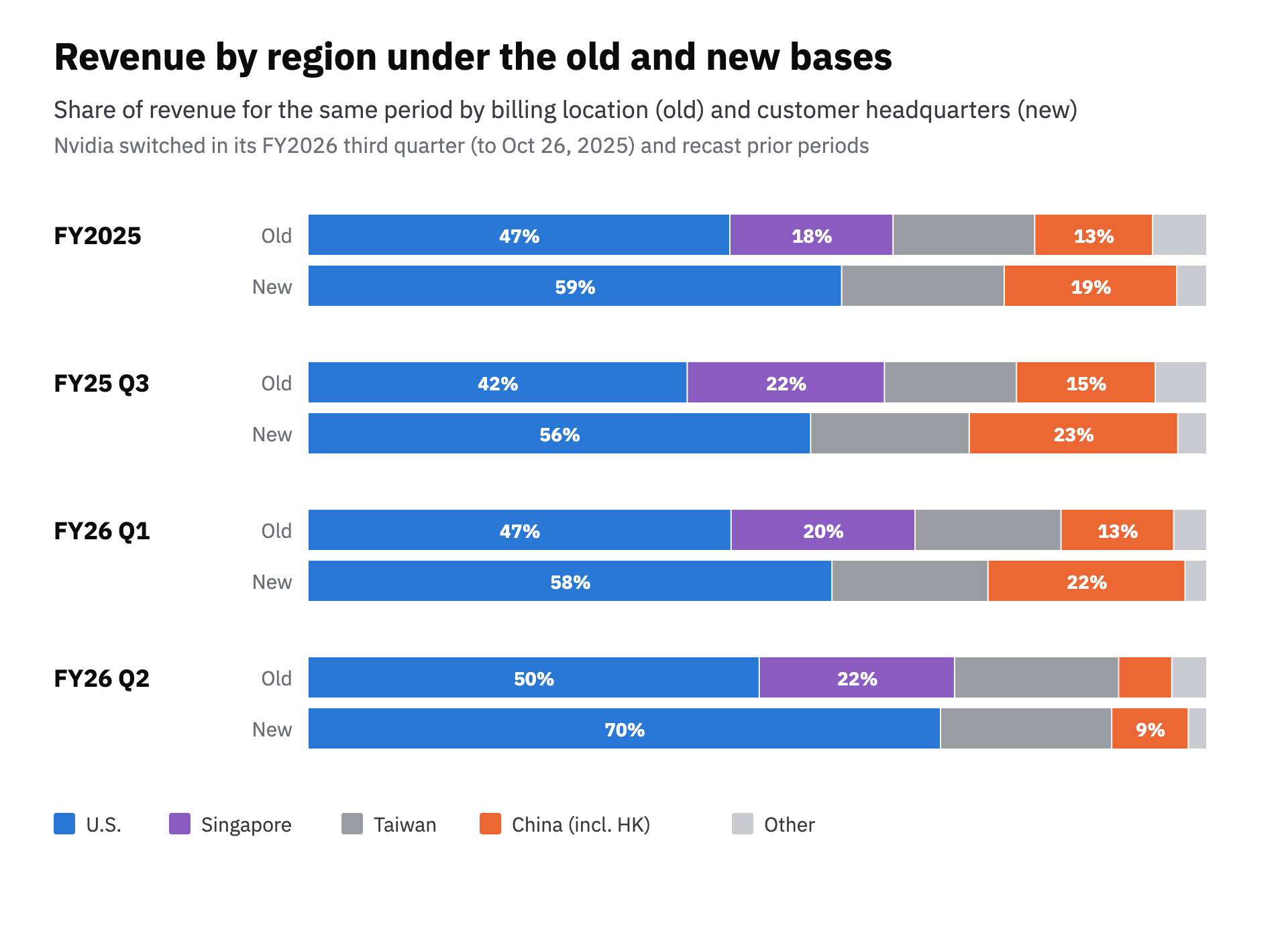
The table does not show where the revenue billed to Singapore went. Changing the basis also moves customers in rows other than Singapore. What the table shows is the net change for each region: in fiscal 2025 the U.S. rose by $16.225 billion, China by $7.940 billion and Taiwan by $3.027 billion, while Singapore fell by $23.684 billion and other regions by $3.508 billion.
Some information disappeared with the change. The old-basis filings had notes on Singapore revenue. The fiscal 2025 10-K said shipments actually delivered to Singapore were less than 2% of revenue. The 10-Qs for the first and second quarters of fiscal 2026 said more than 99% of controlled data center compute revenue billed to Singapore came from orders by U.S.-based customers. The new-basis filings have neither the Singapore row nor these two notes. Instead they give an estimate of how much data center revenue from Taiwan-headquartered customers was attributed to end customers in the U.S. and Europe: 86% in the third quarter of fiscal 2026 and 76% for fiscal 2026.
On November 17 the FT reported that Nvidia had stopped disclosing its Singapore sales. According to the FT article as quoted by Slashdot, the Singapore business had external sales of $104 billion in 2025, 72% more than a year earlier. The Singapore subsidiary's financial statements showed revenue of $117.8 billion for the 12 months to January 2026, of which $13.6 billion was intra-group, and a profit of $53 million. The expanded Reuters story, citing the FT, said Singapore sales had grown to nearly half of global sales.
This "Singapore sales" figure is not the billing-location figure in the 10-K and 10-Qs. Dividing the $104 billion of external sales by fiscal 2026 revenue of $215.938 billion, a period that largely overlaps, gives 48%, consistent with Reuters' "nearly half". By billing location Singapore accounted for 18% to 22%, and shipments actually delivered to Singapore were less than 2%. There are three different Singapore numbers: what the subsidiary sold, where customers were billed, and where products were shipped. We could not read the FT original; the subsidiary figures come from Slashdot's quotation.
Nvidia: FY2026 Q3 10-Q (change of basis) / Slashdot: quoting the FT / Reuters (via Euronext): expanded story / Nvidia: FY2025 10-K / Nvidia: FY2026 10-K
The value of listed equity holdings
The other background point Reuters raised is concern that, through investments in AI companies and cloud operators and guarantees on data center projects, money is circulating between Nvidia and its customers. As our November 19 article noted, net additions to privately held equity were $46.4 billion over nine months, and the maximum amount of guarantees reached $118 billion. Equity valuation gains over the nine months were $25.5 billion, 11.6% of pretax income.
The value of listed holdings changes as share prices fall. The 13F Nvidia filed with the SEC on November 16 lists eight stocks worth $48.33 billion in total as of September 30. Assuming the 13F share counts were unchanged through November 20 and applying each stock's closing price gives the following.
| Stock | Shares | Value on Sept 30 | Valued at Nov 20 close | Change |
|---|---|---|---|---|
| SpaceX | 130.47 million | $19.68bn | $16.67bn | −15% |
| Intel | 161.08 million | $19.37bn | $8.26bn | −57% |
| CoreWeave | 47.21 million | $4.11bn | $1.87bn | −55% |
| Coherent | 7.79 million | $2.24bn | $1.46bn | −35% |
| Synopsys | 4.35 million | $1.89bn | $1.72bn | −9% |
| Nokia | 72.86 million | $0.74bn | $0.50bn | −32% |
| Nebius | 1.19 million | $0.28bn | $0.10bn | −66% |
| Generate Biomedicines | 0.83 million | $0.01bn | $0.01bn | −36% |
| Total | $48.33bn | $30.59bn | −37% |
On the same assumptions, the holdings were worth $35.82 billion at the November 11 close and $34.02 billion on November 18. That implies a fall of $5.23 billion over the seven trading days to November 20 and $3.44 billion on November 20 alone. At the October 23 close, near the end of the third quarter, they come to $40.11 billion, $4.1 billion short of the $44.2 billion of listed equity (current assets) at October 25 in the results documents. The 13F shows holdings at September 30 and excludes trades from October onward and warrants and convertible preferred shares that do not appear in it. This calculation indicates the direction and rough size of the change in holdings.
Nvidia discloses each quarter the unrealized gains on listed equity held at period end; they were $1.5 billion in the second quarter and $12.5 billion in the first half. Changes in share prices flow into quarterly profit. The fourth quarter began on October 26, and from October 23, the last trading day before it, to November 20 the value of the 13F holdings fell by $9.52 billion on our calculation. According to the expanded Reuters story, interim CEO Kress said on the November 17 earnings call that Nvidia would be much more selective about financing deals in the AI industry.
Nvidia: 13F (as of September 30, 2026) / Nvidia: Q2 10-Q / LATENT: Nvidia's third-quarter results
Investigations and hearings
Investigations involving Nvidia are under way in four places: the board, the SEC, the state and Congress. In date order:
| Date | Event |
|---|---|
| By November 10 | Independent directors hire the law firm Wachtell Lipton and former acting U.S. attorney Joon H. Kim (CNBC) |
| November 17 | The WSJ reports a civil SEC inquiry (whether disclosures misled investors) |
| November 19 | California's attorney general serves an investigative subpoena |
| November 20 | Reuters reports that the SEC inquiry is focused on accounting |
| November 20 | An aide to Senate Banking Committee Chairman Tim Scott says Huang will testify at a public hearing; the date is not set, and the chairman had originally sought December 3 |
| November 21 | According to Bloomberg, the California inquiry extends to the criminal provisions of state law |
| December 1 | Huang expected to sit for a closed-door interview with the House Foreign Affairs, Intelligence and China select committees (CNBC) |
| December 2 | The general counsel expected to appear before the same three committees (CNBC) |
| December 4 | Deadline for the third-quarter 10-Q |
The California Department of Justice announced on November 19 that it had served a subpoena. Prompted by reports of Huang's relationship with an alleged Chinese spy, the subpoena asks whether advanced chips or confidential information reached China and whether Nvidia misled investors and the public. In a statement the attorney general cited the principle of the state's corporate securities law that companies must not mislead investors. The announcement does not cite specific statutes. According to a Bloomberg report on November 21, republished by Seeking Alpha, the attorney general said his office is looking at civil and criminal provisions of state law that prohibit misleading investors and the public. He said that if violations are found, he could seek injunctions and the disgorgement of profits from unlawful sales. In what LATENT could check on November 22, we found no comment from Nvidia on the subpoena or the SEC report.
As a large accelerated filer, Nvidia must file its 10-Q within 40 days of quarter end, by December 4. If it cannot, filing an NT 10-Q by the next business day after the deadline gives a five-day extension. Since August 2024 Nvidia has filed its 10-Q or 10-K on the same day as its results 8-K, but not this time. As of November 22, neither a 10-Q nor an NT 10-Q had been filed.
On November 19 a notice of proposed sale (Form 144) was filed for general counsel Timothy Teter: 30,000 shares, about $4.54 million, under a 10b5-1 plan adopted on May 22. The second-quarter 10-Q describes the shares to be sold under that plan as 547,942 shares, including future vesting, plus future equity awards. Teter also sold about 30,000 shares each on August 31 and September 21.
California Department of Justice: subpoena / SEC: Form 144 (November 19) / LATENT: Nvidia's third-quarter results
H200 shipments to China
On the November 17 call, Kress said Nvidia was no longer shipping the licensed Hopper data center products to China. We covered this in our November 19 article. Nvidia later said in a statement that the approvals came with strict conditions and limited volumes and that it had stopped shipping H200s to China. In a November 20 statement it said the limited shipments were lawful and authorized by BIS, and that the review and licensing process had taken more than six months.
The government has not changed its policy. Treasury Secretary Bessent said on CNBC on November 20 that the agreement making the H200 the ceiling for chips that can be sold to China continues as planned. Even after it was pointed out that Nvidia had stopped shipments, he said he did not expect a policy change.
On November 19, House Foreign Affairs Committee Chairman Mast used authority under the Export Control Reform Act to release license information on AI chips Nvidia and AMD sought to sell to China. According to the committee's documents, as of May 11, 2026, BIS had received applications for 3,444,160 chips and approved 879,868 in 21 applications. That is an approval rate of 25.5%. According to Reuters, the approvals were granted between December 2025 and May 2026 and covered Nvidia's H200 and AMD's MI325X. Named approvals were 75,000 for Alibaba, 150,000 for Tencent, 43,000 for Baidu and 4,000 for BYD; their total of 272,000 is 31% of the approvals. These are approved license quantities, and Reuters said the number actually shipped is not known. The released license list has four pages, of which LATENT read the first and fourth. All ten entries on the first page were "approved, not shipped".
Reuters (TradingView): House documents / CNBC: Treasury Secretary's remarks / House Foreign Affairs Committee: license information / LATENT: Nvidia's third-quarter results
What LATENT will follow
First, the 10-Q. We will check the regional revenue note, the legal proceedings section, whether it mentions the SEC inquiry, and whether it is filed by the December 4 deadline. If an NT 10-Q is filed, we will read how it explains the delay.
Second, how the shares move relative to peers. November 20 was the first day on which the peers fell 4% or more and Nvidia fell more than they did. We will apply the same calculation to see whether that continues next week.
Third, the valuation of listed and private holdings. We will use the next results and the next 13F to check the size of the valuation losses in fourth-quarter profit and how Nvidia narrows its investments, as Kress described.
Fourth, the congressional and state proceedings. We will follow the hearings from December 1 and whether Nvidia's response to the California subpoena becomes public.
Sources and scope
We took CNBC's daily and five-minute market data at 4:56 a.m. Japan time on November 22. We checked the January 27, 2025 figure against the same source's 2025 daily data. The peer average is the simple average of the daily changes of AMD, Broadcom, TSMC (ADR) and Micron. We used three estimation windows: the 250 trading days to November 19 (from November 21, 2025), the 60 trading days to November 19 (from August 27, 2026), and only the days when the peer average fell 4% or more; none includes November 20. The range for the part specific to Nvidia is LATENT's estimate from these three windows, and other windows or peers would give different values.
We read the first Reuters story via TradingView and the expanded story via Euronext and WHTC; we could not read the original on reuters.com. We could not read the FT's November 17 article and checked its content through Slashdot's quotation and the Reuters story. We could not read Bloomberg either and relied on Seeking Alpha's republication. We did not read Nikkei Asia's article and relied on Newsquawk. The time of President Trump's remark is the time of Newsquawk's item.
We read the fiscal 2025 and 2026 10-Ks and the 10-Qs from the third quarter of fiscal 2025 to the second quarter of fiscal 2027 from SEC filings on November 22 Japan time. LATENT calculated the shares and differences in the regional table. LATENT estimated the listed holdings by applying each stock's closing price to the September 30 share counts in the 13F information table filed on November 16. The estimate excludes trades from October onward, warrants, convertible preferred shares and private holdings. The dates of investigations and hearings come from CNBC, TechCrunch reporting on the WSJ, the California Department of Justice, Reuters, Benzinga, and Seeking Alpha reporting on Bloomberg. We could not read pages two and three of the four-page House license list, so we have not checked the overall split between Nvidia and AMD or the status of each entry.
- Reuters, "US SEC's Nvidia probe is examining potential accounting issues, sources say" (first story)
- Reuters, "Nvidia's accounting is a focus of US SEC investigation, sources say" (expanded story)
- WHTC (Reuters republication)
- TechCrunch, "SEC reportedly investigating Nvidia amid Huang exit"
- California Department of Justice, "Attorney General Bonta Serves Investigative Subpoena on Nvidia"
- Seeking Alpha (Bloomberg report): the California inquiry
- CNBC, "Nvidia stock plunges 14%, wraps up longest weekly losing streak since 2008 financial crisis"
- CNBC, "S&P 500 correction: Five forces behind the market sell-off"
- CNBC, market live updates for November 20
- CNBC, remarks on taxing overseas data centers
- CNBC, Treasury Secretary Bessent's remarks
- Newsquawk, U.S. market wrap for November 20
- Slashdot, quoting the FT
- House Foreign Affairs Committee, release of license information
- Reuters, House documents and approval numbers
- Nvidia, Form 10-Q (FY2026 Q3, change in regional revenue basis)
- Nvidia, Form 10-K (FY2025)
- Nvidia, Form 10-K (FY2026)
- Nvidia, Form 10-Q (FY2025 Q3)
- Nvidia, Form 10-Q (FY2026 Q1)
- Nvidia, Form 10-Q (FY2026 Q2)
- Nvidia, Form 10-Q (FY2027 Q1)
- Nvidia, Form 10-Q (FY2027 Q2)
- Nvidia, Form 13F-HR (as of September 30, 2026)
- Form 144 (November 19, 2026, Timothy S. Teter)
- CNBC, NVDA quote