Business & Markets · · Team LATENT
Nvidia's third-quarter results: a Q4 outlook up 4% per week, $390 billion in supply commitments, and its equity stakes and guarantees
Nvidia's third-quarter revenue of $115.8 billion beat the company's own outlook by 7.3%. The $130 billion fourth-quarter outlook covers a 14-week quarter, one week longer than usual; per week it is a 4.2% sequential rise. Supply commitments rose to $390 billion, 3.4 quarters of revenue. Net additions to privately held equity were $46.4 billion over nine months, 41% of free cash flow, and guarantees gained a $9.5 billion line with no counterparty or terms given. We also look at revenue from customers headquartered in China and the 10-Q that has not been filed.
At 4:20 p.m. Eastern on November 17, Nvidia filed the 8-K with its third-quarter results. It came five days after Jensen Huang's resignation as CEO was announced, and the quote in the press release came from interim CEO Colette Kress. Revenue was $115.8 billion, 2.03 times the year-earlier quarter, and data center revenue was $107.6 billion. The fourth-quarter revenue outlook is $130 billion, 12.2% above the third quarter.
That outlook includes one more week than usual. Nvidia's fiscal 2027 is a 53-week year, and only its fourth quarter has 14 weeks. This article works from the press release, the CFO commentary, the supplemental financial information and the results documents of the past nine quarters. It checks, in turn, the gap with the company's outlook, the outlook's growth per week, the gross-profit outlook, supply commitments, equity stakes and guarantees, and revenue from customers headquartered in China. It also covers the 10-Q that did not arrive with the results, and the share reaction.
The events leading up to Huang's resignation are covered in "Nvidia's board inquiry into Jensen Huang and reports of his removal" and "Jensen Huang resigns and Colette Kress becomes Nvidia's interim CEO". We read the company filings between 5 and 6 a.m. Japan time on November 19. Remarks on the earnings call were checked against two transcripts published by third parties; we did not read an official company transcript. Per-week values, ratios and totals are LATENT calculations. This article does not recommend buying or selling shares and does not forecast the share price.
Nvidia: Q3 results press release / Nvidia: CFO commentary / Nvidia: supplemental financial information
Key takeaways
- Revenue of $115.8 billion beat the company's outlook by 7.3%, the second-largest beat in nine quarters. The $130 billion Q4 outlook covers 14 weeks; per week it is a 4.2% sequential rise. Even after adding past beats (2.5% to 7.9%), per-week growth comes to 6.8% to 12.5%, below the 18% to 22% of the past five quarters. With the 71% to 72% gross-margin outlook, gross profit per week falls 0.4% at the midpoint.
- Supply and capacity commitments rose from $279 billion to $390 billion, 3.4 quarters of revenue, against 0.9 quarters a year earlier. Receivables rose to $81.0 billion on extended payment terms and shipment timing, with DSO at 64 days; at the 51 to 54 days of fiscal 2026's second to fourth quarters they would have been $64.9 billion to $68.7 billion. Net additions to privately held equity were $46.4 billion over nine months, 41% of free cash flow over the same period.
- Revenue from customers headquartered in China was $11.05 billion, up 2.4 times in two quarters and 9.5% of revenue. Hopper shipments to China were $2.4 billion, and the Q4 outlook assumes no data center compute revenue from China. For the first time since August 2024 the 10-Q was not filed on results day; the deadline is December 4. Against reports of a Huang comeback, the board said it does not intend to bring him back, and the prediction-market price for a return this year fell from a peak of 20.1% to 7.7%.
The gap with the company's outlook
Each quarter Nvidia gives a revenue outlook for the next quarter as a midpoint and a range. The third-quarter outlook, issued on August 26, was $108.0 billion plus or minus 2%. Actual revenue of $115.8 billion was 7.3% above the midpoint and 5.2% above the top of the range, $110.16 billion. According to CNBC, the LSEG analyst consensus was $109.1 billion, which revenue beat by 6.2%. Adjusted earnings per share were $2.68 against a consensus of $2.48.
Setting outlook against results for the past nine quarters shows how large this beat was. Revenue beat the midpoint in all nine quarters, by 2.5% to 7.9%, with an average of 5.2%. This quarter's 7.3% is the second largest, after 7.9% in the third quarter of fiscal 2025.
| Quarter | Outlook given a quarter earlier | Actual | Gap with midpoint |
|---|---|---|---|
| FY25 Q3 | $32.5bn ±2% | $35.08bn | +7.9% |
| FY25 Q4 | $37.5bn ±2% | $39.33bn | +4.9% |
| FY26 Q1 | $43.0bn ±2% | $44.06bn | +2.5% |
| FY26 Q2 | $45.0bn ±2% | $46.74bn | +3.9% |
| FY26 Q3 | $54.0bn ±2% | $57.01bn | +5.6% |
| FY26 Q4 | $65.0bn ±2% | $68.13bn | +4.8% |
| FY27 Q1 | $78.0bn ±2% | $81.62bn | +4.6% |
| FY27 Q2 | $91.0bn ±2% | $96.22bn | +5.7% |
| FY27 Q3 | $108.0bn ±2% | $115.84bn | +7.3% |
Gross margin also beat. The outlook was 74.0% plus or minus 0.5 points; the result was 74.8% on a GAAP basis and 74.9% on a non-GAAP basis. That was slightly below the previous quarter's 75.0%, which the company put down to the initial Rubin ramp. GAAP net income was $65.3 billion and diluted earnings per share were $2.70.
Nvidia: Q2 results press release (Q3 outlook) / Nvidia: Q3 results press release
A 14-week fourth quarter and growth per week
Nvidia's fiscal year ends on the last Sunday in January, so it runs 52 or 53 weeks. The fiscal 2026 10-K says fiscal 2027 is a 53-week year with a 14-week fourth quarter. Fiscal 2024 through 2026 were all 52-week years. The press release also says the fourth-quarter outlook "includes an additional week".
To put the quarters on the same footing, we divided each quarter's revenue by its number of weeks. The third quarter had 13 weeks and $8.91 billion of revenue per week. Dividing the $130 billion fourth-quarter outlook by 14 weeks gives $9.29 billion, a 4.2% sequential rise per week. Across the plus or minus 3% range, revenue per week is $9.01 billion to $9.56 billion, a rise of 1.1% to 7.3%.
Over the past five quarters, starting with the third quarter of fiscal 2026, sequential growth per week was 22.0%, 19.5%, 19.8%, 17.9% and 20.4%. The fourth-quarter outlook is well below that pace. It is also the first time in ten quarters that the range has widened from plus or minus 2% to plus or minus 3%.
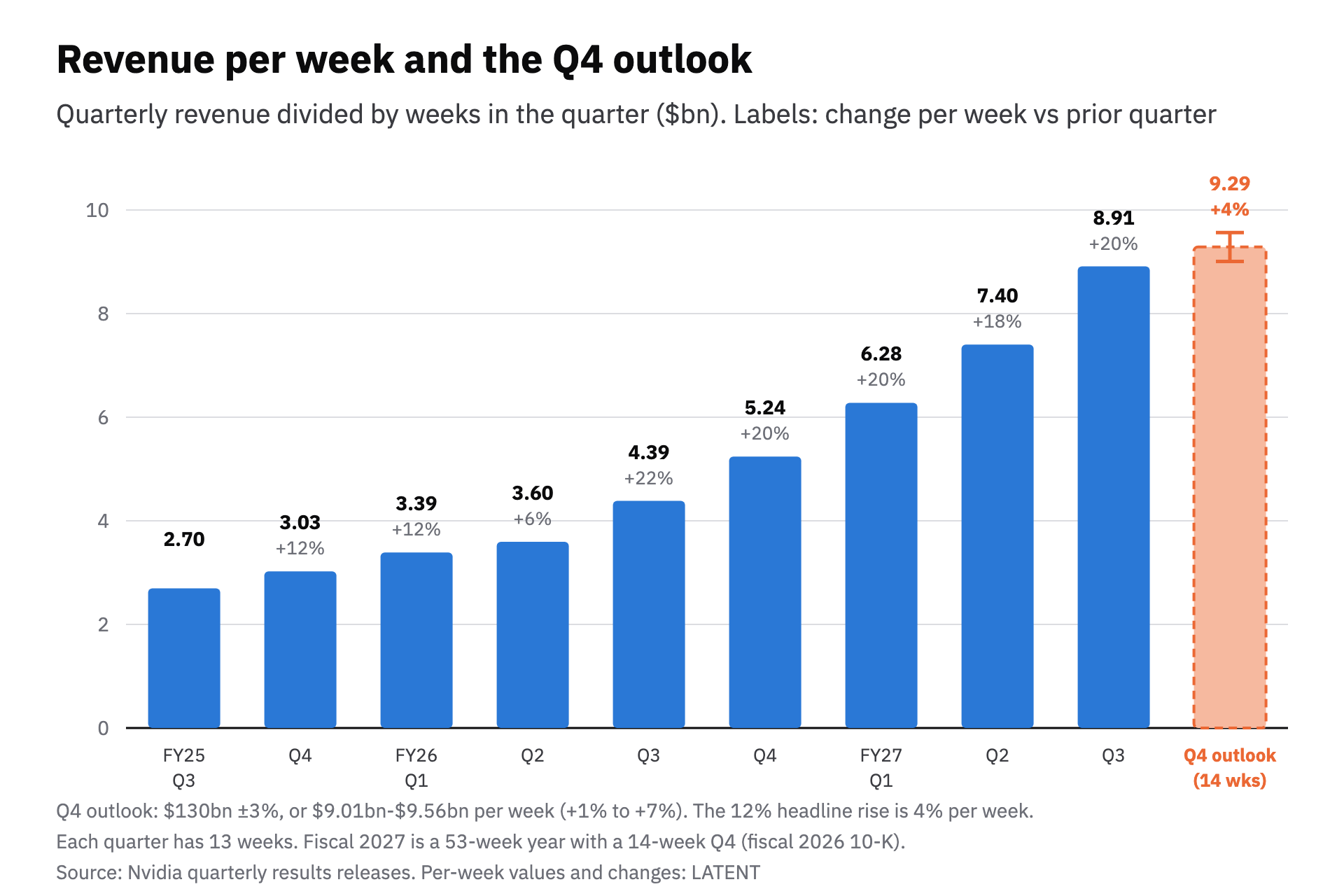
Nvidia has beaten its outlook for nine straight quarters. We applied past beats to the fourth-quarter outlook and calculated growth per week. The smallest beat, 2.5%, gives 6.8%; the average, 5.2%, gives 9.7%; the largest, 7.9%, gives 12.5%. Even a beat of 7.3%, as this quarter, gives 11.8%, short of the 18% to 22% of the past five quarters.
| Q4 scenario | Revenue | Revenue per week | Per-week change |
|---|---|---|---|
| Bottom of range (-3%) | $126.1bn | $9.01bn | +1.1% |
| Midpoint | $130.0bn | $9.29bn | +4.2% |
| Top of range (+3%) | $133.9bn | $9.56bn | +7.3% |
| Average past beat (+5.2%) | $136.8bn | $9.77bn | +9.7% |
| Largest past beat (+7.9%) | $140.3bn | $10.02bn | +12.5% |
The calculation assumes revenue is spread evenly across weeks. In practice revenue moves with shipment timing, and the company itself cited shipment linearity from the Rubin launch as one reason receivables rose in the third quarter. The company has not said how much revenue the extra week brings, so per-week values are a guide. According to the third-party transcripts, Kress mentioned the extra week on the call and said the operating-expense outlook includes the extra week and costs tied to the leadership transition.
The previous 14-week quarter was the fourth quarter of fiscal 2021. In November 2020 Nvidia gave an outlook of $4.80 billion plus or minus 2% that included 14 weeks. Against third-quarter revenue of $4.73 billion, that implied a 5.7% fall per week. Actual revenue was $5.00 billion, 4.2% above the midpoint, and fell 1.7% per week. This time the outlook rises 4.2% even per week, a stronger outlook than last time.
On the call Kress raised the outlook for fiscal 2028 revenue growth from about 70% to about 75% (third-party transcripts). Fiscal 2027 revenue, adding the fourth-quarter outlook to nine months of actual revenue of $293.68 billion, comes to $423.68 billion. Growth of 75% would give $741.4 billion, or $14.26 billion per week over the 52-week fiscal 2028. That is 1.54 times the $9.29 billion per week in the fourth-quarter outlook.
Nvidia: fiscal 2026 10-K / Nvidia: CFO commentary
Lower gross margin and profit per week
The fourth-quarter gross-margin outlook is 71.0% to 72.0%, more than 3 points below the third quarter's 74.8%. The outlooks for the previous four quarters were 74.0% to 74.9% on a GAAP basis. According to the third-party transcripts, Kress said 71% to 72% was the same as the outlook given a quarter earlier. On the August call she had said memory price increases had exceeded expectations and described the fourth quarter as the trough. In this call's Q&A she said the company had absorbed part of the higher supply costs, would ship orders already received on the earlier terms, and would apply new prices from the new fiscal year. She said margins would return to 72% to 73% in fiscal 2028.
Multiplying the revenue outlook by the gross-margin outlook gives fourth-quarter gross profit of $92.95 billion at the midpoint. Third-quarter gross profit was $86.68 billion, so the total rises 7.2%. Per week, however, it goes from $6.67 billion in the third quarter to $6.64 billion in the fourth, a 0.4% fall. With revenue and margin both at the bottom of their ranges, gross profit per week falls 4.1%; with both at the top, it rises 3.3%.
The GAAP operating-expense outlook is about $11.0 billion, 20.1% above the third quarter's $9.16 billion, and 11.6% higher per week. Operating income at the midpoint comes to $81.95 billion, 1.8% less per week than in the third quarter. The fourth-quarter outlook combines record total revenue with roughly flat gross profit and operating income per week.
The precedent for an outlook near 71% is the Blackwell ramp. The outlook given with fourth-quarter fiscal 2025 results was 70.6% on a GAAP basis, after outlooks of 74.4% and 73.0% for the two quarters before. This time the company attributes the decline to memory prices.
Nvidia: Q3 results press release / Nvidia: FY25 Q4 results press release
Who buys the data center products
Nvidia splits data center revenue into Hyperscale, the large cloud providers, and AI Clouds, Industrial, & Enterprise for everyone else. In the third quarter Hyperscale was $60.1 billion, up 71% on the year, and the rest was $47.5 billion, up 195%. The non-Hyperscale share of data center revenue rose from 31% a year earlier to 44%. Sequentially, though, Hyperscale grew 23% and the rest 18%, so Hyperscale grew faster this quarter. The company attributed growth in both to the Rubin introduction, standalone Vera CPUs and Blackwell Ultra.
Direct customers accounting for at least 10% of revenue numbered three in the first quarter (21%, 17% and 16%, 54% in total), one in the second (16%) and three in the third (14%, 11% and 11%, 36% in total). Direct customers include board and server makers, distributors, cloud providers and AI developers, so the figure does not measure concentration among end users.
Receivables, on the other hand, lean on two customers. They accounted for 18% and 17% of receivables at the end of the third quarter, about $28.4 billion. That concentration ties in with the extended payment terms covered later.
Nvidia: supplemental financial information / Nvidia: Q1 10-Q
$390 billion in supply commitments, and inventory
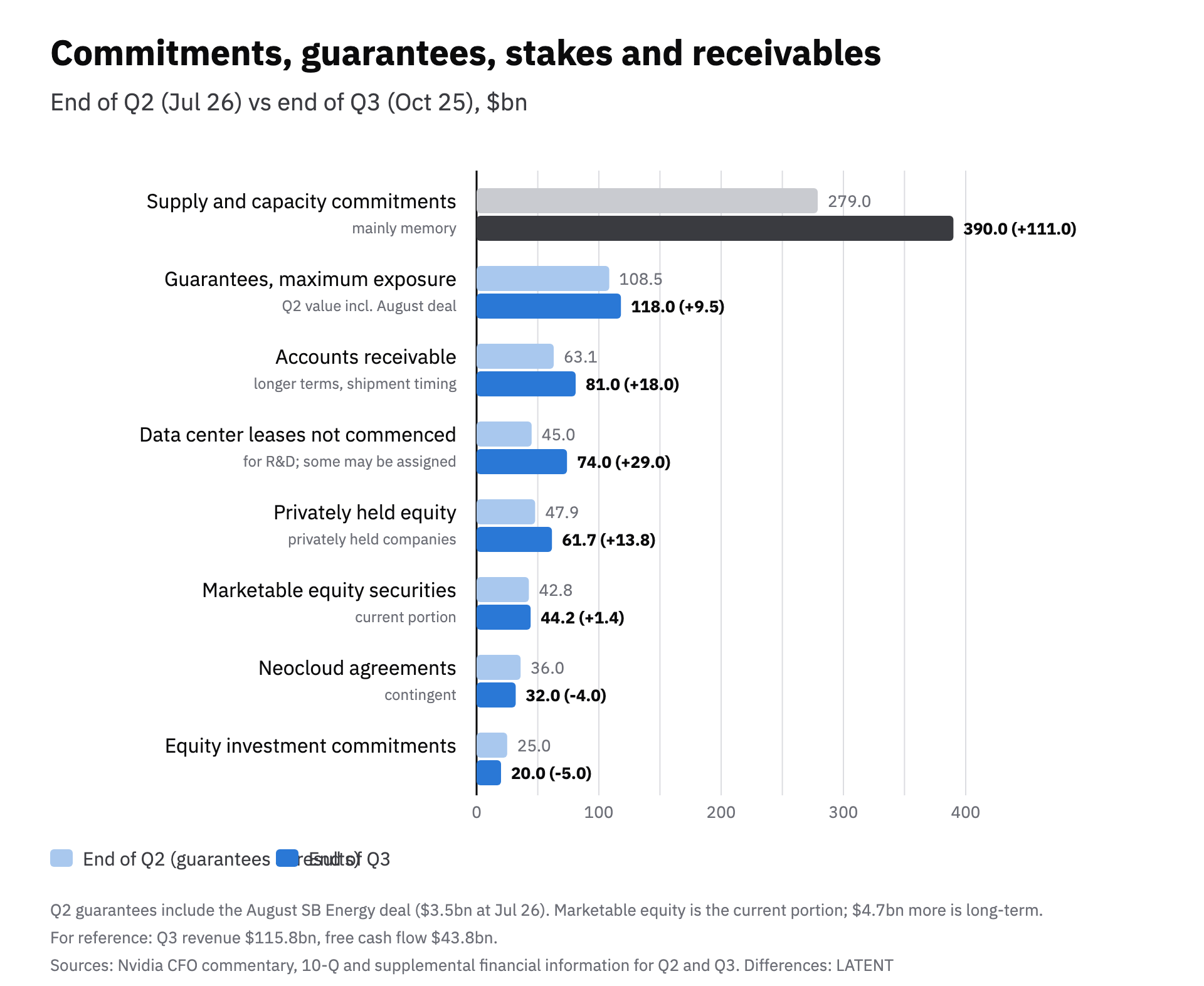
According to the CFO commentary, commitments for components and capacity rose from $279 billion at the end of the second quarter to $390 billion. The $111 billion increase is mainly multi-year procurement of memory. It equals 96% of third-quarter revenue.
Dividing the commitments by quarterly revenue gives 3.4 quarters. A year earlier the figure was 0.9 quarters. Up to the first quarter of fiscal 2027 the number was labeled "total supply-related commitments" or similar; from the second quarter it is the "Supply and capacity" line of a table. In its second-quarter commentary the company compared the two directly, describing an increase from $119 billion to $279 billion. On that series, commitments rose 7.8 times in a year.
| Quarter end | Supply commitments | Quarters of revenue | Inventory |
|---|---|---|---|
| FY26 Q3 | $50.3bn | 0.9 | $19.8bn |
| FY26 Q4 | $95.2bn | 1.4 | $21.4bn |
| FY27 Q1 | $119.0bn | 1.5 | $25.8bn |
| FY27 Q2 | $279bn | 2.9 | $31.6bn |
| FY27 Q3 | $390bn | 3.4 | $39.7bn |
By payment year, the largest amount, $203 billion, falls due in fiscal 2028, 1.6 times the fourth-quarter revenue outlook. Inventory of $39.7 billion equals 124 days of third-quarter cost of revenue, up slightly from 119 days at the end of the second quarter. Raw materials were $15.8 billion, 4.2 times the $3.8 billion at the end of January. Finished goods were $6.2 billion, less than January's $8.8 billion.
Nvidia: CFO commentary / Nvidia: FY26 Q3 CFO commentary
Stakes, guarantees and payment terms
Receivables rose from $63.1 billion at the end of the second quarter to $81.0 billion, and days sales outstanding (DSO) lengthened from 60 to 64. In fiscal 2026 DSO was 46 to 54 days, and in the first quarter of fiscal 2027 it was 45. The company attributed the first quarter's 45 days to customer payments received before the next quarter's invoice due dates and said DSO would return to more normal levels. Since the second quarter it has said it extended payment terms on large, multi-quarter agreements with certain investment-grade customers. For the third quarter it also cited shipment linearity from the Rubin launch.
On third-quarter revenue, DSO of 51 to 54 days, the range of the second to fourth quarters of fiscal 2026, would have meant receivables of $64.9 billion to $68.7 billion. The gap with the actual $81.0 billion is $12.3 billion to $16.1 billion. The $18.1 billion rise in receivables in the third quarter absorbed 37% of operating cash flow of $48.3 billion.
The CFO commentary also describes arrangements that support customers' financing. Nvidia says it has entered into arrangements to help customers whose growth outpaces their balance sheets secure land, power and shell for data centers. These consist of neocloud agreements and guarantees; equity investment commitments are shown separately. The company says its equity investments are focused on frontier labs, infrastructure financiers and other private companies. The table sets end-of-second-quarter values against end-of-third-quarter values.
| Item | End of Q2 | End of Q3 | Change |
|---|---|---|---|
| Neocloud agreements | $36.0bn | $32.0bn | -$4.0bn |
| Guarantees, maximum exposure | $108.5bn | $118.0bn | +$9.5bn |
| Equity investment commitments | $25.0bn | $20.0bn | -$5.0bn |
| Privately held equity | $47.9bn | $61.7bn | +$13.8bn |
The end-of-second-quarter guarantee figure is the value at results time and includes the SB Energy agreement signed in August; at July 26 guarantees were $3.5 billion. Guarantees are the maximum payable if counterparties default, and Nvidia has made no payments under them so far. Neocloud agreements take effect only once the neocloud secures financing and the compute capacity is running and accepted by Nvidia.
The guarantee breakdown gained a new line. To the $105 billion for SB Energy, for an Ohio data center to be leased by OpenAI, and $3.5 billion for neoclouds, the company added $9.5 billion of "power and systems credit support guarantees". The CFO commentary does not name the counterparties or the terms.
Equity stakes moved more than guarantees. Net additions to privately held equity were $15.4 billion in the third quarter and $46.4 billion over nine months. The nine-month figure is 41% of free cash flow of $113.7 billion over the same period. Including unrealized gains, reclassifications after listings, and impairments, the privately held balance rose $39.4 billion, from $22.3 billion at the end of January to $61.7 billion. In the third quarter those holdings produced a $1.0 billion loss, including a $1.8 billion impairment. Over nine months, gains on equity securities totaled $25.5 billion, 11.6% of pretax income.
Data center leases not yet commenced rose from $45.0 billion at the end of the second quarter to $74.0 billion. The second-quarter $45.0 billion combined $25.0 billion for R&D and $20.0 billion to be reassigned to third parties. The company describes these leases and its cloud agreements as infrastructure for its R&D and says it may assign some leases to third parties. The leases run up to 20 years and begin between the fourth quarter of fiscal 2027 and fiscal 2033.
On the call Kress said the company would evaluate future investments, commitments and guarantees rigorously (third-party transcripts). She called shareholder returns the top priority and also described prepaying supplier capacity as the top priority. She listed completing investments already committed and selective guarantees for strong customers as other uses. She also explained that guarantees start when a facility is ready and fall away if it is delayed. No analyst asked about the extended payment terms.
Nvidia: CFO commentary / Nvidia: Q2 CFO commentary / Nvidia: 8-K on the SB Energy agreement
Where the free cash flow went
Third-quarter operating cash flow was $48.3 billion and free cash flow $43.8 billion. Repurchases of $22.1 billion and dividends of $6.0 billion returned $28.1 billion to shareholders, which the company says was a quarterly record. Purchases of equity securities were $15.7 billion and acquisitions $2.7 billion. Those four uses add up to $46.6 billion, 106% of free cash flow. Over nine months, repurchases, dividends and equity purchases totaled $131.6 billion, 116% of free cash flow of $113.7 billion.
The third-quarter shortfall was covered by selling marketable debt securities: sales and maturities brought in $21.26 billion against purchases of $11.41 billion. Nvidia had issued $25 billion of notes in the second quarter. Cash, cash equivalents and marketable debt securities fell from $56.6 billion at the end of the second quarter to $53.5 billion.
The remaining repurchase authorization is $227.3 billion, which the company says it plans to use by the end of fiscal 2028. Fiscal 2028 ends in January 2028. Using it up over five quarters, the fourth quarter and the four quarters of fiscal 2028, would take $45.5 billion a quarter. That is 2.1 times third-quarter repurchases of $22.1 billion and more than third-quarter free cash flow.
Nvidia: supplemental financial information / Nvidia: CFO commentary
Revenue from customers headquartered in China
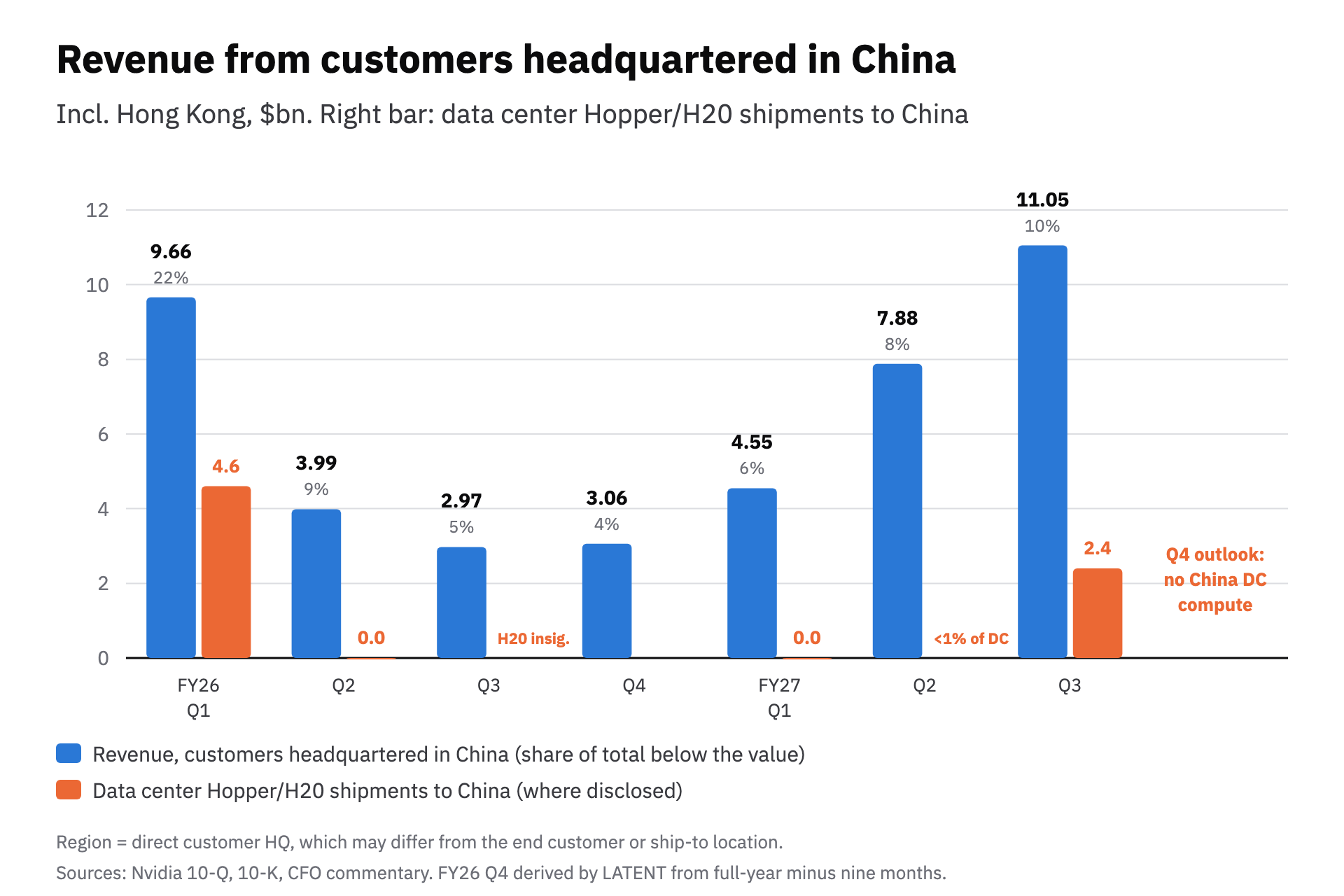
Nvidia reports revenue by region according to where its direct customers are headquartered. Revenue from customers headquartered in China, including Hong Kong, was $11.05 billion in the third quarter, 9.5% of revenue. It rose from $4.55 billion in the first quarter of fiscal 2027 and $7.88 billion in the second, 2.4 times in two quarters.
| Quarter | Customers headquartered in China | Share of revenue | Data center Hopper and H20 to China |
|---|---|---|---|
| FY26 Q1 | $9.66bn | 21.9% | $4.6bn |
| FY26 Q2 | $3.99bn | 8.5% | No H20 sales to China-based customers |
| FY26 Q3 | $2.97bn | 5.2% | H20 sales insignificant (not limited to China) |
| FY26 Q4 | $3.06bn | 4.5% | Not stated |
| FY27 Q1 | $4.55bn | 5.6% | No shipments |
| FY27 Q2 | $7.88bn | 8.2% | Under 1% of data center revenue |
| FY27 Q3 | $11.05bn | 9.5% | $2.4bn |
The fiscal 2026 fourth-quarter figure was calculated by subtracting nine months from the full year. According to the CFO commentary, data center Hopper shipments to China were $2.4 billion in the third quarter. That leaves $8.65 billion of the $11.05 billion from customers headquartered in China, and the filings do not break that gap down. Because the region is set by the direct customer's headquarters, it can differ from the end customer or the shipping destination.
The fourth-quarter outlook assumes no data center compute revenue from China. Nvidia has given every outlook on that basis since its fiscal 2026 fourth-quarter results. The third-quarter outlook was given on the same basis, yet the company shipped $2.4 billion of Hopper products to China. That $2.4 billion is about 30% of the $7.8 billion gap between the outlook midpoint and actual revenue. According to the third-party transcripts, Kress said on the call that Nvidia is no longer shipping the licensed data center Hopper products to China. Neither the press release nor the CFO commentary says shipments have stopped. TechCrunch reported the remark as Nvidia ending H200 sales in China; the term H200 does not appear in either transcript. On the August call, however, Kress had described the products shipped to China-based customers under U.S. government licenses as "Hopper 200" products.
On November 17, hours before the results, the board set up a standing committee to oversee national security and export controls. It is chaired by Suzanne Nora Johnson and will meet at least quarterly. The company's national security and trade compliance teams report directly to the committee and to interim CEO Kress. The day before, November 16, the Commerce Department's Bureau of Industry and Security (BIS) issued an interim final rule. It restricts remote use of advanced semiconductors through data centers in third countries, and its scheduled Federal Register publication date is November 19. The press release and the CFO commentary do not mention the rule. On the call Kress referred to the new export rules issued that week and said she expects results to stay strong because demand far exceeds supply. She said the company was still reviewing the rule (third-party transcripts).
Nvidia: supplemental financial information / Nvidia: Q2 10-Q / Nvidia: oversight committee / BIS: remote access rule
Results under an interim CEO, and the 10-Q
Since August 2024 Nvidia has filed its 10-Q or 10-K with the SEC on the same day as the results 8-K. On all nine occasions up to August 2026 it filed 10 to 44 minutes after the 8-K. This time no 10-Q has been filed, and the CFO commentary says the company plans to file it in the coming weeks. The cautionary note on forward-looking statements in the press release lists the 10-Q, the CEO transition and search, and an ongoing investigation by an independent committee of the board.
For large filers the 10-Q is due 40 days after quarter end. The third quarter ended on October 25, so the deadline is Friday, December 4. A company that cannot meet it can extend it by five days by filing a notice, which would make it December 9. On the call Kress said the 10-Q would be filed within weeks and that supplemental materials were on the company's website in the meantime. She gave no reason for the delay, and no analyst asked (third-party transcripts).
Board chair Harvey Jones opened the call. According to the transcripts, he said the board unanimously accepted Huang's resignation and does not intend to bring him back as CEO. The search for a successor has been given to the executive search firm Heidrick & Struggles, which will consider internal and external candidates. He said the call would not take questions about the circumstances of the resignation or the investigation. In the precedents counted in our previous article, the six cases with a CFO as interim CEO took a median of 110 days to name a permanent CEO; counted from November 12, that is March 2, 2027.
Investigations and congressional dates continue. According to CNBC, the independent directors had by November 10 retained the law firm Wachtell Lipton and former acting U.S. attorney Joon H. Kim. TechCrunch, citing the WSJ, reported that the SEC is running a civil inquiry into whether Nvidia's disclosures misled investors. Nvidia's results documents and the call do not mention it. According to CNBC, Huang will sit for interviews expected to be closed-door with three House committees (Foreign Affairs, Intelligence, and the Select Committee on China) on December 1, and the company's general counsel will appear before the same committees on December 2.
Nvidia: CFO commentary / Motley Fool: call transcript / CNBC: the investigating law firm / TechCrunch: SEC inquiry report / CNBC: congressional interviews
Reports of a Huang comeback
Since the resignation there has been speculation that Huang could return as CEO. According to Reuters, the FT reported on Sunday, November 15, that Huang was considering a comeback and had discussed it with confidants. A person close to Huang told the FT they were assembling Silicon Valley executives to lobby for his return and would seek White House support. According to CNBC, an online petition for his reinstatement has drawn 180,000 signatures and support from Elon Musk, Y Combinator's Garry Tan and Epic Games' Tim Sweeney. On November 16 President Trump told reporters he was open to Huang returning.
Huang himself wrote in a post on X on November 17 that he would be honored to return as CEO if the board decided it was in the best interest of shareholders, employees, the company and America (NBC). He also wrote that employees, investors, partners and customers had called for his return.
The board has rejected the idea. On November 16 CNBC, citing a person familiar with the matter, reported that the board is not considering bringing him back and is focused on its investigation. On the November 17 call, as noted in the previous section, Jones said the board does not intend to reinstate Huang as CEO.
Prediction-market prices moved sharply over the same period. Polymarket runs a market on whether Huang rejoins Nvidia by December 31, 2026. It resolves "yes" on an announcement of any formal role, not only CEO but also director or formal adviser. The price is the probability implied by traders, not a forecast. At 7 p.m. Eastern on November 12, the day the resignation was announced, it was 4.6%. It rose to 20.1% at 3 p.m. on November 15, after the FT report, and stood at 10.7% at 1 p.m. on November 16, after CNBC's report. It was 12.3% at 4 p.m. on November 17, after Huang's post, and fell to 8.3% at 7 p.m., after Jones's remarks. At 4:08 p.m. on November 18 it was 7.7%, just under 40% of its peak. The market on a return by December 31, 2027 stood at 31.5% at the same time.
Reuters: the FT report / CNBC: board not considering a return / NBC News: Huang's post / Polymarket: Jensen Huang rejoins NVIDIA by...?
The share reaction
The shares closed at $155.46 on November 17, down 0.4% on the day. According to NBC, they rose as much as about 5% in after-hours trading following the results. On November 18 they opened at $159.19, then fell and closed at $150.96, 2.9% below the previous close and 5.2% below the open.
That is 13.1% below the November 11 close of $173.73 and 19.1% below the November 6 close of $186.64, before the board announced its inquiry. According to NBC, the record close was $239.24 on October 6; the shares are now 36.9% below it. Using 24.1 billion shares outstanding, the market value is $3.638 trillion, about $860 billion less than the $4.498 trillion at the November 6 close. Revenue beat both the company's outlook and analysts' estimates, yet the November 18 close was below the previous day's.
CNBC: NVDA / NBC News: live blog
What LATENT is watching
First, the 10-Q. It may name the counterparties and terms of the $9.5 billion of power and systems credit support, describe the board investigation, and explain sales to China. We will check whether it arrives by the December 4 deadline or whether an extension notice is filed.
Second, fourth-quarter growth per week. On the outlook it is 4.2%, and even with past beats it reaches only 12.5%. We will also check whether gross profit per week rises.
Third, equity stakes and guarantees. Net additions to private stakes reached $46.4 billion over nine months, and guarantees gained an unexplained $9.5 billion. Using the remaining repurchase authorization by the end of fiscal 2028 would take $45.5 billion a quarter, more than third-quarter free cash flow of $43.8 billion. We will check how the split between stakes, guarantees and buybacks changes.
Fourth, China. The BIS rule is scheduled to appear in the Federal Register on November 19. We will check how revenue from customers headquartered in China and Hopper shipments to China move in the fourth quarter.
Fifth, the leadership. We will check whether Huang sits for the House interviews on December 1 and the public hearing on December 3 sought by the chair of the Senate Banking Committee. We will compare the timing of a permanent CEO with the precedent median of March 2, 2027, and follow the push for Huang's return and the prediction-market prices.
Sources and scope
We read the results 8-K, press release, CFO commentary and supplemental financial information in the original from the SEC filing index between 5 and 6 a.m. Japan time on November 19. Past outlooks and results were checked against each quarter's results press release from August 2024 to August 2026. Supply commitments, receivables and inventory come from each quarter's CFO commentary, and revenue from customers headquartered in China from each quarter's 10-Q and the fiscal 2026 10-K. For the first and second quarters of fiscal 2026 we used the prior-year figures restated on a headquarters basis in the fiscal 2027 10-Qs. The 53-week year and the 14-week fourth quarter were checked in the fiscal 2026 and fiscal 2021 filings.
Per-week values treat each quarter as 13 weeks and only the fourth quarter of fiscal 2027 as 14 weeks, assuming revenue spreads evenly across weeks. Fourth-quarter gross profit and operating income are LATENT calculations combining the revenue, margin and expense outlooks; the company has not given them. For guarantees we used the second-quarter value at results time, which includes the August agreement. Supply commitments for the second quarter of fiscal 2026 were a broader total that included cloud agreements, so we left that quarter out of the table. Supply commitments carry different labels up to the first quarter of fiscal 2027 and from the second; because the company compared the two in its second-quarter commentary, we treat them as one series.
Call remarks were checked against transcripts published by Motley Fool and The Singju Post. Both are third-party transcripts, and we did not read an official company transcript. The passages on China, the 10-Q, the CEO search and the extra week matched in both. Analyst estimates are the LSEG and StreetAccount figures reported by CNBC. Prediction-market prices come from Polymarket's hourly price history, retrieved around 6 a.m. Japan time on November 19. We read the FT report through Reuters, not the FT original. The SEC inquiry is a WSJ report relayed by TechCrunch; we did not read the WSJ original. For the BIS rule we read the press release and the Federal Register listing, not the text of the rule.
Share prices are from CNBC market data; we checked the 4 p.m. Eastern close on November 18 at 6 a.m. Japan time on November 19. After-hours moves on November 17 and the record close come from NBC's live blog. This article does not analyze why the shares moved.
- Nvidia, Form 8-K (filed November 17, 2026, Q3 results)
- Nvidia, "NVIDIA Announces Financial Results for Third Quarter Fiscal 2027"
- Nvidia, "CFO Commentary on Third Quarter Fiscal 2027 Results"
- Nvidia, "Supplemental Financial Information for Third Quarter Fiscal 2027"
- Nvidia, fiscal 2027 Q2 results press release
- Nvidia, fiscal 2027 Q2 CFO commentary
- Nvidia, fiscal 2027 Q2 10-Q
- Nvidia, fiscal 2027 Q1 10-Q
- Nvidia, fiscal 2026 10-K
- Nvidia, fiscal 2026 Q3 10-Q
- Nvidia, fiscal 2026 Q3 CFO commentary
- Nvidia, fiscal 2025 Q4 results press release
- Nvidia, Form 8-K (August 17, 2026, SB Energy agreement)
- Nvidia, fiscal 2021 Q3 CFO commentary
- Nvidia, fiscal 2021 Q4 CFO commentary
- Nvidia, "NVIDIA Board of Directors Establishes National Security and Export Control Oversight Committee"
- BIS, "BIS Issues Rule Addressing Remote Access to American Super Intelligence Technology"
- Federal Register, "Addressing Remote Access to Advanced Semiconductors"
- Motley Fool, Q3 earnings call transcript
- The Singju Post, Q3 earnings call transcript
- Motley Fool, Q2 earnings call transcript
- CNBC (November 17, results and analyst estimates)
- NBC News (November 17, live blog)
- TechCrunch, "Nvidia is abandoning China after Jensen Huang's ouster"
- TechCrunch, SEC inquiry report (November 17)
- CNBC (November 10, the investigating law firm)
- CNBC (November 17, congressional interviews)
- Reuters, "Jensen Huang discusses comeback as Nvidia CEO with allies, FT reports" (republished)
- CNBC (November 16, board not considering a return)
- NBC News (November 17, Huang's post)
- Polymarket, "Jensen Huang rejoins NVIDIA by...?"
- CNBC, "NVDA"