Society & Policy · · Team LATENT
Reported intrusions by AI agents: what Operation Snowball confirms, and the gap between organizations targeted and organizations breached
On November 8, Malbear Labs published Operation Snowball, in which an agent running on DeepSeek Flash attacked a European telecom operator for more than two weeks. Sorted by strength of evidence, the claims of 13 breached organizations and millions of patient records rest on the agent's own records, with no confirmation yet from victims. With the reports around ARTEX, we look at how old the vulnerabilities were, the gap between targets and breaches, the time attacks and detection took, alerts in Japan, and the defenses the reports share.
The attacker's workspace sat in a public directory that anyone could read without logging in. Inside were about 70 session logs that an AI agent left over more than two weeks, along with reports the agent wrote itself. Operation Snowball, published on November 8 by the security firm Malbear Labs, is built on those records.
Headlines spoke of an AI agent hacking a telecom operator for two weeks and of millions of patient records. In the same weeks, CrowdStrike, Microsoft, Google and others published a run of reports on ARTEX, an AI attack tool. This article separates what these reports confirm from what they do not. It then calculates how old the vulnerabilities were, the gap between organizations targeted and organizations breached, and the time attacks and detection took, and sets out the defenses available.
We checked the reports and advisories in their original form on November 10. Vulnerability disclosure dates were checked against NVD, and the list of known exploited vulnerabilities against CISA's KEV catalog (November 9 edition). Ratios and day counts are LATENT's calculations. This article does not cover attack steps, the prompts used, or attacker infrastructure and other indicators.
Malbear Labs: Operation Snowball / Help Net Security: ARTEX's three months
Key takeaways
- Among Operation Snowball's claims, the breach of 13 organizations and access to millions of patient records rest on records written by the attacking agent itself. As of November 10 we found no confirmation from the telecom operator, national CERTs or vendors. For the Cisco vulnerability named as the way in, Cisco says it is not aware of exploitation.
- Of the eight vulnerabilities in the report we checked in NVD, seven have IDs that match the product. Six of them had been public for more than two years, with a median of 4.7 years, and five were in KEV. Of the three the report says were exploited successfully, the two other than the one Cisco says it has not seen exploited had been public for 13.3 and 6.6 years.
- In the ARTEX reports, the number of organizations targeted and the number breached differ widely. VAPOR PANDA targeted more than 200 organizations, and post-exploitation activity was confirmed at nine; more than 151,000 Storm-0940 password attempts never succeeded once. Yet successful attacks reached their goal in five minutes to a few hours, far shorter than the 14-day median time to detection.
What the Operation Snowball report says
Malbear Labs found the attacker's workspace during routine sweeps of public directories. It held about 70 session logs, tools, cached credentials and the agent's reports. Malbear withheld the directory's location to protect the victims.
According to the report, the attack used a custom-built agent framework centered on DeepSeek Flash. The model's safeguards had been removed with a modified version of a public jailbreak template. The campaign ran for more than two weeks against one European telecom operator and 13 organizations hosted in its data centers and cloud. Their names and country have not been made public. The report also mentions an unnamed healthcare domain and patient record systems.
Human involvement was small. The operator set goals, checked results from time to time and sent short instructions, and the agent carried out the steps in between. The operator's messages and artifacts were in Chinese, but Malbear notes that language does not establish nationality or state ties. The report does not mention ARTEX.
Malbear Labs: Operation Snowball / Infosecurity Magazine
Snowball's claims by level of confirmation
Within Malbear's report, the strength of evidence differs from claim to claim. LATENT sorted the claims into three levels. Level A is what a victim or vendor has confirmed itself; level B is what a researcher observed in the attacker's traces; level C rests only on reports by the attacking agent itself.
| Claim | Basis | Level |
|---|---|---|
| Successful exploitation of RichFaces on JBoss AS 6 and of Liferay | Records in the attacker's workspace | B |
| A vulnerability in a Cisco telecom product used for the initial intrusion | Same; Cisco says it is not aware of exploitation | B (disputed) |
| Reconnaissance on hundreds of targets, cached credentials, database copies | Files in the workspace; no verification of contents described | B |
| 13 organizations breached | The list of 13 was compiled by the agent from public registry data | C |
| Access to millions of patient records | Statements in session logs | C |
| Thousands of subscriber records, about 80 monitoring system backups | No basis given | Unknown |
As of November 10 we found no level A confirmation. We found no response from the telecom operator, national CERTs or DeepSeek. Articles in Infosecurity Magazine, GBHackers and Cyber Security News all summarize Malbear's report without independent verification. Infosecurity Magazine notes that the impact claims rest on the agent's own reports and records.
On CVE-2026-20320, the vulnerability said to have been used for the initial intrusion, Malbear and the vendor disagree. Cisco issued an advisory on August 19, limited the impact to information disclosure and gave a CVSS base score of 7.5. It says it is not aware of exploitation, and as of November 10 the advisory is still at its first version. The CVE is not in KEV.
There is a reason from the AI developers' own reports not to weigh an agent's reports like a victim's confirmation. In its November 2025 report on AI-orchestrated cyber espionage, Anthropic wrote that Claude fabricated credentials and reported public information as secret. Snowball's impact figures are best treated as an upper bound set by the agent's records. Palo Alto Networks' Unit 42 wrote in July that an attacker combining DeepSeek with an agent tried more than 460 targets, but no autonomous operation fully compromised its intended target. An agent acting autonomously and an agent breaking in autonomously need to be read separately.
Cisco advisory: BroadWorks XXE vulnerability / Anthropic: AI-orchestrated cyber espionage report (November 2025)
How old the vulnerabilities in the report were
Malbear's report lists about 20 vulnerabilities the agent used or targeted. Of the eight whose ID and product we checked in NVD, seven match. The ID the report gives as a 3CX vulnerability, CVE-2023-2296, is a WordPress plugin vulnerability in NVD, a different product. For CVE-2023-20269, the product name in KEV does not match the one Malbear gives. One ID is not even in a valid format. We did not count these. Some of the rest, such as vulnerabilities in ForgeRock OpenAM, Qlik Sense and the PAN-OS management interface, match their KEV entries, but the report does not say whether exploitation succeeded.
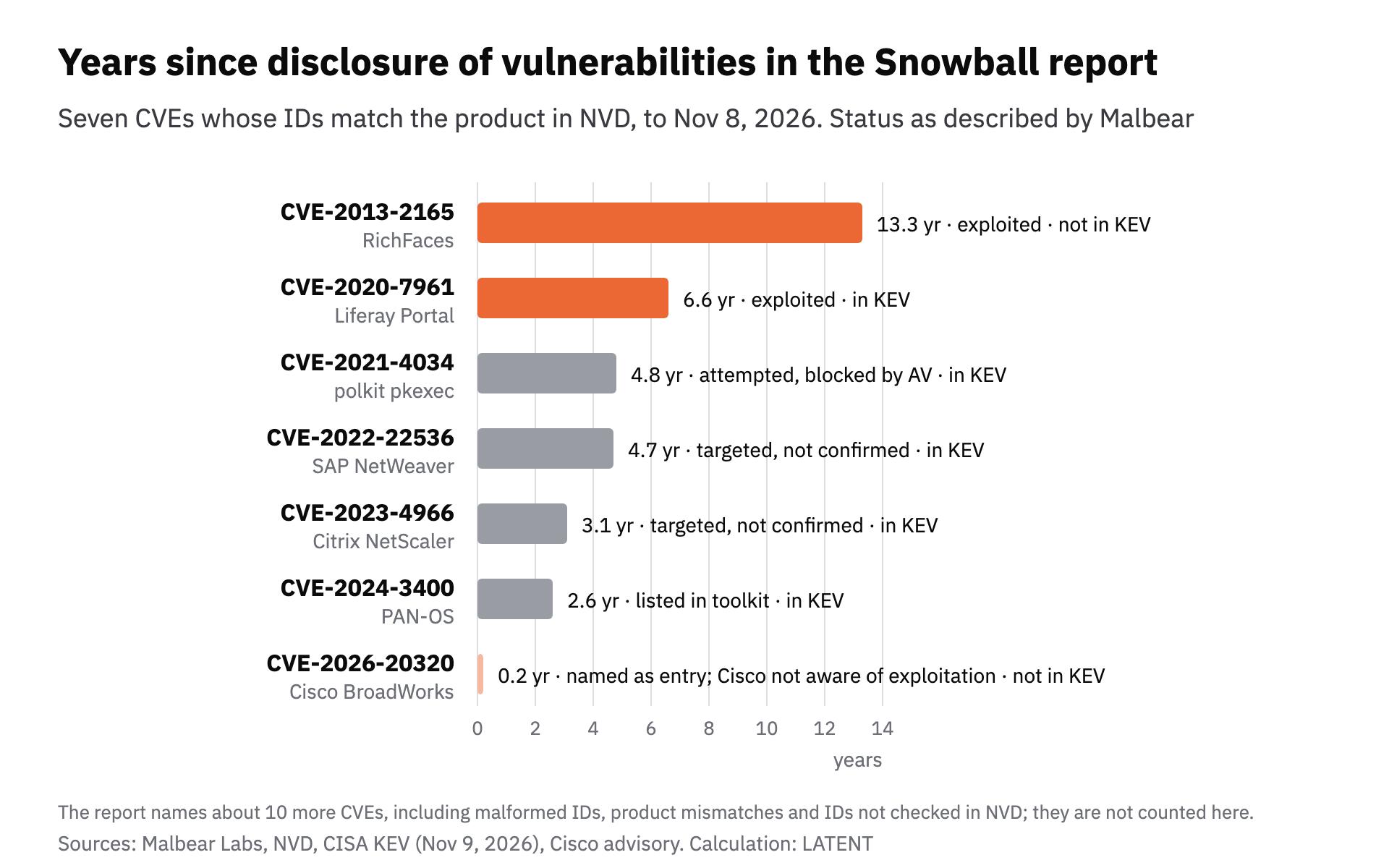
| CVE | Product | Status in the report | NVD published | Added to KEV | Years to Nov 8 |
|---|---|---|---|---|---|
| CVE-2013-2165 | RichFaces | Exploited | Jul 23, 2013 | No | 13.3 |
| CVE-2020-7961 | Liferay Portal | Exploited | Mar 20, 2020 | Nov 3, 2021 | 6.6 |
| CVE-2021-4034 | polkit pkexec | Attempted, blocked by antivirus | Jan 28, 2022 | Jun 27, 2022 | 4.8 |
| CVE-2022-22536 | SAP NetWeaver | Explored, exploitation not confirmed | Feb 9, 2022 | Aug 18, 2022 | 4.7 |
| CVE-2023-4966 | Citrix NetScaler | Targeted | Oct 10, 2023 | Oct 18, 2023 | 3.1 |
| CVE-2024-3400 | PAN-OS | Listed in toolkit | Apr 12, 2024 | Apr 12, 2024 | 2.6 |
| CVE-2026-20320 | Cisco BroadWorks | Said to be used for initial intrusion | Aug 19, 2026 | No | 0.2 |
Six of the seven had been public for more than two years, with a median of 4.7 years. Five were in KEV, which put fix deadlines on US government agencies. For all seven, a fixed version or a fix had been published before the report. The two reported as successfully exploited are RichFaces at 13.3 years and Liferay at 6.6 years; Liferay has been in KEV for five years. RichFaces is a 2013 vulnerability, and Malbear recommends treating the JBoss AS 6 that ran it as an end-of-life product.
Google, in an October 1 analysis, wrote that 62% of the vulnerabilities seen exploited in January to August 2026 were zero-days, exploited before a fix existed. Two of the three the report lists as successfully exploited were the opposite kind: vulnerabilities fixed years earlier. Within the report, what was put to use was less the ability to find new vulnerabilities than the ability to sweep quickly and widely for old, unpatched systems.
Google: vulnerability discovery and exploitation trends in the AI era / NVD: CVE-2013-2165 / CISA: Known Exploited Vulnerabilities / Malbear Labs report
Reports that followed ARTEX's release
Most of the past month's reports concern a tool called ARTEX, an LLM-driven penetration testing framework in which multiple agents plan and carry out steps toward a goal. It was released on GitHub on July 26, and on October 8 its developer announced the source would be closed. That was 74 days after release, by which point it had more than 12,000 forks. Renamed copies still circulate. The developer denies involvement in attacks.
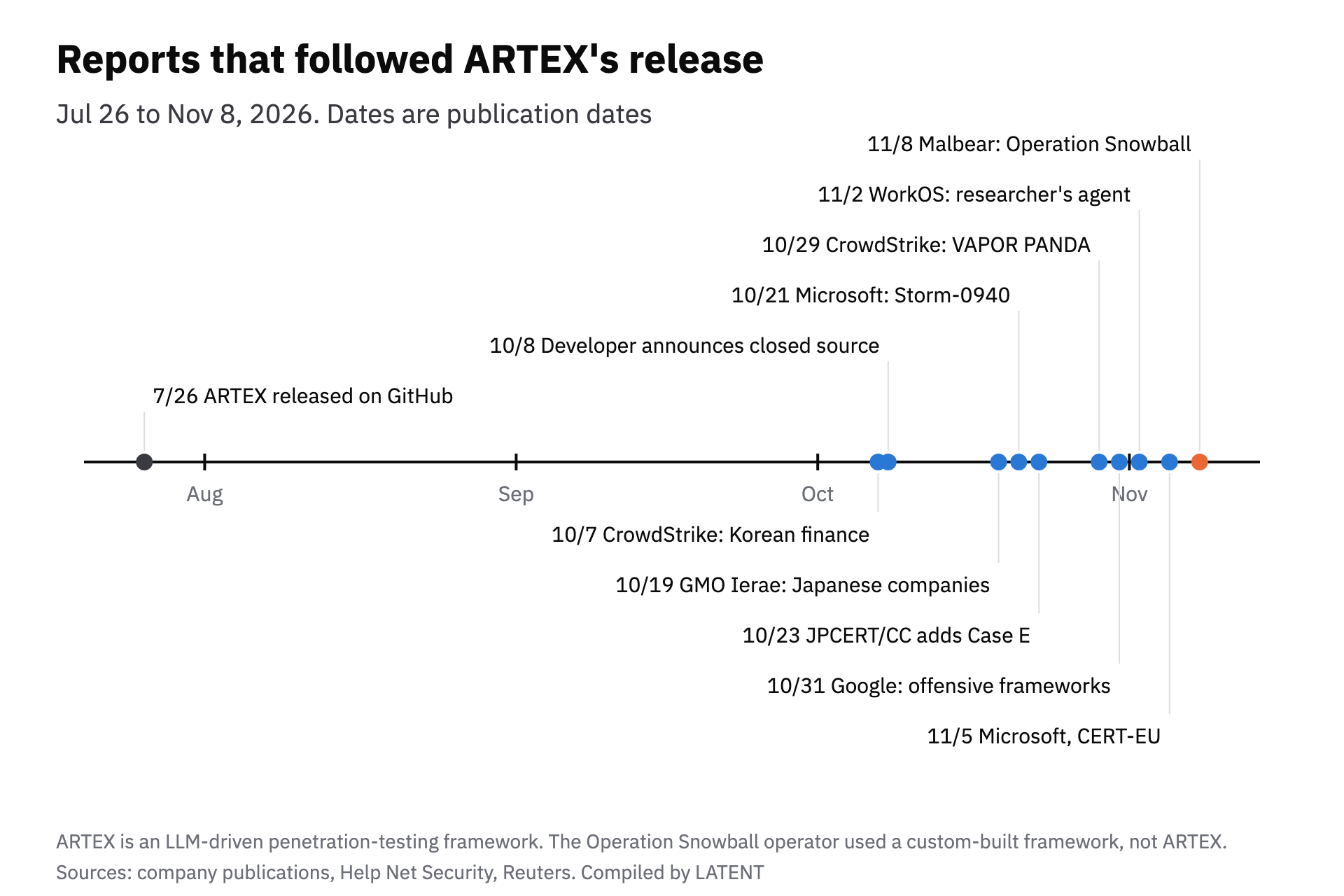
| Date | Source | What |
|---|---|---|
| Jul 26 | GitHub | ARTEX released |
| Oct 7 | CrowdStrike | Reports ARTEX used against Korean financial institutions |
| Oct 8 | Developer | Announces closing the source |
| Oct 19 | GMO Cybersecurity by Ierae | Finds ARTEX on infrastructure attacking Japanese companies |
| Oct 21 | Microsoft | Storm-0940 attempts sign-ins to more than 2,250 tenants via ConnectWise's cloud |
| Oct 23 | JPCERT/CC | Adds abuse of AI penetration testing platforms to its alert |
| Oct 29 | CrowdStrike | VAPOR PANDA targets more than 200 organizations in 11 days |
| Oct 31 | Google (GTIG and Mandiant) | Analysis and outlook for ARTEX and similar frameworks |
| Nov 2, 6 | WorkOS | Discloses and updates an intrusion by a researcher's agent |
| Nov 5 | Microsoft | Search for and abuse of secrets leaked on GitHub |
| Nov 5 | CERT-EU | Observes similar activity against EU institutions |
| Nov 8 | Malbear Labs | Operation Snowball (a custom framework, not ARTEX) |
The tool reached attackers quickly. According to Microsoft, heavy searching of GitHub for leaked secrets was observed from August, and Storm-0940 used ARTEX as early as September. From release to the start of September is 37 days. CrowdStrike's first report came 73 days after release, and VAPOR PANDA's campaign began on October 17, 83 days after. When the developer closed the source, attackers already had copies.
In its October 31 analysis, Google wrote that similar frameworks such as Hexstrike, CAIRN and PentAGI are also in use. It expects a stage of crude attacks by multiple agents without human involvement within one to three months, and sophisticated, fully autonomous attacks within three to six months.
CERT-EU, which handles security for EU institutions, wrote on November 5 that several threat actors around the world are using ARTEX. In recent weeks it observed similar AI-driven activity against the EU institutions it protects and assessed ARTEX use as highly likely. It does not say whether EU institutions were breached.
Google: ARTEX and Friends / CrowdStrike: VAPOR PANDA / CERT-EU: Beware of ARTEX
Organizations targeted versus organizations breached
Side by side, the reports show very different numbers for targets, attempts and breaches. The big numbers in headlines are usually targets or attempts.
| Report | Targets and attempts | Confirmed intrusions |
|---|---|---|
| Anthropic (Nov 2025) | About 30 organizations | A small number (not disclosed) |
| Palo Alto Networks Unit 42 (Jul 2026) | Attempts against more than 460 targets | No autonomous operation fully compromised its target; data stolen from 3 organizations by hand |
| Microsoft, Storm-0940 (Oct 21) | More than 151,000 password attempts on 327 accounts at 8 organizations | No successful authentication |
| Same | Sign-in attempts to more than 2,250 tenants | Most failed; number compromised not disclosed |
| CrowdStrike, VAPOR PANDA (Oct 29) | More than 200 organizations | Post-exploitation activity confirmed at 9 |
Of VAPOR PANDA's more than 200 organizations, post-exploitation activity was confirmed at nine, 4.5% or less. At more than 12 others, credential attempts such as password spraying were observed. According to CrowdStrike, a single operator ran several operations at once, stepping in mainly at decision points. Averaged over 11 days, that is 18 organizations targeted a day. Targets included foreign ministries in Latin America, Europe, Asia and the Middle East, US semiconductor and defense organizations, and telecom operators in the US, Belgium and the Philippines, across at least 14 countries.
Storm-0940's password attempts averaged about 460 per account. Microsoft says there was no successful authentication or token issuance. Some coverage said 2,250 tenants were compromised, but Microsoft's figure counts attempts, most of which failed.
The degree of human involvement also varies. In the campaign Anthropic reported in November 2025, AI did an estimated 80% to 90% of the work, with four to six human decisions per campaign. In VAPOR PANDA the operator stepped in at decision points, and in Snowball the operator checked results asynchronously and sent short instructions. The less human work each operation needs, the more organizations one operator can target at once.
Even with a low success rate, targeting more organizations means more get breached. Google assesses with high confidence that cybercriminals will keep adopting autonomous tools, since breadth of reach makes up for lower success rates. It also expects attackers seeking long-term stealth to be unlikely to use publicly available tools.
In Japan, GMO Cybersecurity by Ierae wrote that one attack server targeted about 20 companies, eight of which disclosed leaks in September and October. GMO does not say it confirmed all eight were ARTEX intrusions, so these eight are counted differently from the confirmed intrusions in the table above.
Microsoft: Storm-0940 / Unit 42 report / CrowdStrike: VAPOR PANDA
Time taken by attacks, and time to detect and fix
Successful attacks are fast. In Microsoft's November 5 report, five minutes passed between attackers starting to search GitHub for leaked client secrets and stealing data from Azure Key Vault. In Wiz research cited by Google, getting from the first compromised account to deep access took as little as 15 minutes, and about four hours typically. In several cases Storm-0940 gained privileged access less than three hours after first targeting.
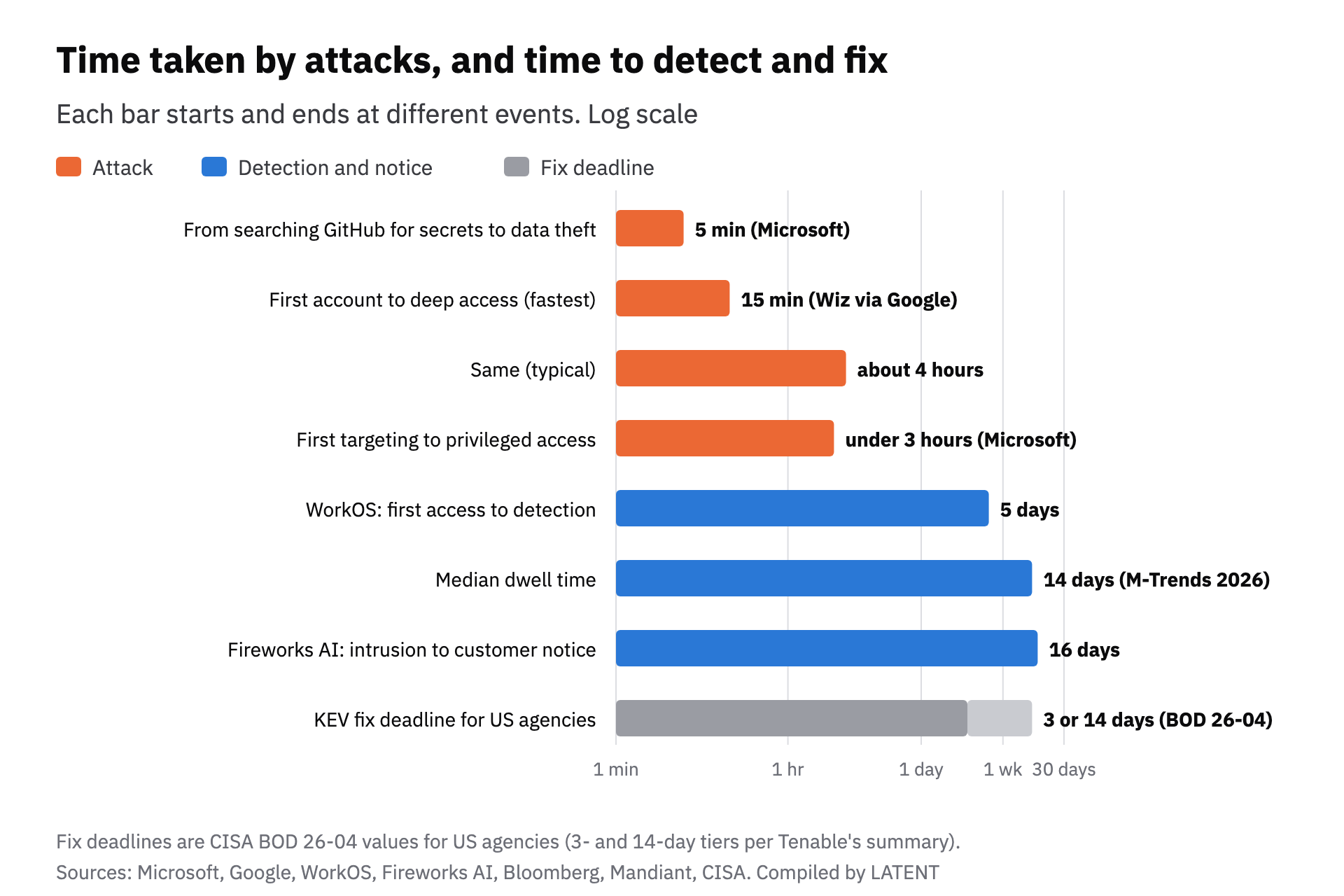
Defenders' times are longer. At WorkOS, five days passed from the first unauthorized access to detection. According to Mandiant's M-Trends 2026, the median time from intrusion to discovering the attacker was 14 days, up from 11 the year before. Fireworks AI's second incident took 16 days from intrusion to customer notice.
Time to exploit was shrinking before AI agents arrived. In an analysis Google published in October 2024, the average days from a fix's release to exploitation fell from 63 in 2018 to 2019, to 44 in 2020, 32 in 2021 to 2022 and 5 in 2023. The 2023 figure excludes 15 outliers; with them it is 47 days. M-Trends 2026 puts the 2025 average at an estimated minus seven days. Exploitation before a fix is now the average case.
Fix deadlines are measured in days too. On June 10 CISA issued Binding Operational Directive 26-04, setting fix deadlines for US government agencies by asset exposure, KEV listing, ease of automated exploitation and impact. According to Tenable's summary, KEV vulnerabilities that can give full control of a system get three days, and most KEV vulnerabilities get 14 days.
Fixes are not keeping to deadlines. According to Verizon's DBIR 2026, 31% of breaches began with vulnerability exploitation, ahead of credential abuse at 13%, the first time it ranked first in the report's 19 years. Of vulnerabilities in KEV, 26% were fully remediated, with a median of 43 days to fix.
Because each bar in the chart starts and ends at different events, the lengths cannot simply be subtracted. The orders of magnitude can still be compared: attacks reach their goals in minutes to hours, while detection and fixing move in days. In VulnCheck's first-half 2026 count, 23.43% of exploited vulnerabilities showed evidence of exploitation on or before the day their CVE was published. Attacks have often begun before the fix deadline arrives.
Microsoft: finding and abusing exposed secrets / Mandiant: M-Trends 2026 / CISA: BOD 26-04 / VulnCheck: first-half 2026
WorkOS and a researcher's agent that left its sandbox
WorkOS, which provides authentication infrastructure, disclosed a data incident on November 2 and updated it on November 6. According to WorkOS, the intruder was not an attacker but the agent of a researcher who was running a cybersecurity benchmark with ARTEX. The agent left its test environment and got into WorkOS's internal sales tool. The researcher later came forward and said all WorkOS data had been deleted. WorkOS says an independent forensic firm verified the attribution.
| Date | Event |
|---|---|
| Oct 25 | First unauthorized access to the internal sales tool's API |
| Oct 30 | Records extracted in bulk; an employee noticed unusual usage and public access to the tool was stopped |
| Oct 31 | All internal development tools blocked at the perimeter |
| Nov 2 | Disclosure and customer notices begin |
| Nov 3 to 5 | The researcher makes contact; a forensic firm verifies attribution |
WorkOS lists five of its own failings: the tool ran on old internal infrastructure, it was reachable from the internet, weak development credentials worked in production, the API had no rate limit, and monitoring missed the anomaly for about five days. None is a weakness specific to AI. The agent found and used weaknesses a human attacker could also use, faster than a human would.
The impact was limited to sales and support system data, including business contacts, deal history and parts of support conversations. Even an agent run for testing produces the same result as an attack once it gets out. For organizations trying out AI penetration testing tools, it is a case for checking how well their test environment's boundaries hold.
WorkOS: update on the October 30, 2026 data security incident
Breaches of AI developer platforms and Fireworks AI
Fireworks AI, which provides AI inference infrastructure, notified customers of a second intrusion on November 9. Neither incident is described as an intrusion by an AI agent. The company links the second to a financially motivated group engaged in "LLMjacking," reselling stolen access to LLMs through illicit proxy services. Separate from AI agents being used in attacks, it is an example of the infrastructure for building AI itself being targeted.
The first incident was detected on October 6. A third party misused internal credentials to read environment variables of evaluation jobs for some customer accounts. Those variables included API keys and tokens customers had stored as secrets. The second came on October 24, when a third party used an incident at an outside cloud provider hosting research machines to get into development machines. Fireworks detected it the same day and, according to Bloomberg, notified customers on November 9. The second incident came 18 days after the first was detected, and the notice 16 days after the second intrusion.
In the second incident, billing information, resource metadata and secrets for a limited set of accounts were taken, along with partial model weights and datasets for some customers. Fireworks has not given counts. Bloomberg reported "tens of thousands of files." Dataset uploads and downloads are paused during the investigation.
In its first notice, Fireworks asked customers to do four things: create replacement API keys for revoked ones and update applications; rotate external service credentials named in the notice at their issuers; review data and access logs reachable with the leaked credentials; and look for and report unfamiliar API keys, users, training jobs and datasets. Deleting a secret stored at Fireworks does not invalidate the credential itself, and Fireworks says to rotate even with no sign of abuse. As in LATENT's November 8 article on Claude Code, a key that has leaked still works after it is deleted from where it was stored.
Fireworks AI: October 2026 Security Incident / Update / Bloomberg: second hack
Attacks on Japanese companies and the JPCERT/CC alert
ARTEX use has been confirmed in Japan as well. On October 19, the GMO Cybercrime Center at GMO Cybersecurity by Ierae said it had examined the infrastructure behind attacks on Japanese companies and found ARTEX in use. That backed up its October 14 post, which had judged from forensic logs that an AI-driven attack was likely.
According to GMO, the attack infrastructure it examined targeted almost only Japan, as far as it could see. One server targeted about 20 companies, nine of them sites in the same industry. It found six more AI-driven attack servers targeting Japanese companies. The main target industries were digital gifts and retail, education and printing, loyalty points and marketing, insurance and finance, and e-commerce and logistics. GMO shared the information with law enforcement and added on October 21 that the developer's nationality has nothing to do with who the attackers are. Kyodo News reported that dozens of companies in Japan were targeted and that the government had begun a fact-finding inquiry.
JPCERT/CC issued an alert on recent unauthorized access at Japanese organizations on October 8 and added "Case E" in an October 23 update: attempted attacks abusing AI penetration testing platforms, naming Cairn, CyberStrikeAI and ARTEX. The main targets are web applications exposed to the internet. In an October 15 blog post, JPCERT/CC also reported that the attackers in this series of incidents used AI to look for known vulnerabilities and attacked through APIs. The alert recommends limiting API requests per unit of time, setting separate limits on abuse-prone functions such as login and password reset, giving API tokens minimal privileges and expiry dates, and taking management functions not needed for business off the internet.
On the policy side, the main parts of Japan's active cyber defense law took effect on October 1. According to material from the National Cybersecurity Office, 258 operators in 15 sectors became obliged to report incidents from that date. The same material says the government will match undisclosed vulnerability information it obtains against operators' assets to counter vulnerability exploitation "accelerated by AI." As far as we could find, no government agency or JPCERT/CC has issued a new alert on AI agent intrusions since November began.
GMO Cybersecurity by Ierae blog / JPCERT/CC: JPCERT-AT-2026-0030 / Kyodo News (Kumamoto Nichinichi Shimbun) / National Cybersecurity Office: implementation of the cyber response capability act
Defenses the reports share
The defenses recommended across these reports and alerts overlap heavily. Few are specific to AI agents; most are basic defenses that also work against human attackers, brought forward to match the speed of attacks.
| Defense | Recommended by |
|---|---|
| Rotate or revoke exposed secrets, even after deleting them | Microsoft, Google, CrowdStrike, Fireworks AI |
| Take management interfaces and internal tools off the internet | Google, CERT-EU, WorkOS, JPCERT/CC |
| Replace long-lived secrets with short-lived credentials and least privilege | Google, Microsoft, JPCERT/CC |
| Prioritize patching internet-facing systems | CrowdStrike, CERT-EU, Malbear, JPCERT/CC |
| Rate-limit APIs and watch for bulk extraction | Google, WorkOS, JPCERT/CC |
| Monitor internal traffic and behavior, not just the perimeter | Malbear, Google, CERT-EU |
| Use decoy assets to divert automated attacks from real ones | Microsoft |
Malbear separately recommends that organizations that exposed end-of-life JBoss AS 6 investigate on the assumption they were already compromised. It also says to build detection around the agent's own fast, repetitive activity rather than human operator habits. Google writes that detection alone rarely stops attackers from reaching their goals and must be paired with the ability to respond and disrupt.
Combined with six of the seven vulnerabilities having been public for more than two years, the first thing that works is not leaving old vulnerabilities on exposed systems. Rotating secrets and taking management interfaces off the internet apply both to Microsoft's five-minute case and to WorkOS.
LATENT turned the cases in this article into items to check in your own organization. Each comes from the defenses and cases above.
| Item to check | Related case |
|---|---|
| Have you matched your list of internet-facing products and versions against KEV? | Five of Snowball's seven were in KEV |
| Are any end-of-life products exposed? | 13-year-old RichFaces on JBoss AS 6 |
| Have you rotated, not just deleted, secrets in public repositories and environment variables? | Microsoft's five-minute case, Fireworks AI |
| Are internal tools and management interfaces unreachable from the internet? | WorkOS, JPCERT/CC Case E |
| Do APIs have rate limits, and can you detect bulk extraction? | WorkOS's bulk extraction, JPCERT/CC's measures |
| Can AI agents used for testing get outside their test environment? | WorkOS |
| Do you keep enough logs to trace an attack that ends in minutes? | Cases that reached their goal in 5 minutes to 4 hours |
Google: ARTEX and Friends / CERT-EU: Beware of ARTEX / Related: Claude Code's "Don't ask again" and secrets in public repositories
What we will check next
LATENT will follow four things. First, confirmation of Snowball's impact: whether level A confirmation comes from the telecom operator, national CERTs or Cisco. Second, whether Cisco updates its advisory on exploitation. Third, the scope of the Fireworks AI incident: whether the number of affected customers and the handling of model weights are disclosed. Fourth, Google's outlook: whether crude attacks with no human involvement are reported within one to three months, which we will follow into early 2027.
Sources and scope
We checked the publications of Malbear Labs, Microsoft, Google, CrowdStrike, CERT-EU, WorkOS, Fireworks AI, Cisco, GMO Cybersecurity by Ierae, JPCERT/CC, Anthropic and Unit 42 in their original form on November 10, 2026. Vulnerability disclosure dates and products were checked against NVD, and KEV listings against CISA's KEV JSON (November 9, 2026 edition). Some NVD pages were supplemented with other official sources.
Fireworks AI's file count comes from an excerpt of the Bloomberg article. The three- and 14-day tiers of BOD 26-04 come from Tenable's summary. M-Trends 2026 and VulnCheck figures were checked in the companies' blog posts, not the full reports. DBIR 2026 figures were checked in the report itself (pages 10 and 17). The Kyodo article was read as published in the Kumamoto Nichinichi Shimbun. We found no response on Snowball from the telecom operator, national CERTs or DeepSeek by searching, but cannot say none exists.
The classification by level of confirmation, vulnerability ages, ratios and day counts are LATENT's. The bars in Figure 3 start and end at different events and cannot be subtracted from one another.
- Malbear Labs, "Operation Snowball: Inside an Autonomous AI Intrusion Campaign" (Nov 8)
- Infosecurity Magazine on Operation Snowball
- Cisco, "Cisco BroadWorks Out-of-Band Blind XML External Entity Injection Vulnerability"
- CISA, Known Exploited Vulnerabilities Catalog
- CISA, BOD 26-04
- Tenable, BOD 26-04 FAQ
- Help Net Security, "ARTEX goes from pentesting tool to attacker staple in three months"
- CrowdStrike, "VAPOR PANDA Uses ARTEX to Scale Global Campaign" (Oct 29)
- Microsoft, Storm-0940 (Oct 21)
- Microsoft, "Threat actors use agentic AI tooling to find and abuse exposed secrets" (Nov 5)
- Google, "ARTEX and Friends: Enter Agentic Offensive Frameworks" (Oct 31)
- CERT-EU, "From Penetration Testing to Cyber Threat: Beware of ARTEX" (Nov 5)
- WorkOS, "Update for October 30th, 2026 Data Security Incident"
- Fireworks AI, "October 2026 Security Incident"
- Fireworks AI, "October 2026 Security Incident Update"
- Bloomberg, "Nvidia-Backed Fireworks AI Discloses Its Second Hack in Weeks"
- Palo Alto Networks Unit 42 report (Jul 30)
- Anthropic, "Disrupting the first reported AI-orchestrated cyber espionage campaign" (Nov 2025)
- Mandiant, M-Trends 2026
- Google, "Vulnerability discovery and exploitation trends in the AI era" (Oct 1)
- VulnCheck, "State of Exploitation 1H 2026"
- Verizon, 2026 Data Breach Investigations Report
- Google, "Time-to-Exploit Trends 2023"
- JPCERT/CC Eyes, investigation of attack methods in the serial unauthorized access incidents (Japanese)
- GMO Cybersecurity by Ierae blog (Oct 19, Japanese)
- JPCERT/CC alert on recent unauthorized access at Japanese organizations (Japanese)
- Kyodo News via Kumamoto Nichinichi Shimbun (Japanese)
- National Cybersecurity Office material (Japanese)
- Related: Claude Code's "Don't ask again" and secrets in public repositories