Chips & Infrastructure · · Team LATENT
Data center pause pledges after the US midterms and the chip selloff: 256GW that could stop, and the roughly 11GW expected to stop
In the November 3 US midterms, governor candidates who backed pauses or conditions on data center construction won in Texas, Georgia, Ohio and elsewhere, and the Philadelphia Semiconductor Index fell 12.25% on November 5. The pause states are said to hold 40% of US capacity, but most of it is proposals that have not broken ground. We converted an analytics firm's figures into GPU counts and investment dollars, and calculated how much is actually expected to stop, how household power prices moved by state, and where OpenAI's new commitments overlap with governors' conditions.
On November 4, at a WSJ technology conference in Napa, California, Meta President Dina Powell McCormick said building data centers is "going to be harder." Candidates who had made data centers a campaign issue had won governor races in several states the day before. She also said every hyperscaler is now thinking about whether it needs to build outside the United States.
The next day, the Nasdaq 100 fell 6.36% and the Philadelphia Semiconductor Index (SOX) fell 12.25%. For both, it was the largest one-day drop since March 16, 2020. On November 6 in Tokyo, the Nikkei Stock Average fell 3,643 yen.
A figure spread through the coverage: 40% of planned capacity could stop. This article breaks that 40% into its parts and converts it into GPU counts and investment dollars. It also puts numbers on the capacity actually expected to stop, household power prices by state, and the commitments companies made.
We checked the figures on November 8. Stock moves were calculated from Yahoo Finance daily closes and checked against AP's daily tables; they are not official exchange figures. The capacity breakdown comes from Modo Energy's November 4 analysis. Conversions into GPU counts and dollars are LATENT's estimates, and each section states its assumptions. This article does not recommend buying or selling any security.
Gizmodo: Meta's president / CNBC: chip stocks on November 5 / Modo Energy analysis
Key takeaways
- On November 5 the Nasdaq 100 fell 6.36% and the SOX fell 12.25%, both the largest drops since March 16, 2020. Over November 4 to 6, the market value of 12 chip stocks fell by about $1.23 trillion, while the four hyperscalers gained about $196 billion. Sellers of components and power fell, and the builders of data centers rose.
- Modo Energy counts 256GW, or 40% of the US capacity it tracks, in 11 states with pause or condition pledges. But 83% of the 242GW not yet operating there is proposals that have not broken ground, and of the capacity Modo expects to be built, about 11GW would stop. Once projects can move to other states, the 2030 shortfall in US capacity is only 3GW.
- Converted into GPUs and dollars, about 11GW is roughly 4.1 to 4.8 million GPUs and $550 billion to $660 billion in total. Nvidia's share is $385 billion to $440 billion, about the same as the roughly $447 billion in market value Nvidia lost on November 5 alone. Electricity for 1GW costs $0.6 billion to $1.1 billion a year, only 1 to 2-plus percent of the construction cost.
What happened from November 3 to 6
Table 1 lists the main events in the three days after the vote. Dates are US dates, except for the Tokyo market.
| Date | Event |
|---|---|
| Nov 3 (Tue) | Midterm voting. 41 ballot measures related to data centers were decided in 10 states |
| Nov 4 (Wed) | Wins were reported for candidates backing pauses or conditions, including Gina Hinojosa in Texas, Keisha Lance Bottoms in Georgia and Amy Acton in Ohio. Meta's president said building will be harder. Power stocks fell, with Vistra and NRG down about 13% |
| Nov 5 (Thu) | The Nasdaq 100 fell 6.36% and the SOX 12.25%. OpenAI published a document of commitments to communities. Google announced a $17 billion data center in Wyoming. The FT reported that Microsoft had not exercised an option to expand its contract with Nscale |
| Nov 6 (Fri) | The Nikkei closed at 57,434.77 yen, down 3,643.13 yen. In the US, the Nasdaq 100 rose 1.35% and the SOX 4.21%. Microchip, which reported results the night before, fell 10.02% |
November 4 was an up day for the market as a whole. The S&P 500 rose 1.58% and the Dow 3.03%. The biggest losers that day were power stocks and data center operators. The SOX fell 3.13%. Chip stocks fell hard on November 5, when a weak outlook from Qualcomm the night before added to the pressure.
AP daily table (Nov 4) / AP daily table (Nov 5) / Reuters: Microsoft and Nscale
Chip stocks versus hyperscalers
Table 2 shows the main indexes. Compared with every trading day since 2020, the November 5 drops in the Nasdaq 100 and the SOX were the largest since March 16, 2020. They also exceeded the tariff selloff of April 2025, when the largest drops were 6.07% for the Nasdaq 100 on April 4 and 9.88% for the SOX on April 3.
| Index | Nov 4 | Nov 5 | Nov 6 | 3 days |
|---|---|---|---|---|
| Nasdaq Composite | +1.44% | -5.52% | +1.09% | -3.12% |
| Nasdaq 100 | +0.91% | -6.36% | +1.35% | -4.22% |
| S&P 500 | +1.58% | -4.36% | +0.31% | -2.54% |
| Dow | +3.03% | -3.44% | -0.46% | -0.97% |
| SOX | -3.13% | -12.25% | +4.21% | -11.42% |
CNBC reported the November 5 drop as 5.5%, while some news roundups said 6.4%. The first is the Nasdaq Composite and the second the Nasdaq 100; only the index differs.
The gaps were wider stock by stock. Nvidia fell 9.26% on November 5, which works out to about $447 billion of market value. CNBC reported "almost $450 billion." AMD fell 17.26%, Micron 17.46%, Broadcom 10.43% and TSMC's American depositary receipts 10.78%.
Figure 1 shows the change in market value by group. The 12 chip stocks lost about $342 billion on November 4 and about $1.32 trillion on November 5, then regained about $436 billion on November 6. The three-day total was a loss of about $1.23 trillion. The four hyperscalers (Microsoft, Amazon, Alphabet and Meta) gained about $557 billion on November 4. They lost about $352 billion on November 5, but over three days they were up about $196 billion.
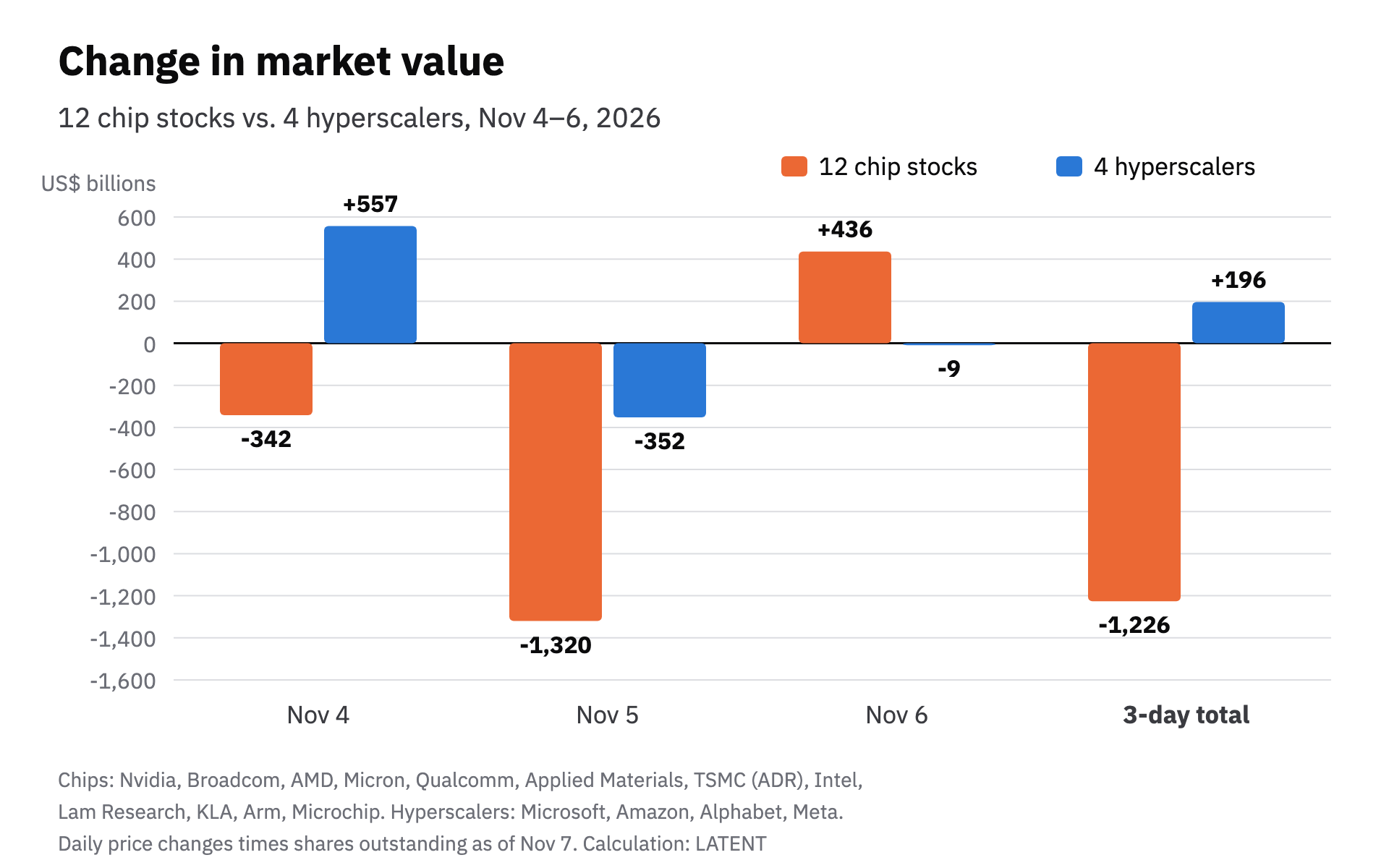
Shares of the companies that build data centers rose, and shares of those selling them components and power fell. Table 3 shows selected stocks.
| Stock | Business | Nov 4 | Nov 5 | Nov 6 |
|---|---|---|---|---|
| Nvidia | Chips | -3.17% | -9.26% | +2.78% |
| Micron | Chips | -7.00% | -17.46% | +5.12% |
| Vertiv | Power and cooling equipment | -12.89% | -14.02% | +3.47% |
| Vistra | Power generation | -13.83% | -6.15% | +10.55% |
| NRG | Power generation | -13.52% | -3.24% | +9.61% |
| CoreWeave | Compute rental | -9.90% | -9.83% | +6.28% |
| Oracle | Cloud | -1.95% | -6.93% | +0.82% |
| Microsoft | Hyperscaler | +6.68% | -3.58% | -0.99% |
| Amazon | Hyperscaler | +6.12% | -2.19% | -0.35% |
On November 4, the day after the election, the largest drops were in power generators, power equipment makers and compute rental companies. The big drop in chip stocks came the following day. On November 4, Microsoft and Amazon each rose more than 6%.
As LATENT calculated in its November 1 article, the four hyperscalers' capital spending in July to September exceeded their operating cash flow by about $26 billion. If construction slows, the four companies spend less cash. investingLive argued that the market welcomes a slower buildout by the hyperscalers.
Market value changes are estimates made by multiplying daily price changes by share counts as of November 7. The 12 chip stocks are Nvidia, Broadcom, AMD, Micron, Qualcomm, Applied Materials, TSMC's ADRs, Intel, Lam Research, KLA, Arm and Microchip.
CNBC: chip stocks on November 5 / investingLive / Related article: Where the money for AI comes from
41 ballot measures and governors' pledges
The election results came through two channels, local ballot measures and governor races. Coverage lumped both together as a backlash against data centers, but they differ in scale.
We checked the ballot measures against Ballotpedia's table. On November 3, 41 measures were decided in 10 states, and 40 went the restrictive way. Table 4 shows the breakdown.
| State | Measures | Result |
|---|---|---|
| Ohio | 21 | All 21 went the restrictive way: 15 restrictions passed, including bans and zoning rules, and 6 pro-development measures failed |
| Illinois | 7 | 2 restrictions passed and 5 pro-development measures failed |
| Maine | 4 | A size-based ban and three 180-day pauses all passed |
| Kansas | 3 | All bans passed. Ottawa banned projects above 25MW |
| California, Florida, Wisconsin | 1 each | Bans or resident-approval requirements passed |
| New Jersey, Nevada | 1 each | Pro-development measures failed |
| North Dakota | 1 | Harwood's extra-review requirement failed, the only one of the 41 to favor developers |
Ohio's 21 measures are 51% of the 41. Many set size thresholds; four Ohio municipalities, including Defiance, and Ottawa, Kansas targeted projects above 25MW. Across 2026, at least 50 measures were held in 13 states, and as of November 4, 46 of the 47 decided had gone the restrictive way.
In the governor races, Modo Energy classified 11 states as pause states. Five winners back an immediate pause (Texas, Georgia, New Mexico, Maine and New Hampshire). Three back a conditional pause (Ohio, Michigan and Wisconsin), and three states already have a pause in effect (New York, Oregon and Illinois). Table 5 shows the pledges in the three largest states.
| State | Winner | Pledge | How it would be carried out |
|---|---|---|---|
| Texas | Gina Hinojosa | Halt approvals for all data centers until laws are passed. Calls for data centers to pay for transmission, proof that household power and water bills will not rise, an end to subsidies and a ban on nondisclosure agreements | Takes office January 19, 2027. Permanent rules need the legislature |
| Georgia | Keisha Lance Bottoms | Pause new construction statewide and study effects on communities, the environment and power bills. She said the details are not yet set | The utility regulator is elected, and a newly elected commissioner supports a pause longer than a year |
| Ohio | Amy Acton | Stop new projects that do not meet conditions: paying their own power, gas and water costs, ending nondisclosure agreements with local officials, union construction and operation, environmental standards and clawback clauses on incentives, among others | It is unclear how far approval from the Republican-majority legislature is needed |
The two channels barely overlap by state. Texas and Georgia had no ballot measures on November 3. Only four states appear both among the 10 ballot-measure states and Modo's 11: Ohio, Maine, Wisconsin and Illinois. Ballot measures stop individual projects town by town or county by county. A governor's pledge covers a whole state's plans. The second has the larger effect on capacity.
SemiAnalysis estimated the scale of local restrictions in September. More than 300 towns, cities and counties had adopted pauses, including 45 in Michigan and 40 in Ohio. About 20GW of plans fell within them, but only about 1.5GW (7.6%) would actually be delayed, or about 2.3GW overall. Local pauses are numerous but stop little capacity.
Ballotpedia: data center ballot measures, 2026 / Texas Tribune: Hinojosa's win / WABE: Georgia's governor race / Signal Ohio: Acton's plan
Inside the 40% and the roughly 11GW expected to stop
Modo Energy tracks 633GW of US data centers. Of that, 165GW (26%) sits in the five states whose governors back an immediate pause. Adding conditional pauses and pauses already in effect brings the 11 states to 256GW (40%). That is the 40% that spread through the coverage.
Figure 2 narrows the 256GW step by step. Of the 256GW in the 11 states, 242GW is not yet operating. Of that, 41GW is under construction and 201GW is proposed, so proposals make up 83%. According to Modo, in every pause state at least 61% of tracked capacity is only announced or waiting for a grid connection.
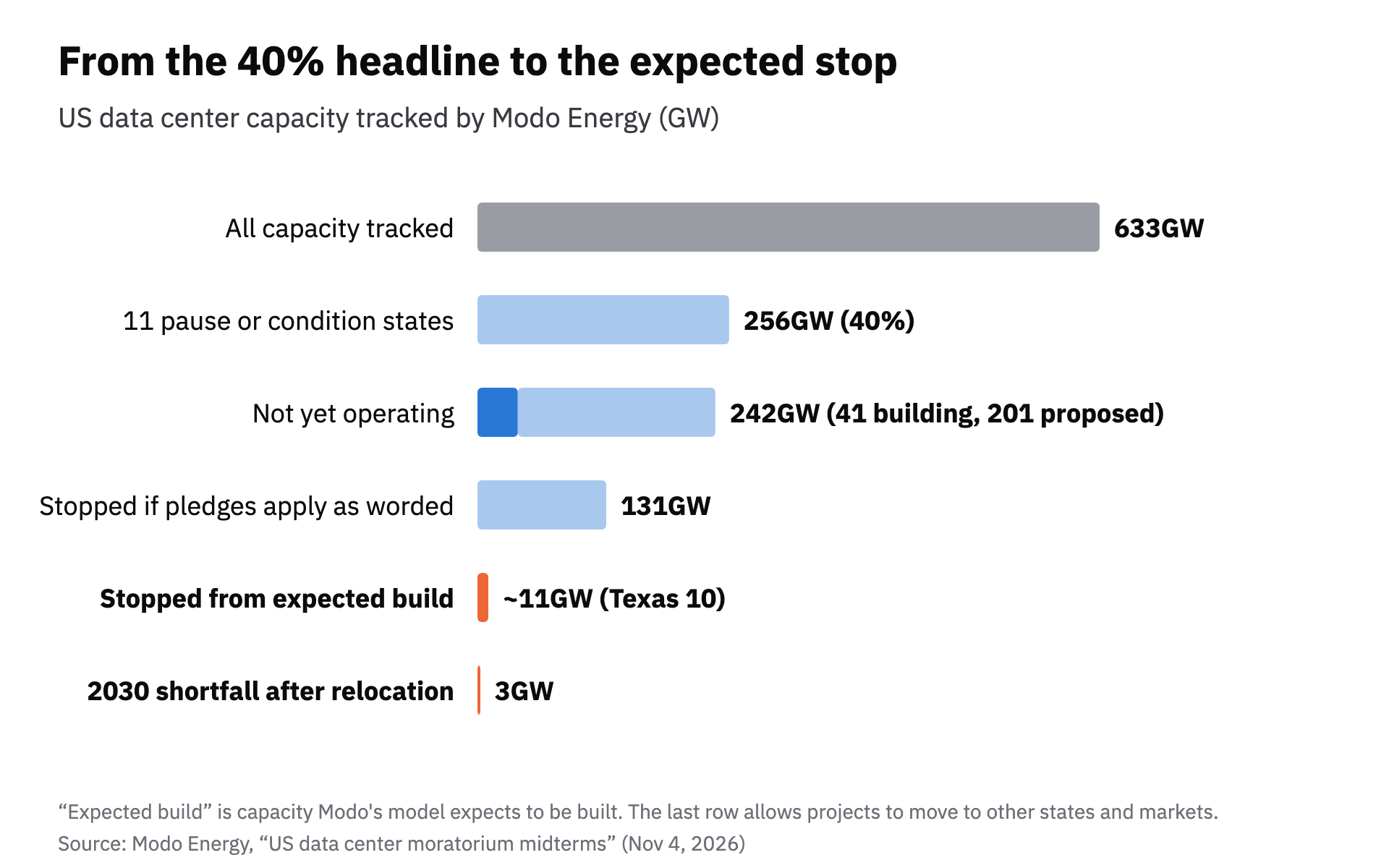
Applying the pledges as worded, 131GW of the 242GW would stop, 14GW would be delayed and 54GW would face new conditions. Many proposals, though, were unlikely to be built anyway. Grid Strategies says utilities expect peak demand to grow by 166GW by 2030, about 90GW of it from data centers. Its own market analysis puts the data center share at around 65GW, meaning utility forecasts may be up to 40% too high.
Modo recalculated the effect using only the capacity its forecast expects to be built. On that basis, about 11GW would stop (10GW of it in Texas), about 1GW would be delayed and about 4GW would face new conditions. About 11GW is 4.3% of 256GW.
If none of the stopped capacity moved to other states, Modo's 2030 US forecast would fall from 147GW to 136GW. Allowing projects to move to other states and markets, the shortfall is 3GW in 2030 and 4GW in 2035, about 2% of the forecast.
Table 6 lists other estimates. Most of the difference comes from different denominators.
| Estimate | Figure | Denominator |
|---|---|---|
| Modo Energy | 40% (256GW) | All 633GW tracked nationwide, including operating capacity |
| The National (Cleanview data) | 37% (Texas 22.8%) | Planned capacity (GW not given) |
| Goldman Sachs economist | About 45% | Planned capacity (original not found) |
| SemiAnalysis | About 30GW | Net US additions of 62.2GW in 2028 |
| UBS | About 30% (Texas 18GW) | Capacity additions in 2028 |
| Jefferies | About 13GW | Announced projects in Texas |
| Modo Energy (forecast model) | About 11GW | Capacity Modo expects to be built |
The 40% and 45% are shares of capacity that includes plans that have merely been announced. Estimates limited to additions through 2028 come to about 30GW, and Modo's estimate limited to expected construction is about 11GW. Most of the figure that spread the day after the vote was plans that may never be built.
Modo Energy analysis / The National / investingLive: Goldman Sachs's 45% / SemiAnalysis / Finimize: UBS estimate
The scale in GPUs and investment dollars
In gigawatts, the numbers are hard to compare with the market drop. So we converted capacity into GPU counts and dollars.
GPU counts are based on facility power per GPU, worked back from real projects. Nscale's Texas site for Microsoft plans to run about 104,000 GB300s on about 240MW, or about 2.3kW per GPU. OpenAI and Oracle's site in Abilene, Texas runs more than 450,000 GB200s on 1.2GW, or about 2.7kW per GPU. A GB300 NVL72 rack holds 72 GPUs at 135kW, or about 1.9kW per GPU inside the rack. Including cooling and power distribution, we used 2.3kW to 2.7kW of facility power per GPU. On that basis, 1GW is about 370,000 to 430,000 GPUs.
We used two dollar figures. According to Cushman & Wakefield, building and power infrastructure, excluding chips, averages about $17.6 million per MW in the US and Canada, or about $17.6 billion per GW. For the total including chips, we used the $50 billion to $60 billion per GW given by Nvidia CEO Jensen Huang. He put Nvidia's share at about $35 billion, and in October 2026 also said "two gigawatts to us is like $80 billion." We used $35 billion to $40 billion per GW for Nvidia's share. Table 7 shows the results.
| Capacity | GPUs | Building and power | Total | Nvidia's share |
|---|---|---|---|---|
| 256GW in the pause states | 95 million to 111 million | About $4.5 trillion | $12.8 trillion to $15.4 trillion | $9.0 trillion to $10.2 trillion |
| 41GW under construction in the 11 states | 15 million to 18 million | About $722 billion | About $2.1 trillion to $2.5 trillion | $1.4 trillion to $1.6 trillion |
| About 30GW of 2028 additions | 11 million to 13 million | About $528 billion | $1.5 trillion to $1.8 trillion | $1.05 trillion to $1.2 trillion |
| About 11GW expected to stop | 4.1 million to 4.8 million | About $194 billion | $550 billion to $660 billion | $385 billion to $440 billion |
| 3GW shortfall in 2030 after relocation | 1.1 million to 1.3 million | About $53 billion | $150 billion to $180 billion | $105 billion to $120 billion |
The 256GW comes to $12.8 trillion to $15.4 trillion in total. The four hyperscalers' combined 2026 capital spending outlook is about $720 billion to $740 billion, so this equals 17 to 21 years of it. The 40% figure does not describe investment in the next few years.
The roughly 11GW expected to stop comes to $550 billion to $660 billion in total. That is 74% to 92% of the four companies' 2026 capital spending, close to a full year. Nvidia's share of it is $385 billion to $440 billion, about the same as the roughly $447 billion in market value Nvidia lost on November 5 alone.
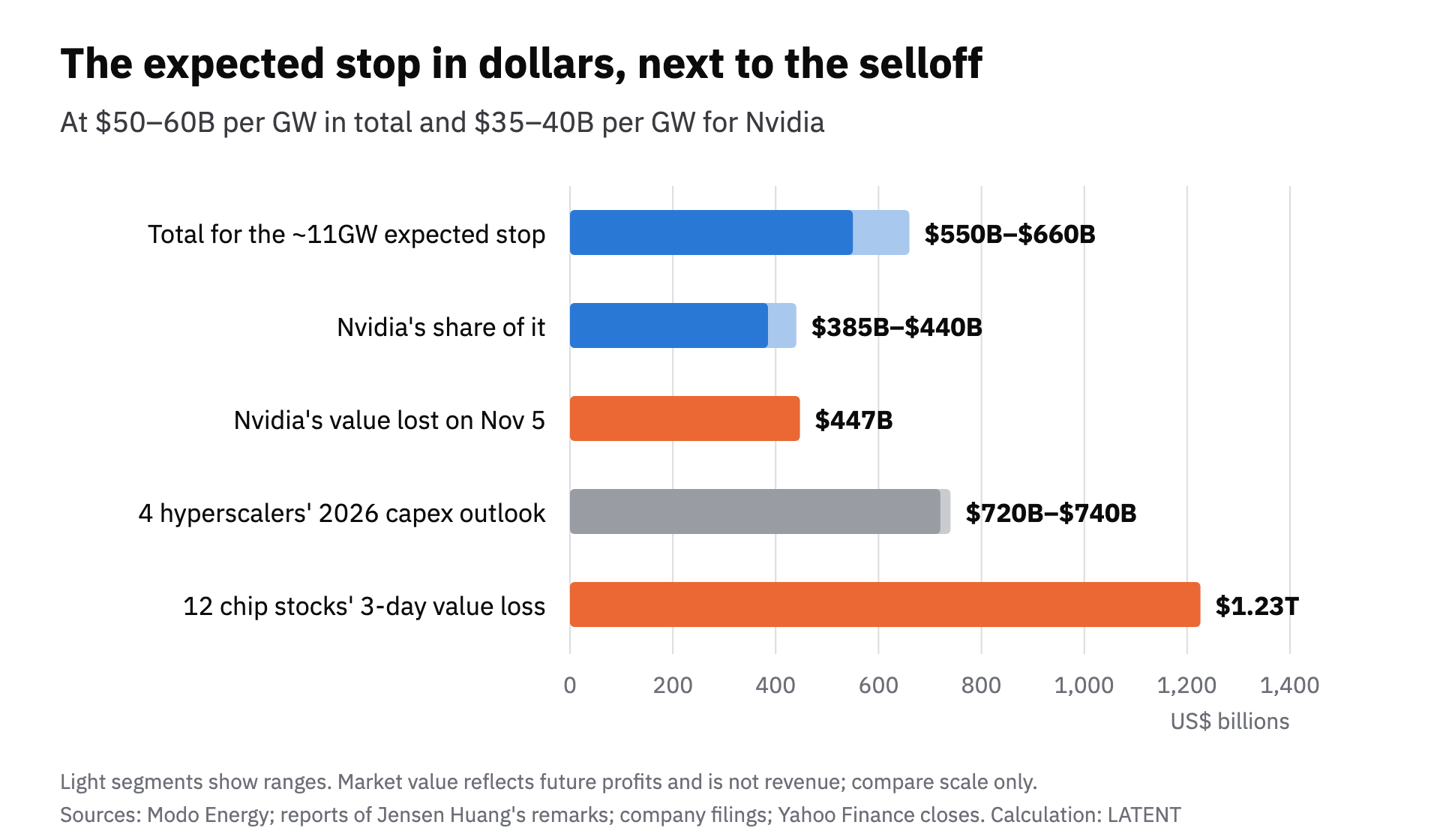
In energy terms, about 11GW running for a full year uses about 96TWh. According to a US Department of Energy report, US data centers consumed 176TWh in 2023. The capacity expected to stop alone equals 55% of all data center consumption in 2023. In dollars, it is about the same as the $600 billion in total compute spending through 2030 that OpenAI showed investors in February.
Market value is a valuation of many years of future profits, and it is a different kind of number from revenue. Only the scale can be compared. On scale alone, Nvidia's November 5 loss in market value is close to all the revenue Nvidia would earn from the capacity Modo expects to stop. In Modo's calculation, most of that capacity moves to other states. The shortfall left after relocation is 3GW, for which Nvidia's share would be $105 billion to $120 billion.
Nscale announcement / Lenovo Press: GB300 NVL72 / TIKR: Huang's remarks / Related article: Where the money for AI comes from
Texas, where the plans concentrate
Of the roughly 11GW expected to stop, 10GW is in Texas. The size of Texas's plans shows up in figures from ERCOT, the state's grid operator. According to Governor Abbott's August letter, large-load interconnection requests to ERCOT total about 474GW, about 90% of them data centers. That is more than five times ERCOT's record peak demand.
Modo tracks 124GW in Texas, operating and planned combined. ERCOT's requests are 3.8 times that. In September, ERCOT sent 362 requests totaling about 192GW to 194GW into a batch review. Seventeen requests, about 6.6GW, have passed the stability assessment, to be brought online over about five years. That 6.6GW is 1.4% of 474GW. Only a small part of the 474GW in requests has cleared grid review so far.
In Texas, construction had begun to stall before the election. On August 3, Governor Abbott halted new grid connections for data centers and ordered an audit. The state environmental agency froze permits on September 21. ERCOT plans to deliver its audit report on December 10.
Hinojosa pledged: "When I am governor I will issue a moratorium — a ban — on all data center approvals until laws can be passed." She takes office on January 19, 2027, and the legislature's regular session runs from January 12 to May 31. Modo expects that if the pause ends with the session in May, the batch review slips to summer 2027, a delay of only six to nine months. A one-year ERCOT pause would leave a shortfall of about 9GW in 2035, and a pause of two years or more about 13GW.
Large sites under construction in Texas include Nexus Hubbard in Hill County (6,400MW), Stargate Frontier (1,820MW) and Stargate Abilene (1,200MW). Vistra and NRG, which fell sharply on November 4, operate many power plants in Texas.
Utility Dive: ERCOT audit / Reuters: Texas data centers / Hinojosa campaign release / Cleanview: Texas data centers
Household power prices by state
Power bills come up again and again in the candidates' pledges. Using US Energy Information Administration (EIA) data, we calculated the one-year change in residential power prices by state (Figure 4). The comparison is August 2026 against August 2025, and 2026 values are preliminary.
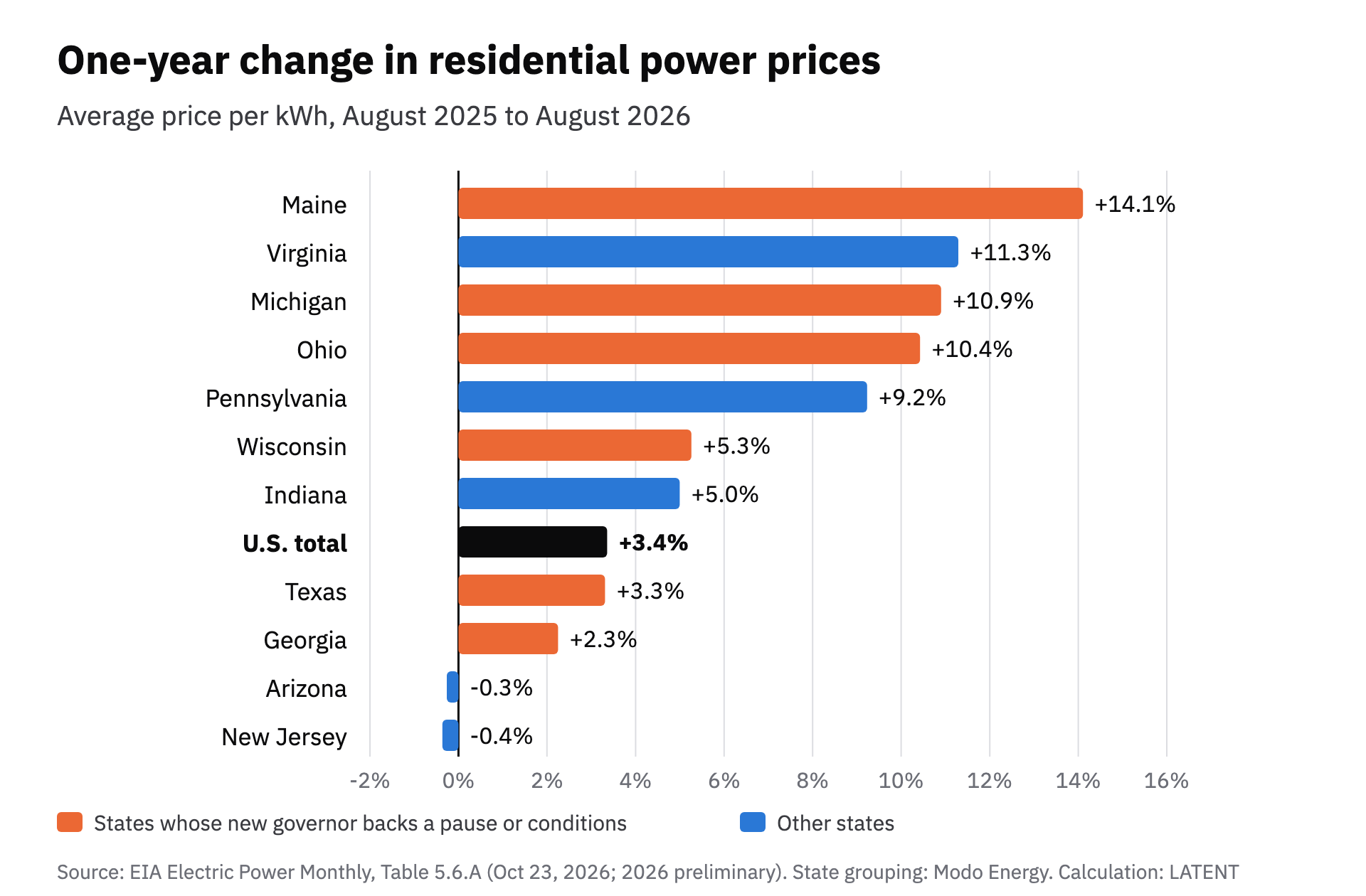
The US average rose 3.4%, from 17.57 cents to 18.16 cents per kWh. Prices rose 10.4% in Ohio, which had 21 ballot measures, and 14.1% in Maine, which had four. They rose 10.9% in Michigan, where a candidate backing a conditional pause won, and 11.3% in Virginia, which has the largest concentration of data centers.
By contrast, Texas rose 3.3% and Georgia 2.3%, below the national average, though candidates backing a pause won in both. The power-bill items in those two states' pledges ask whether future load will push rates up. Hinojosa's demand for proof that household bills will not rise is one example. In Texas, the 474GW of requests to ERCOT feeds into future transmission costs.
EIA: Electric Power Monthly, Table 5.6.A
OpenAI's commitments and governors' conditions
On November 5, OpenAI published a "National Community Compact" setting out commitments to communities, along with policy proposals for lawmakers. We read the original PDF of the eight-page compact. It covers sites that OpenAI will own and operate.
There are three main commitments: not using nondisclosure agreements with public officials, paying the full cost of powering its sites plus the incremental cost of the grid infrastructure they require, and providing financial assurances before major spending begins. The assurances are meant to keep other customers from bearing costs if a project is delayed, reduced or canceled. In Effingham, Georgia, OpenAI signed an agreement with Georgia Power and committed to cut up to 1,000MW of demand during periods of high demand.
Table 8 sets these commitments beside the conditions of Ohio's Acton and Texas's Hinojosa.
| Item | Acton (Ohio) | Hinojosa (Texas) | OpenAI's commitments |
|---|---|---|---|
| Power bills | Pay their own power, gas and water costs without raising rates | Pay for transmission, and prove household bills will not rise | Pay the full cost of power and the incremental cost of grid infrastructure |
| Nondisclosure agreements | End them with local officials | Ban them | Not used with public officials |
| Jobs | Union construction and operation | Union jobs | Publish workforce plans. Project labor agreements are one option communities can choose |
| Incentives | Clawback clauses | End subsidies | Not addressed |
| Canceled projects | Not addressed | Not addressed | Financial assurances to protect other customers |
On power bills and nondisclosure agreements, the three largely overlap. The differences that remain are incentives and union labor. OpenAI's document does not mention giving up tax incentives.
The weight of the commitment to pay full power costs can be calculated. A 1GW site running for a full year uses 8.76TWh. At the EIA's August 2026 average industrial price of 9.64 cents, that comes to about $840 million a year. At Texas's 7.21 cents it is about $630 million, and at Georgia's 13.05 cents about $1.14 billion. Against a total of $50 billion to $60 billion per GW, a year of electricity is only 1 to 2-plus percent. A company can make the commitment to pay for power at a small cost relative to construction. What drives the construction schedule is the time it takes to get permits, more than the cost of power.
The commitments have limits. They cover future sites that OpenAI owns and operates, and the document does not list sites built by partners such as Oracle. It does not state that the commitments are legally binding. The document's examples of community investment are Effingham County, Georgia ($80 million) and Pike County, Ohio ($40 million). Both are in states where candidates backing pauses or conditions won the governor's race.
OpenAI, "National Community Compact" / OpenAI announcement / CNBC: OpenAI's commitments
Moves to build elsewhere
Modo's 2030 shortfall is only 3GW because it expects much of the stopped capacity to move to other states and markets. In the days after the election, several moves pointed that way.
On November 5, Google announced a $17 billion data center in Laramie County, Wyoming. It will run on 702MW of natural-gas Bloom Energy fuel cells, with the carbon dioxide stored underground. Google also wrote that it will pay for all the power it uses. Wyoming is not among Modo's 11 states.
Meta's president said every hyperscaler is thinking about whether it needs to build outside the United States. SpaceX's Elon Musk posted on X early on November 4 that "Data centers in space looking pretty appealing right now." SemiAnalysis estimates that SpaceX has raised its data center target for 2027 to about 13GW.
The Microsoft and Nscale story reported by the FT has a different timeline from the election. Microsoft did not exercise an option to more than double the compute it rents at Nscale's Texas site. The decision was made months earlier, before Nscale filed for its IPO in September. Nscale described the option as about 500MW. According to Reuters, the expanded contract would have used about 200,000 Nvidia chips.
Google: Wyoming data center / Summary of SemiAnalysis's estimate / Reuters: Microsoft and Nscale
Anthropic's filing ahead of its IPO
Anthropic filed the first amendment to its IPO registration statement on November 2. The price range is still blank, and no later amendment had been filed as of November 8. Reports say the investor roadshow starts the week of November 9, aiming for a listing before Thanksgiving. According to the WSJ, institutional investors are pushing for a valuation of $1.5 trillion to $1.6 trillion, below the roughly $2 trillion that had been discussed.
The filing's risk factors cite New York's permit pause and Texas's emergency load-shedding as examples. It then says such pauses could delay or prevent the construction or expansion of facilities Anthropic depends on for compute. As LATENT calculated in its October 30 article, Anthropic's four main contracts with Google, Amazon, Microsoft and SpaceXAI come to about $5.9 billion a month from December. Anthropic's compute runs in facilities others build, so pauses reach it through its partners' construction schedules.
Anthropic, S-1/A / Bloomberg: IPO timeline / Related article: What Anthropic's S-1 reveals about its operating profit
What matters for readers in Japan
On November 6, the Nikkei Stock Average closed at 57,434.77 yen, down 3,643.13 yen (5.96%). According to NHK, it was the third-largest closing drop in points on record. During the session it fell as far as 56,745 yen, down 4,332 yen. On the morning of November 4, the day after the election, Advantest, SoftBank Group and Tokyo Electron were reported to have pulled the Nikkei down by about 1,241 yen in the morning session alone.
SoftBank Group is developing Stargate with OpenAI and Oracle. Of the Stargate-branded sites under construction, Abilene (1,200MW) and Frontier (1,820MW) are in Texas. Whether Texas's pause reaches projects already under construction matters for these sites' schedules. The content of the rules the legislature passes, and how they treat projects already being built, will decide that.
NHK: Nikkei close / Gaitame.com: Nikkei on November 6
What we will check next
There are four things LATENT will check next.
The first is ERCOT's audit report, scheduled for December 10. If it shows how many of the 474GW in requests are likely to be built, we can test the 10GW estimate for Texas.
The second is the Texas legislature, which convenes on January 12, 2027, and Hinojosa's inauguration on January 19. Whether the approval halt reaches projects under construction changes how much capacity stops. According to Modo, Texas has 24GW of expected capacity under construction, more than twice the 10GW expected to stop.
The third is Anthropic's amended filing with a price range. The valuation and the amount raised will show how investors see things after the November 5 drop.
The fourth is how OpenAI carries out its commitments. The compact calls for annual progress reports. We will check how much each site discloses about the allocation of power costs and the terms of its financial assurances.
Sources and scope
Stock and index figures were calculated on November 8 from Yahoo Finance daily closes. The Nasdaq Composite, S&P 500 and Dow matched AP's daily tables. The Nasdaq 100 and SOX are not in AP's tables and were not checked against official exchange figures. The ranking of drops since 2020 and the changes in market value were calculated by LATENT from the same data.
Ballot measures were checked against Ballotpedia's table. Governors' pledges were checked against the campaign's release and the Texas Tribune for Texas, WABE for Georgia and Signal Ohio for Ohio. Classifications for the other states come from Modo Energy. Modo's figures were checked against the original November 4 analysis. The National's 37%, Goldman Sachs's 45% and the SemiAnalysis, UBS and Jefferies figures were checked through news reports and summaries, not the originals. The denominator for Goldman Sachs's 45% is unknown.
OpenAI's commitments were checked against the original PDF. The WSJ's report that OpenAI discussed revisiting its 2027 capacity plans and the FT's report on Microsoft and Nscale were checked through summaries, as we could not read the articles. Power prices are from the EIA's table, and 2026 values are preliminary.
Conversions into GPU counts and dollars, the electricity cost estimates and the ratios were calculated by LATENT from the figures in the sources. The total per GW and Nvidia's share are from articles summarizing Huang's remarks. We could not confirm the "$2.3 trillion loss in Nasdaq 100 market value" in some reports or a Microchip executive's reported "32-week lead times," so this article does not use them.
- Modo Energy, "US data center moratorium midterms"
- Ballotpedia, "Data center-related ballot measures, 2026"
- OpenAI, "National Community Compact"
- EIA, "Electric Power Monthly, Table 5.6.A"
- Anthropic, "S-1/A (November 2)"
- CNBC, chip stocks on November 5
- CNBC, OpenAI's commitments
- Gizmodo, Meta's president
- Google, Wyoming data center
- Nscale, contract with Microsoft
- Cleanview, Texas data centers
- NHK, Nikkei close
- Related article: Where the money for AI comes from
- Related article: What Anthropic's S-1 reveals about its operating profit