Technology & Research · · Team LATENT
Anthropic says Claude discovered a previously unknown enzyme system
Researchers followed up on patterns identified by AI with further analysis and experiments. We examine what is new, what has been verified, and why ten attempts to repeat the search failed to rediscover it.
Can AI discover biological mechanisms that researchers have not yet recognized? Anthropic reports that Claude found an unknown system in DNA. We trace the paper to understand what is new and how far the experiments support it.
Key points
- Claude found a combination of repeated DNA sequences and associated genes near a known enzyme.
- Experiments confirmed the production of short RNAs, but the system's function and potential for gene editing remain unknown.
- An autonomous search produced a promising lead, but repeated searches did not rediscover it.
What happened
- Anthropic announced the findings and released a technical paper on September 23, early September 24 in Japan.
- The researchers named the family ART. The search used Claude Mythos 5.
- Anthropic also disclosed a life sciences research team and laboratory established in spring 2026.
Primary sources: Anthropic's announcement, research paper, official post
An unknown combination surrounding a known enzyme
Anthropic announced that Claude searched DNA databases and identified a previously uncharacterized enzyme system. The researchers named it ART, for array-associated reverse transcriptases. It occurs in some bacteriophages, viruses that infect bacteria.
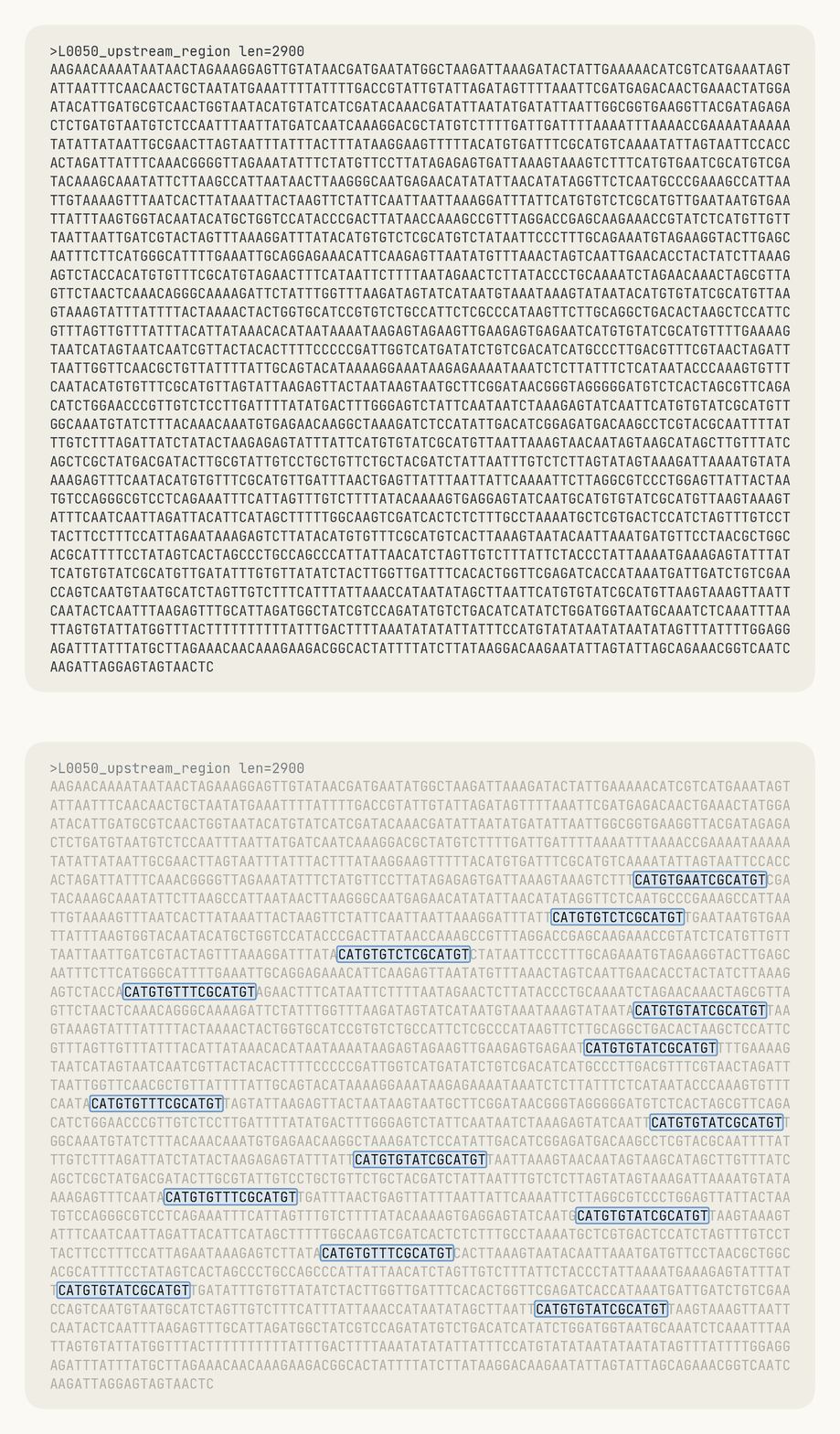
At the center is a type of protein called a reverse transcriptase, which generally makes DNA using RNA as a template. Claude noticed short, repeated DNA sequences beside its gene, along with another gene encoding a different protein.
The enzyme itself was not newly discovered. A 2021 study reported this reverse transcriptase in a phage called MarsHill and suggested that a nearby region might produce RNA. Anthropic's paper cites that earlier work.
The new contribution is identifying the repeats and associated genes and grouping examples with the same features into a family. Reexamining already public data revealed a combination that had been overlooked as a research subject.
Claude read DNA and noticed a pattern it was not asked to find
According to the paper, the search used Claude Mythos 5. Researchers asked it to look for new associations between reverse transcriptases and nearby genes. They did not specify the crucial feature by asking it to search for DNA repeats.
Claude divided the work between agents examining sequences and agents checking their plans and findings. They could initiate follow-up investigations when something looked interesting. An agent reading the DNA sequence directly noticed repeats, measured their spacing, and compared them with known systems and the literature.
The initial autonomous search lasted 21.5 hours, used 949 agent runs, and produced 19 reports. The number 949 refers to sessions opened to carry out the work, not different models. Likewise, 21.5 hours covers the search, not the entire study including experiments.
Researchers then selected promising reports and pursued additional analyses through conversations with Claude Science. During this process, they found repeats in 28 of 95 groups of similar reverse transcriptases. The initial autonomous search should be distinguished from this later, human-involved validation.
Experiments found short RNAs produced from the repeats
An unusual arrangement of sequences does not by itself establish a biological role. The researchers first examined previously published infection experiment data. They found abundant RNAs corresponding to ART repeats, divided into short units.
They then examined the system in experiments using E. coli separately from phage infection. These also produced multiple short RNAs from the repeats. The pattern seen in the sequence was reflected in the RNAs actually produced.
However, this establishes only that the repeats produce RNA. It does not yet show whether ART's reverse transcriptase uses those RNAs or how it works with the protein encoded by the neighboring gene.
Anthropic also disclosed that it established a life sciences team and laboratory in spring 2026. Human researchers performed all of the laboratory work in this study. AI identified candidates in data, and people tested them experimentally.
Humans defined the research question. Further analysis and experiments continued after the initial search.
Find candidates in dataAn autonomous search lasting 21.5 hours
ResponsibleClaude
FindingPreviously unknown repeats
Find related examples and compare their featuresResearchers pursued further analysis with Claude Science
ResponsibleHumans and Claude
FindingA family sharing the same features
Test the system experimentallyResearchers performed all laboratory work
ResponsibleHumans
FindingProduction of short RNAs
ART's enzymatic activity and biological role remain unknown. Confirming RNA production does not establish the function of the entire system.
Research team reportCompiled by the editors from the paper and Anthropic's announcement.
Whether it can edit DNA like CRISPR remains unknown
The announcement highlights similarities between ART's sequence arrangement and CRISPR: short, similar sequences repeat with different sequences between them. CRISPR is used for gene editing, but this structural resemblance alone does not establish that ART could serve the same purpose.
The paper's discussion explicitly states that it does not demonstrate activity by ART's reverse transcriptase or its use of the short RNAs as substrates. Whether it associates with the related protein, and what role it plays for the phage, are also unknown. Targeted DNA cutting or rewriting has not been demonstrated.
Anthropic's hopes for applications rest on examples of known systems with similar components that developed into tools for manipulating DNA. The possibility that ART could follow a similar path remains far from a working tool.
Other related discoveries exist. A team including Stanford researchers reported in a preprint that a genome-analysis AI identified RNA arrays near a different reverse transcriptase family called UG27. Anthropic's paper also mentions this work. It is not the same discovery as ART, but attributing progress in this area solely to Claude would also be inaccurate.
Ten repeated searches failed to rediscover the pattern
The team repeated the search ten times to test whether the same setup could make the discovery again. None of the ten runs found the repeats. Some reached the target enzyme but did not read the surrounding DNA that contained the decisive clue.
This does not mean the discovered sequences were absent. It means the autonomous search did not consistently select the right location among many candidates and read the necessary data.
A separate evaluation compared giving models the sequences directly with having them open files and investigate. Capable models could recognize repeats when they read the sequences, yet sometimes finished without reading the relevant sections even when tools were available. Access to information is different from actually using it in an investigation.
The achievement goes beyond answering a question with a known solution: AI found a lead worth researchers' attention. One discovery, however, does not establish reliable scientific productivity. The next questions are what ART does experimentally, and whether similar searches can repeatedly uncover promising leads in other targets.
Sources and references
- Claude discovers a novel enzyme system with CRISPR-like repeats Anthropic / September 23, 2026 / Archived version
- Autonomous AI agents discover reverse transcriptases with tandem repeat arrays Anthropic / Preprint / Search: pp. 3–6; experiments: p. 8; repeated runs: pp. 8–10; limitations: pp. 13–14 / Archived version
- Comparative Genomics of Three Novel Jumbo Bacteriophages Infecting Staphylococcus aureus Korn et al. / Journal of Virology / 2021
- Coevolutionary mining of prokaryotic non-coding elements with a genome language model Li et al. / bioRxiv / Preprint released September 23, 2026
- Announcement from Anthropic's official account X / September 24, 2026, 3:18 a.m. Japan time
Update history
- Published.