Technology & Research · · Team LATENT
AI-produced proofs and how they were checked: 17.4 million lines of Lean for the Riemann hypothesis, two VP ≠ VNP proofs hours apart, and what Lean actually verified
On November 20 Levent Alpöge released a proof of the Riemann hypothesis, made with Claude, as a Lean library of 175,187 files and 17.4 million lines, about 6.9 times the size of Mathlib. About 25 hours later the Lean FRO and the Mathlib Initiative certified it. On November 23 Anthropic and, about four hours later, OpenAI added proofs that VP ≠ VNP; OpenAI added nine more papers on November 24. We compare who wrote the statements in Lean, what Lean checked, and how much human review has happened.
At 12:52 UTC on November 20, Levent Alpöge produced a four-page memo as a PDF. It has no title and no author line, and a footnote points to a set of files split into 14 parts. Together they hold 175,187 Lean files and 17.4 million lines. The final theorem proves RiemannHypothesis, a statement that was already in Mathlib. About four hours later every file had compiled. At 13:55 UTC the next day, the Lean FRO, which develops Lean, and the Mathlib Initiative, which runs the Mathlib library, issued a joint statement certifying that both the statement and the proof are correct.
Three days later, at 21:43 UTC on November 23, Anthropic added to its GitHub repository a proof that VP and VNP, two classes in algebraic complexity, are different. About four hours later OpenAI added a paper making the same claim to its repository, and on November 24 it added nine more, including one that puts the matrix multiplication exponent at 9/4.
This article compares the results released over those five days by asking who checked what, and how far. LATENT does not judge whether any proof is correct. For the Riemann hypothesis we measure how long the checks took and how large the proof is. For the other results we record, from each company's own documents, who wrote the statements in Lean and what Lean covers. All times are UTC. We read the GitHub repositories and Sutherland's verification log on November 25, Japan time.
Lean FRO and Mathlib Initiative: joint statement / Sutherland's verification log / Anthropic: vp-vnp / OpenAI: update history
Key takeaways
- The Lean proof of the Riemann hypothesis has 175,187 files and 17.4 million lines, about 6.9 times all of Mathlib and about 1.3 times Anthropic's September formalization of Fermat's Last Theorem. The Lean FRO and the Mathlib Initiative certified it about 25 hours after the memo PDF was created. Independently written checkers passed it in minutes. Lean's official kernel took 48 hours on one thread with default settings and 72 hours in paranoid mode; with one memory-allocation setting changed, they took 9 and 10 hours.
- The Riemann hypothesis statement is Mathlib's existing definition, which human experts had already vetted. For Anthropic's VP ≠ VNP, the statement file was written by AI, and the paper itself says only AI readers judged whether it matches the intended claim. OpenAI's November 23 VP ≠ VNP leaves the quantitative lower bound out of its statement file and does not enable a re-check with an independent kernel.
- Seven of OpenAI's nine November 24 papers have a Lean statement file. The matrix multiplication exponent 9/4 appears as an equality in a division-free model of computation. The linear programming paper, presented as an answer to Smale's ninth problem, has a Lean statement limited to rational inputs; the real-coefficient case the problem asks about is not in it.
The Riemann hypothesis proof and its certification 25 hours later
The Riemann hypothesis says that every nontrivial zero of the zeta function has real part 1/2. It governs the size of the error in the distribution of primes, has been open since 1859, and is one of the Clay Mathematics Institute's seven Millennium Prize Problems.
Alpöge's memo describes a plan that carries Stepanov's argument for the Riemann hypothesis over function fields to the integers. The memo's timeline table was made by Claude; it starts on October 6, 2026 and ends on November 16 with the generalized Riemann hypothesis. The memo says that toward the end Claude far outstripped Alpöge, and that the formalization was done by "Claude and I". Because the argument is so long, he released only the Lean, not an unreadable giant document. The memo gives no affiliation and no Claude model name. News reports describe Alpöge as an Anthropic employee, and Nature calls him a number theorist on leave from Harvard. We found no official Anthropic announcement; Nature, AP and AFP wrote that Anthropic did not respond to them.
The library proves five theorems. The first is Mathlib's RiemannHypothesis and the second states the same claim written out. The remaining three say, among other things, that no Dirichlet L-function has a zero with real part greater than 1/2. Sutherland's log states that the generalized Riemann hypothesis here is limited to Dirichlet L-functions.
The joint statement from the Lean FRO and the Mathlib Initiative says all four conditions set out on the Xena blog on November 12 are met: the statement matches Mathlib's definition, dozens of people reproduced the same export, two tools confirmed the statement matches, and several kernels and checkers accepted the proof. The statement went out at 13:55 UTC on November 21, about 25 hours after the memo PDF was created.
Alpöge's memo (PDF) / Lean FRO and Mathlib Initiative: joint statement / Xena: four questions for a proof checked in Lean / Nature: coverage of the Riemann hypothesis claim
How long the checks took, and on what machines
Andrew Sutherland of MIT ran the checks with Claude Code and posts the results with timestamps. Rubinstein at the University of Waterloo also checked it independently on university machines. We lined up both logs by hours elapsed since the memo PDF was created.
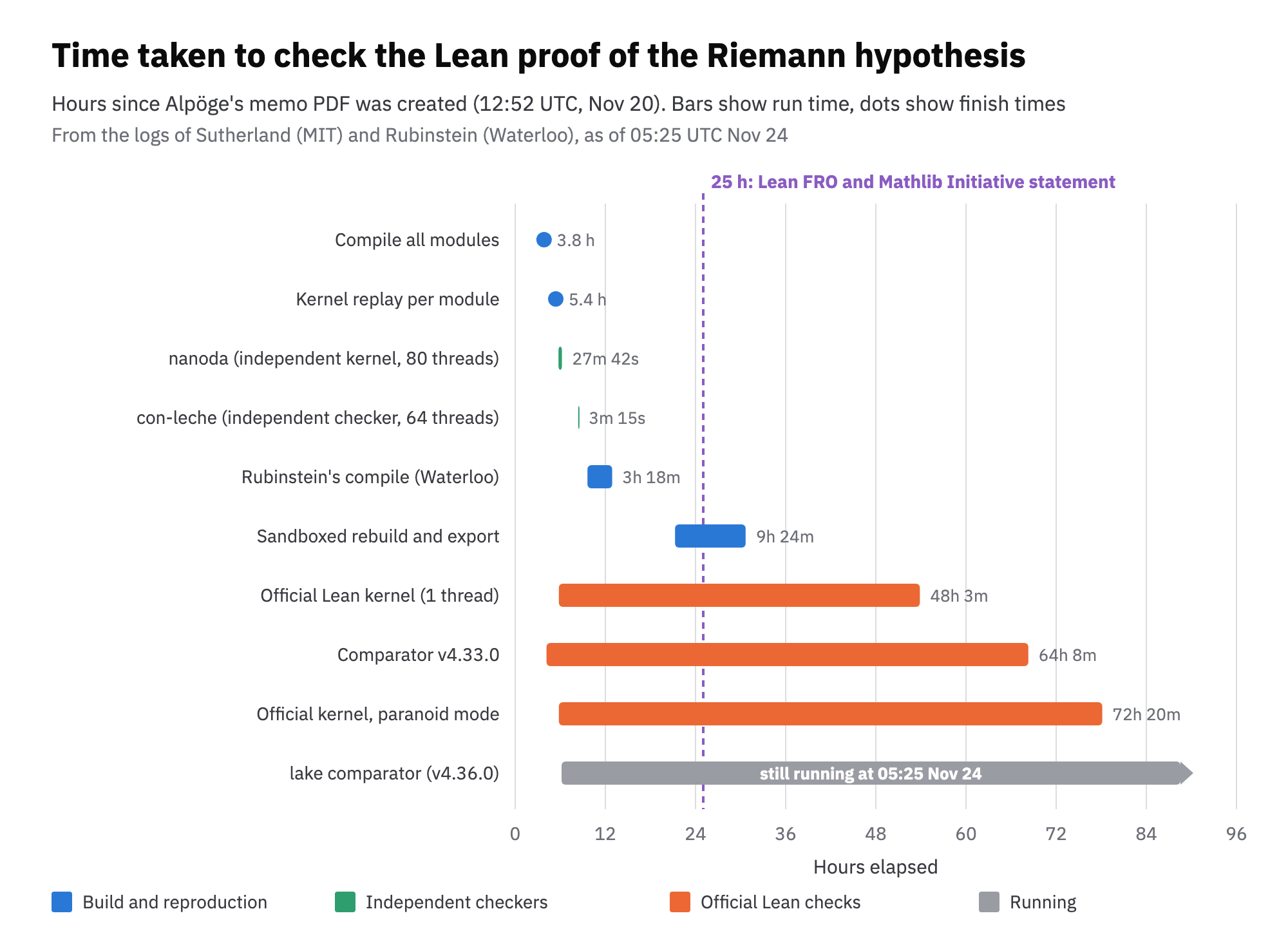
The fast checks were the ones written independently of Lean. nanoda, a kernel written in Rust, accepted the whole export in 27 minutes 42 seconds on 80 threads. con-leche took 3 minutes 15 seconds on 64 threads and accepted 1,468,418 declarations. According to the Lean FRO statement, con-leche and con-ron come with a formal proof, relative to set theory, that they cannot accept a false proof. The idea is that even if Lean's own logic had a flaw, a proof exploiting that flaw would not get past these two.
The slow checks were Lean's official ones. The official kernel took 48 hours 3 minutes on a single thread, and 72 hours 20 minutes in paranoid mode, peaking at about 99 GiB of memory. In runs with one memory-allocation (mimalloc) setting changed, they passed in 9 hours 8 minutes and 10 hours 0 minutes. Comparator v4.33.0, which checks that the statements match, printed "Your solution is okay!" at 09:10 on November 23, about 43 hours after the joint statement. In Sutherland's log, the statement-matching check that had finished before the joint statement was con-leche's comparison at 21:19 on November 20. The statement does not say which runs it relied on. The lake comparator of Lean v4.36.0 was still running its final stage at 05:25 on November 24.
To check it yourself, Sutherland says you need about 100 GB of memory and about 70 GB of disk. The export file is about 7.7 billion bytes compressed and about 61.6 billion bytes uncompressed. Even con-leche, the fastest checker, uses about 50 GB of memory. An ordinary laptop is not enough; you need a machine with a lot of memory.
Sutherland's verification log / Rubinstein's verification log
The size of the proof
According to NOTES.md in the repository where leanprover-community keeps a copy, the original library has 175,187 files and 17,374,215 lines, or 15,531,759 lines excluding blank lines. It contains 818,755 theorem and lemma declarations.
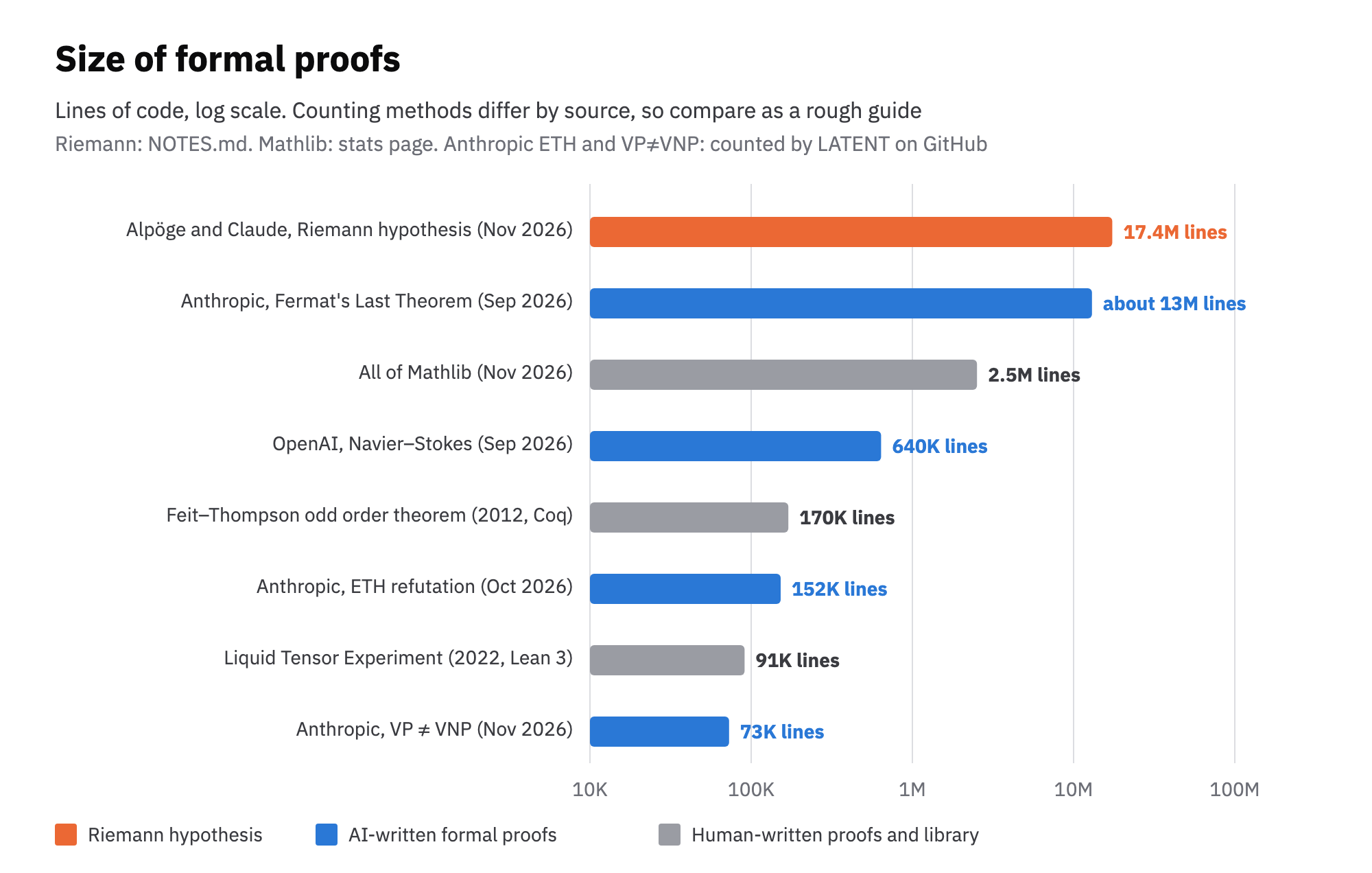
17.4 million lines is about 6.9 times the 2,516,978 lines in the whole Mathlib repository. The Mathlib figure counts the entire repository and may include non-Lean files. Against the roughly 13 million lines of Anthropic's formalization of Fermat's Last Theorem, announced in September, it is about 1.3 times larger. Among large human-written formal proofs, it is about 102 times the 2012 Feit–Thompson odd order theorem (Coq, about 170,000 lines) and about 191 times the 2022 Liquid Tensor Experiment (Lean 3, 90,967 lines).
According to the Xena blog, Anthropic's Fermat formalization barely compiled on a machine with 96 cores and 500 GB of memory. OpenAI's 640,000-line Navier–Stokes proof, by contrast, compiles on a laptop.
leanprover-community: riemann-hypothesis (NOTES.md) / Mathlib statistics / Xena: November 12 post
Who wrote the statements in Lean
What a Lean check guarantees is that the statement written in the file has been proved. Whether that statement is the proposition the mathematicians intended is something Lean does not check. The Xena post gives the example of a wrong "Fermat's Last Theorem" that compiles in Mathlib: because the natural numbers include 0, setting everything to 0 gives a counterexample. A wrong statement still compiles, so the post says you have to read the statement before the proof.
The documentation of Comparator, the tool that matches statements with proofs, also limits its guarantee to three things: the proof proves the same statement as the challenge file, it uses only the specified axioms, and Lean's kernel accepts it. Whether the statement in the challenge file matches the paper's claim is outside the guarantee.
On this point the Riemann hypothesis differs from the results of November 23 and after. Its statement is RiemannHypothesis, which has been in Mathlib for some time. According to the joint statement, that definition has been vetted by experts in Lean and number theory. In Anthropic's vp-vnp, the 98-line Statement.lean that sets out the definitions and claims was written by AI. The README says no machine checks that this file says what is claimed. Appendix Q.1 of the paper says only AI readers judged whether the statements match the intent, and that no human checked any part.
The Xena post also gives examples of statements that drifted. Of 290 OpenAI theorems with Lean attached, about 38 did not even state the paper's main theorem in Lean, about 13%. Among the papers without Lean, three were withdrawn in October because of a sign error.
leanprover: comparator / Anthropic: vp-vnp README / Xena: November 12 post
Two VP ≠ VNP proofs, hours apart
VP and VNP are classes in algebraic complexity defined by Valiant in 1979. VP is the families of polynomials computable by arithmetic circuits of polynomial size, and contains the determinant. VNP contains the permanent, a close relative of the determinant. VP ≠ VNP is called the algebraic version of the P versus NP problem, but both companies' papers say it does not settle P versus NP.
| Item | Anthropic | OpenAI (November 23 paper) |
|---|---|---|
| Commit created | 20:04, Nov 23 | 01:14, Nov 24 |
| Merged into main | 21:43, Nov 23 | 01:30, Nov 24 |
| Date the result was obtained | Not stated | November 6 |
| Paper | 70 pages, author Claude | 30 pages, author OpenAI |
| Circuit lower bound | m^(c(log m)^(1/3)), i.e. 2^(c(log m)^(4/3)) | exp(Ω((log n)^(5/4))) |
| What the Lean statement covers | The quantitative lower bound, approximating circuits, VP ⊊ VNP, and VNP not in the closure of VP | VP ≠ VNP for exact circuits |
| Independent kernel nanoda | Enabled | Disabled |
| Public automated checks (CI) | Yes, passing | None |
| Human review | Stated as not done | Not stated |
The gap between merges into main is about 3 hours 47 minutes, and between commit creation times about 5 hours 10 minutes. Anthropic's commit was not visible from outside until the PR was opened at 21:06. Writing the lower bounds in the form exp(c(log m)^a), Anthropic has a = 4/3 and OpenAI's November 23 paper has a = 5/4. In a November 24 paper OpenAI claims to strengthen the bound for the Hamiltonian cycle polynomial and the permanent to exp(c(log N)^2/(log log N)^2), but it says itself that this bound is not formalized.
In October, too, the two companies released refutations of the exponential time hypothesis (ETH) almost simultaneously. OpenAI merged into main at 21:18 on October 26 and Anthropic at 03:07 on October 27, a gap of about 5 hours 49 minutes. Both fall on October 26 by U.S. date. Both companies say the algorithm that breaks ETH was found on October 16.
The two companies' papers cite each other. OpenAI's November 23 and 24 papers say they use techniques from Anthropic's October ETH paper. Anthropic's VP ≠ VNP paper cites OpenAI's September manuscript on the permanent. Neither cites the other's VP ≠ VNP paper.
Expert reactions are only starting. Scott Aaronson wrote that both papers resemble each other in using diagonalization after a large compression step, and called the Lean formalizations far beyond the standard of journals. Lance Fortnow called Anthropic's result the most important computational complexity result of the year. Amir Shpilka, noting he had only looked at it for a few minutes, said it is a new technique. None of the three says he checked the proof himself. We found no report of a third party reproducing either company's Lean proof of VP ≠ VNP.
Anthropic: formal-math PR #51 / OpenAI: VP and VNP are different / Scott Aaronson: Shtetl-Optimized / Lance Fortnow: Computational Complexity
OpenAI's nine papers of November 24
On November 24 OpenAI added nine papers in two families, 533 pages in all. We lined up each paper's claim with the formalization scope that OpenAI's Lean documents (379.md and 380.md) describe.
| Paper | Claim | Lean statement file | Not formalized |
|---|---|---|---|
| Euclidean geometry in the asymptotic spectrum of tensors (86 pages) | Measures how hard tensors are to compute through the geometry of point placements | None (described in the document only) | Extension to infinite dimensions |
| Paths, trees and grids separate Valiant's hierarchy (21 pages) | VF ⊊ VBP ⊊ VP ⊊ VNP | Yes | Explicit lower bound for grids |
| Circuit lower bounds for Hamiltonian cycle and the permanent (80 pages) | Lower bound exp(c(log N)^2/(log log N)^2) | None (the document describes a superpolynomial bound) | The paper's main lower bound |
| The logarithmic exponent of finite Fourier transforms (41 pages) | Gate count N(log N)^(1/2+o(1)) | Yes | Lower bound for polynomial multiplication |
| The logarithmic exponent of integer multiplication on tapes (43 pages) | Time n(1+log n)^(1/2+o(1)), conditionally optimal | Yes | Division and square roots |
| The matrix multiplication exponent is nine fourths (111 pages) | ω = 9/4; multiplying n×n matrices needs at least ⌈n^(9/4)/2⌉ multiplications or divisions | Yes (ω = 9/4 in a division-free model) | The explicit gate count for each n |
| An exponential bound for sunflowers (36 pages) | The Erdős–Rado conjecture with a fixed number of petals | Yes | The explicit threshold |
| Strongly polynomial linear programming (58 pages) | Number of steps polynomial in problem size even with real coefficients; an answer to Smale's ninth problem | Yes (rational inputs) | Real coefficients (not listed in the document; the statement file is limited to rationals) |
| Superpolynomial graph diameter of simple polytopes (57 pages) | Disproof of the polynomial Hirsch conjecture | Yes | None listed |
Seven of the nine have a Lean statement file. Of those, five say in the documents that part of the paper's claim is not formalized: the explicit grid lower bound, the lower bound for polynomial multiplication, integer division and square roots, the gate count for each n in matrix multiplication, and the explicit sunflower threshold. For the linear programming paper the document lists nothing as unformalized, but the statement file is limited to rational inputs. Matrix multiplication also uses a different model of computation in the paper and in Lean. In OpenAI's configuration, independent-kernel checks for all of the November 24 additions are disabled, and the repository has no public automated checks. The review status in its formalization catalog is still "unchecked".
The matrix multiplication exponent ω describes how fast, as a power of n, the work to multiply n×n matrices grows. Its lower limit is 2, and there is a conjecture that ω = 2. OpenAI showed the 9/4 upper bound over the complex numbers in a paper dated October 2 and released it on October 6; outside researchers later extended it to every field. What is new on November 24 is the lower bound, which makes ω = 9/4 an equality. If it is correct, the conjecture ω = 2 does not hold. The Lean statement gives ω = 9/4 in a model of division-free programs that use only addition, subtraction and multiplication. Theorem 1.1 of the paper is stated for circuits that allow division. The document says Lean also proves that allowing division does not change the exponent, but we found no such theorem in MatrixExponent.lean, the file used for matching.
Smale's ninth problem asks whether linear programs with real coefficients can be solved with a number of real-number operations polynomial in the problem size. OpenAI's paper claims the result holds for arbitrary real coefficients. The Lean statement says that, for rational inputs, the number of instructions and the bit length of intermediate numbers are bounded by polynomials. The real-number version the problem asks about is not in the Lean statement.
OpenAI's repository has grown from 722 papers in the first release on October 6, through withdrawals and additions, to 730 papers in 375 families. According to the README, the model was given about 4,000 problems. The share of main results that are formalized, about 42%, has not changed since 300/719 on October 7. There were three withdrawals on October 7: a sign error in one paper carried over to two papers that depended on it. Fourteen papers were revised the same day.
OpenAI: 379.md / OpenAI: 380.md / OpenAI: MatrixExponent.lean / OpenAI: LinearProgramming.lean / OpenAI: README
Human-readable proofs and the prize rules
There is still no human-readable write-up of the Riemann hypothesis proof. In the memo Alpöge says he intends to deepen his understanding, simplify the argument and write it up properly. Terence Tao wrote on his blog that, on a preliminary look, the argument appears to use the full force of the Langlands program and arithmetic geometry and will take time to digest. Rubinstein published a 265-page exposition written by AI, but it stops at reducing the Riemann hypothesis to an inequality, which is not proved within the exposition.
Views differ. According to Nature, James Maynard of Oxford said the proof will turn out to be correct, while Andrew Granville of Montreal said what was released is garbled and also criticized the timing, right after Anthropic's IPO. About the memo's footnote saying that a prose version written by Claude exceeded 250,000 pages, Alpöge said on X on November 23 that it was a joke (The Decoder).
On the Clay Mathematics Institute's website, the Riemann hypothesis is still listed as "Active" as of November 25. The prize rules require three conditions before review: publication in a qualifying outlet, at least two years since publication, and general acceptance in the mathematical community. Even if it were published in November, the second condition could be met no earlier than November 2028. Clay's president Martin Bridson told AP that it is a historic announcement but that the road to real understanding will be long and hard.
The same day, November 20, a manuscript proving the generalized Riemann hypothesis without AI also appeared. Ravi Vakil of Stanford hurriedly posted Alessandro Masullo's 940-page manuscript. According to The Decoder, about eight hours later Vakil reported that several people had pointed out problems. Also that day, Alpöge and Tristan Buckmaster of NYU released a proof that solutions of the Navier–Stokes equations can break down in finite time. Its Lean theorem is stated on condition that a certain approximate solution exists, and that approximate solution is not in the repository.
Terence Tao: blog / Clay Mathematics Institute: prize rules / AP (via ABC News) / Buckmaster: navier-stokes
What LATENT is watching
First, the remaining checks and the write-up for the Riemann hypothesis. We will see whether the final stage of lake comparator in Sutherland's log passes, whether Alpöge releases a human-readable write-up, and whether Anthropic says anything officially.
Second, third-party confirmation of VP ≠ VNP. We will follow whether outsiders reproduce either company's Lean proof with Comparator, and whether human experts read Anthropic's Statement.lean and accept it as saying what was intended.
Third, OpenAI's matrix multiplication lower bound. With no public automated checks and no independent-kernel check, we will see whether outside researchers reproduce the build and the statement matching, and how the gap between the division-free model and the paper's circuit model is handled.
Sources and scope
We read in the original Alpöge's memo, Sutherland's and Rubinstein's verification logs, the Lean FRO and Mathlib Initiative statement, the Xena posts and Tao's blog. The size of the Riemann hypothesis proof comes from NOTES.md in the leanprover-community repository; LATENT did not recount the files. The Mathlib line count is the November 25, 2026 figure from the statistics the stats page loads. Line counts for the Fermat formalization, Feit–Thompson and the Liquid Tensor Experiment come from Anthropic's announcement, the Xena posts, a Microsoft Research article and Lean community records. The ratios are LATENT's calculations, and counting methods differ.
For the Anthropic and OpenAI repositories, we took commit times from the GitHub API and read the READMEs, paper PDFs and Lean files. The file and line counts for Anthropic's vp-vnp Lean code and the page counts of OpenAI's nine papers were counted in our supporting research. We did not build OpenAI's Lean code and did not read its lemma files. We read the posts by Aaronson, Fortnow and Shpilka as summaries of the retrieved text. We could not read the NYT, BBC or WSJ articles. Maynard's and Granville's remarks are as reported by Nature. Alpöge's affiliation is as reported in the press.
- Levent Alpöge, memo (November 20, 2026)
- Lean FRO and Mathlib Initiative, "Lean verification of the Riemann Hypothesis"
- Andrew Sutherland, "Verification files for the Lean proof of the Riemann Hypothesis"
- Rubinstein (University of Waterloo), verification log
- leanprover-community/riemann-hypothesis
- Xena, "…and the proof is checked in Lean"
- Xena, "FLT: Anthropic has beaten me to it"
- Mathlib statistics
- leanprover/comparator
- Terence Tao, blog post of November 20, 2026
- Nature, coverage of the Riemann hypothesis claim
- AP (via ABC News)
- The Decoder, November 24
- The Decoder, Masullo's manuscript
- Clay Mathematics Institute, Rules for the Millennium Prize Problems
- Clay Mathematics Institute, Riemann Hypothesis
- tristanbuckmaster/navier-stokes
- anthropics/formal-math, vp-vnp
- anthropics/formal-math, PR #51
- anthropics/formal-math, eth
- openai/math, README
- openai/math, history.md
- openai/math, VP and VNP are different
- openai/math, lean/docs/379.md
- openai/math, lean/docs/380.md
- openai/math, MatrixExponent.lean
- openai/math, LinearProgramming.lean
- openai/math, The Exponential Time Hypothesis is False
- Scott Aaronson, Shtetl-Optimized
- Lance Fortnow, "VP ≠ VNP"
- Interview with Amir Shpilka (Vasek Rozhon's Substack)