Chips & Infrastructure · · Team LATENT
What Revolut pays to run GLM-5.3 on its own GPUs: unit prices against commercial AI, and the engineer count where self-hosting pays off
UK fintech Revolut moved coding assistance for about 2,000 engineers to GLM-5.3 running on 56 B200 GPUs. It puts the blended cost at $0.30 per million tokens and says its bill is one-tenth of what it paid Anthropic and OpenAI. We checked the figures against the talk transcript, compared them with today's list prices using the token mix from Bun's rewrite, estimated the monthly GPU cost, and calculated how many engineers a company needs before self-hosting pays off.
On October 13, at the AI Engineer conference in New York, David Abitbol of UK fintech Revolut gave a 15-minute talk. He leads AI operations at the company. According to the talk, Revolut moved the coding assistance used by about 2,000 engineers to GLM-5.3, which it runs itself on 56 Nvidia B200 GPUs. The blended cost of input and output is $0.30 per million tokens, and the bill is one-tenth of what Revolut had been paying Anthropic and OpenAI.
The Register covered the talk on November 3 and reported that Revolut cut its costs tenfold by dropping Claude. Read on its own, the headline suggests any company could cut its costs to a tenth by doing the same. This article puts the talk's figures on the same scale as today's commercial prices and calculates how large a company has to be for self-hosting to pay off.
We checked the figures on November 4 against the talk transcript, the talk page and each provider's pricing page. GPU prices and rental rates come from a vendor document and an aggregator, and Revolut has not disclosed its actual contracts. The ratios, monthly costs and headcounts are LATENT's calculations, and each section states its assumptions. This article does not recommend any particular service.
Talk transcript / Talk page / The Register
Key takeaways
- Applying the token mix from Bun's rewrite to today's list prices puts Claude Sonnet 5.5 and GPT-6.1 Sol at about $0.33 per million tokens. That is 10 to 20 percent above Revolut's $0.30, and Claude Opus 5.5 is 2.2 to 2.4 times higher. The tenfold figure compares against Revolut's earlier bills, and the gap against today's price lists is much smaller.
- Running 56 B200 GPUs costs an estimated $130,000 a month if bought and about $170,000 a month on a three-year reservation. Working back from the tenfold claim, the earlier bill was $1.30 million to $1.67 million a month, or $649 to $834 per engineer. That is 2.6 to 5.6 times the average of $150 to $250 a month in Claude Code's documentation.
- If usage per engineer and GPU cost match Revolut's, self-hosting becomes cheaper than Opus 5.5 at about 130 engineers and cheaper than Sonnet 5.5 at about 260. Adding the cost of one operator raises the break-even against Sonnet 5.5 to about 1,400 to 3,100 engineers.
What the talk said and how it was reported
Table 1 lists the figures Abitbol gave. Revolut brought Gemini into the company in January 2025, started trying Claude Code that February, and rolled Claude Code out at scale the following January. At that point, he said, engineers were spending $1,000 to $10,000 a month each without much return. Revolut therefore launched Claude Code with strict budget limits. It started self-hosting with GLM-5.1 in April 2026 and later moved to GLM-5.3.
| Item | Figure from the talk |
|---|---|
| Users | About 2,000 engineers |
| GPUs | 56 B200 |
| Model | GLM-5.3, run in FP4 |
| Context length | Served at 256K tokens |
| Time to first token | Target under 3 seconds; complaints grow past 5 seconds |
| Generation speed | About 200 tokens per second per user; about 800 after 5 p.m. |
| Unit cost | $0.30 per million tokens, blended across input and output |
| Bill | One-tenth of what Revolut paid Anthropic and OpenAI |
Fifty-six GPUs equal seven eight-GPU machines. Dividing 2,000 engineers by seven gives about 286 engineers per machine.
The Register described $0.30 as the price per million input and output tokens, but the word used in the talk was "blended". Commercial services charge different prices for input, cached input and output, so comparing against a blended price requires a token mix. The Register's figure of about 380GB for the weights also does not match the 464GB of Nvidia's NVFP4 build. Other outlets named the model as GLM 4.5 or placed the talk at GTC Berlin.
The productivity figures come with caveats. Abitbol said Gemini improved lead time by 10 percent and coding time by 20 percent, and GLM-5.1 improved coding time by 60 percent and lead time by 70 percent. The talk page notes that the comparison does not isolate the model change from other causes. The same page says the figures describe Revolut's deployment and utilization, not a portable price for any self-hosted model. This article does not use the productivity figures and deals only with cost.
Talk transcript / Talk page / Nvidia GLM-5.3 NVFP4
Cost per token using Bun's token mix
Coding agents reread the same files and conversation history many times. Most of their input is therefore served from cache, and cache reads cost less than ordinary input. Abitbol also said the cache hit rate needs to be above 90 percent. Revolut has not published its own token mix, so this article uses a public example instead.
The example is Bun's rewrite in Rust. In a July 8 blog post, Jarred Sumner, who leads Bun, wrote that Claude Code kept 64 Claudes running for the 11 days from May 3 to May 14. Before the merge, the work used 5.9 billion uncached input tokens, 690 million output tokens and 72 billion cached input reads. Of the 78.59 billion tokens in total, cache reads were 91.6 percent, uncached input 7.5 percent and output 0.9 percent. Cache reads made up 92.4 percent of input, above Revolut's 90 percent target. OpenRouter has also reported that just under 90 percent of agents' prompt tokens were cached in September.
Table 2 and Figure 1 apply this mix to each provider's price list. We multiplied Bun's usage by each price, added the results and divided by 78.59 billion tokens.
| Model | Input | Cache read | Output | Price with Bun's mix |
|---|---|---|---|---|
| Revolut self-hosted | Not disclosed | Not disclosed | Not disclosed | $0.30 |
| Claude Sonnet 5.5 | $2 | $0.10 | $10 | $0.33–0.37 |
| GPT-6.1 Sol | $2 | $0.10 | $10 | $0.33 |
| GLM-5.3 (Z.ai API) | $1.4 | $0.26 | $4.4 | $0.38 |
| gpt-5.3-codex | $1.75 | $0.175 | $14 | $0.41 |
| Claude Opus 5.5 | $4 | $0.20 | $20 | $0.66–0.73 |
Prices are per million tokens. The upper end of the Claude ranges counts all uncached input as 5-minute cache writes, which cost 1.25 times the input price.
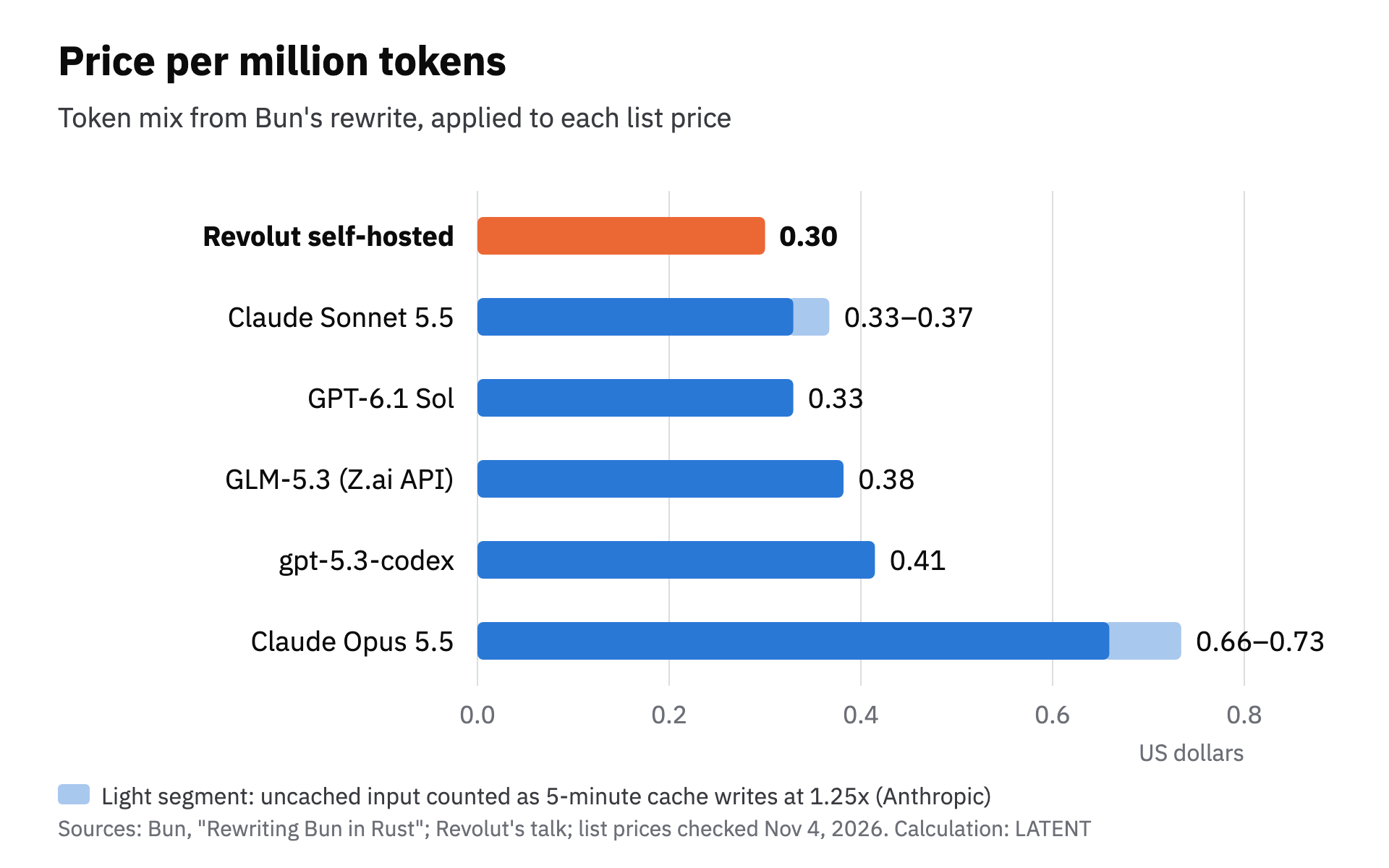
Claude Sonnet 5.5 and GPT-6.1 Sol come to $0.33, about 10 percent above Revolut's $0.30. Including the cache-write premium, Sonnet 5.5 is $0.37, still only 20 percent higher. Claude Opus 5.5 comes to $0.66 to $0.73, or 2.2 to 2.4 times Revolut's figure. GLM-5.3 through the Z.ai API is $0.38, about 1.3 times.
A gap close to tenfold appears only under a different comparison. Against the ordinary input price, ignoring cache, $0.30 is about one-seventh of Sonnet 5.5's $2 and about one-thirteenth of Opus 5.5's $4. Bun put the cost of its rewrite at around $165,000 at API pricing. Divided by 78.59 billion tokens, that is about $2.10 per million, roughly seven times Revolut's figure. Bun used a pre-release version of Claude Fable 5.
This comparison covers the price of a token and nothing else. Different models use different numbers of tokens for the same work, and output quality is not compared here. If Revolut's mix differs from Bun's, the prices change too, and the commercial prices rise as the share of output grows.
Bun, "Rewriting Bun in Rust" / OpenRouter, "Cache is crucial" / Claude API pricing / OpenAI API pricing / Z.ai pricing
Monthly cost of 56 B200 GPUs and the earlier bill
Revolut has not said whether it bought or rented its 56 GPUs, so we estimated the monthly cost both ways (Table 3). For a purchase, we took the $550,475.10 standard selling price Lenovo gives for an eight-GPU HGX B200 server, spread it over five years and added the operating cost from the same document. That operating cost is $12.84 per hour per server: $2.08 for colocation, $3.22 for power and cooling, and $7.54 for maintenance. It assumes US electricity prices. For rental, we used the median rates compiled by American Compute.
| Procurement | Per 8-GPU node per month | 56 GPUs per month | Per engineer per month | Tokens implied at $0.30 |
|---|---|---|---|---|
| Purchase (5-year depreciation, with operating cost) | $18,548 | $129,834 | $65 | 432.8 billion a month |
| 3-year reservation ($4.08 per GPU-hour) | $23,827 | $166,790 | $83 | 556.0 billion a month |
| 1-year reservation ($4.36) | $25,462 | $178,237 | $89 | 594.1 billion a month |
| On demand ($6.82) | $39,829 | $278,802 | $139 | 929.3 billion a month |
A month is 730 hours. The purchase case works out to $3.18 per GPU-hour.
If the $0.30 figure reflects the purchase or three-year reservation cost, Revolut processes 433 billion to 556 billion tokens a month. That is 220 million to 280 million tokens per engineer a month, or 9.8 million to 12.6 million per working day over 22 working days. In Bun's rewrite, each Claude used about 110 million tokens a day on average.
Working back from the claim that the bill fell to one-tenth, the earlier bill was $1.30 million to $1.67 million a month, or $649 to $834 per engineer. Claude Code's documentation puts the enterprise average at $150 to $250 per developer per month. Revolut's earlier spending was 2.6 to 5.6 times that average, which fits Abitbol's remark that some engineers spent $1,000 to $10,000 a month.
Buying the same number of tokens at Sonnet 5.5's current prices would cost $71 to $102 per engineer a month with Bun's mix. The gap with the $65 to $83 of self-hosting is small. The tenfold ratio is relative to Revolut's earlier usage and prices, and it shrinks sharply against today's Sonnet 5.5.
Lenovo TCO document / American Compute B200 data / Claude Code cost documentation
The engineer count at break-even
The cost of self-hosting stays almost the same whether the GPUs are busy or idle. The cost per token therefore depends on the number of GPUs and the number of people using them. Here we assume that usage per engineer and the cost of an eight-GPU node match Revolut's, and that one node serves about 286 engineers. Under these assumptions, the cost per token for a company with N engineers is $0.30 multiplied by "nodes ÷ 7" and "2,000 ÷ N". Up to 286 engineers one node is enough, so the cost is about 85.7 divided by N.
| Compared with | Price with Bun's mix | GPU cost only | Plus one operator | Plus two |
|---|---|---|---|---|
| Claude Opus 5.5 | $0.66–0.73 | 117–131 engineers | 234–261 | 467–521 |
| gpt-5.3-codex | $0.41 | 207 | 827 | 1,654 |
| GLM-5.3 (Z.ai API) | $0.38 | 225 | 1,123 | 2,245 |
| Claude Sonnet 5.5, GPT-6.1 Sol | $0.33–0.37 | 234–261 | 1,401–3,121 | 2,569–5,982 |
Each figure is the first headcount at which the self-hosted cost per token falls below the commercial price.
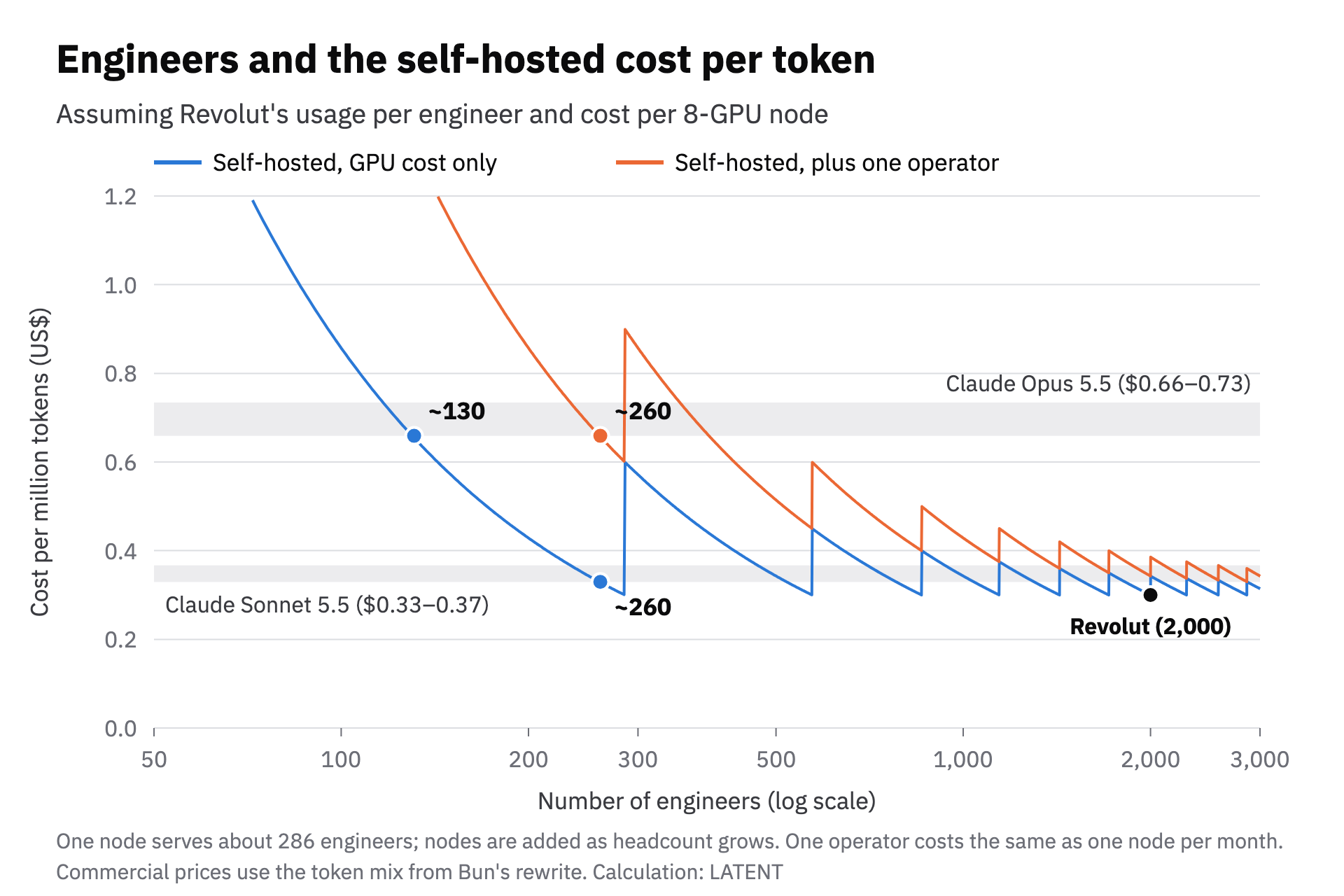
On GPU cost alone, self-hosting becomes cheaper than Opus 5.5 above about 130 engineers and cheaper than Sonnet 5.5 above about 260. A 100-engineer company would pay $0.86 per million tokens, more than Opus 5.5. Past 286 engineers a second node is needed, so a 300-engineer company would pay about $0.57.
Self-hosting also needs people to keep the model running. LATENT assumed one operator costs $20,000 a month. That is close to the monthly cost of one purchased node, so the calculation counts one operator as one node. With this cost added, the break-even against Opus 5.5 rises to about 230 to 260 engineers and against Sonnet 5.5 to about 1,400 to 3,100. Adding one operator to Revolut's own 2,000 engineers gives about $0.34, inside Sonnet 5.5's range of $0.33 to $0.37.
Self-hosting saves the most when the comparison is with an expensive model. A company that relies heavily on top models such as Opus 5.5 can pay off the investment with a few hundred engineers. If its usage is centred on models at Sonnet 5.5's level, the cost difference stays small even beyond 1,000 engineers.
This estimate assumes that tokens per engineer do not change with company size. A company whose engineers use less would pay more per token when self-hosting. Hours when GPUs sit idle at night and at weekends also push the cost up. Abitbol's remark that speed per user rises about fourfold after 5 p.m. suggests that fewer people are online in the evening and the GPUs have spare capacity.
Why eight GPUs is the minimum unit
Nvidia's NVFP4 build of GLM-5.3 takes 464GB for the weights alone. A DGX B200 has 1,440GB across eight GPUs, or 180GB per GPU. Four GPUs give 720GB, enough for the weights but leaving only 256GB. The Register reported that GLM-5.1 needs 6 to 26GB per user for context. On those figures, four GPUs can hold context for only 9 to 42 users at once. Eight GPUs leave 976GB, enough for 37 to 162 users (Figure 3).
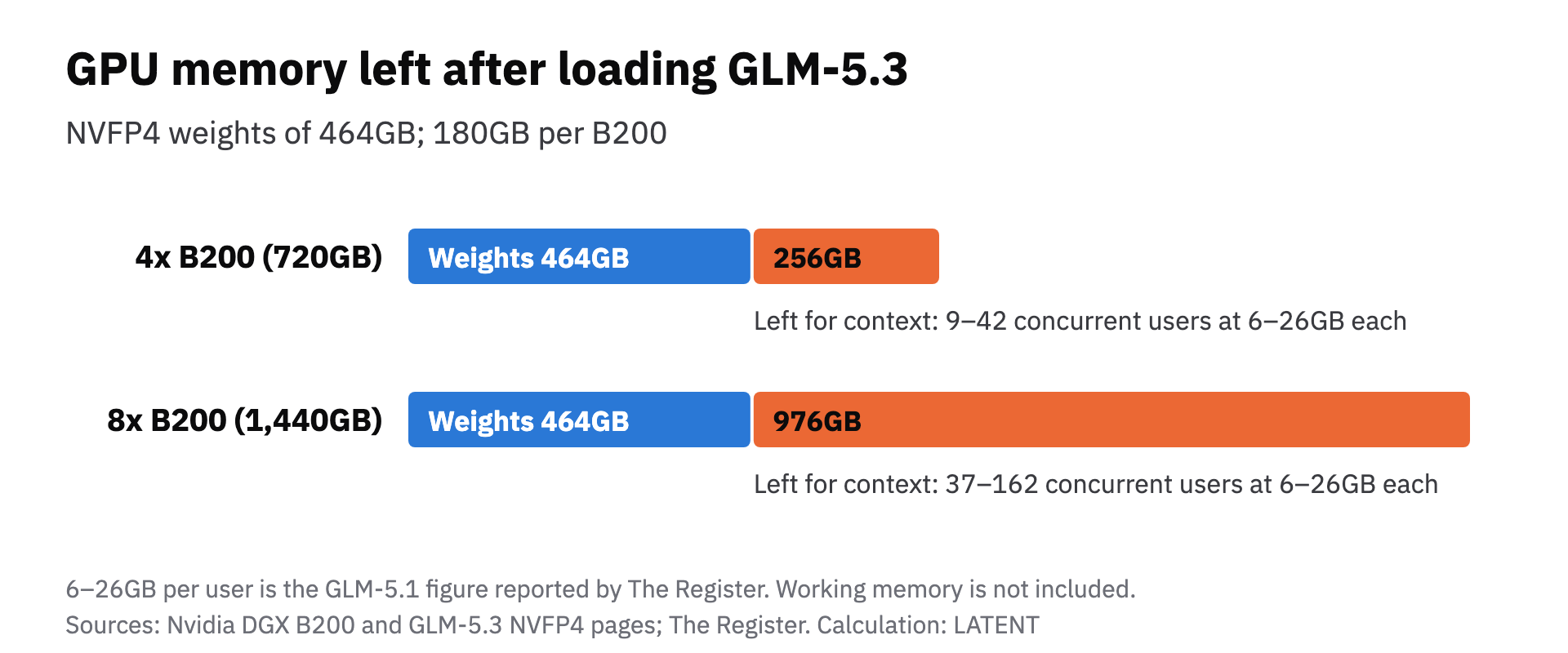
Abitbol also said that GLM fits on four GPUs but leaves too little memory for the KV cache, and that eight may work better. Against Revolut's 286 engineers per node, one eight-GPU node can hold context for 37 to 162 users at once. Not all 286 use it at the same time, so with Revolut's usage pattern this capacity is enough. Starting with four GPUs halves the fixed cost but limits context to a few dozen users at once.
Nvidia DGX B200 / Nvidia GLM-5.3 NVFP4 / The Register
More throughput from the same 56 GPUs
Between April and August, Revolut tuned its setup without adding GPUs. According to the talk page, the slide shows time to first token falling from 14.26 seconds during the migration to 1.68 seconds in the stable setup, with 76 percent more requests per second. In the transcript, Abitbol said there were about three requests per second in April and more than seven in August. Those rounded figures do not match 76 percent, so the calculation uses the talk page's figure.
| Period | Requests per second | Time to first token |
|---|---|---|
| During migration (April in the transcript) | About 3 in the transcript | 14.26 seconds (over 10 in the transcript) |
| Stable setup (August in the transcript) | 1.76 times the migration level (over 7 in the transcript) | 1.68 seconds (about 1.6 in the transcript) |
With the same GPU cost and 1.76 times as many requests, the cost per request falls to 57 percent. If tokens per request stayed the same, the cost before tuning would have been 1.76 times $0.30, or about $0.53. That is above Sonnet 5.5's $0.33 to $0.37 and the GLM-5.3 API's $0.38, and below Opus 5.5's $0.66 to $0.73. Before tuning, self-hosting cost more than Sonnet 5.5 does today.
The settings Abitbol listed were capping context at 256K tokens, using FP4 on Blackwell, splitting the model across eight GPUs where the load requires it, and keeping the cache hit rate above 90 percent. He said FP4 uses 40 percent less GPU capacity than FP8 with no loss of precision. He also mentioned speculative decoding and running prefill and decode on separate GPUs. His advice was to tune the configuration before adding GPUs.
Conditions that do not show up in a price list
One advantage Abitbol cited is that the bill does not change from month to month. Because Claude Code had budget limits, engineers saved tokens for the end of the quarter or for difficult tasks. Once the limits went away, they started using AI for Jira and Confluence work too, and lead time improved more than coding time, he said. Under usage-based pricing, the same behaviour would raise the bill in proportion.
The talk was titled "Shipping like a startup, regulated like a bank", and Revolut is regulated as a bank. According to The Register, Abitbol said concerns about Chinese open-weight models are "really nothing to worry about" when they run on premises or in a regional cloud.
The licence also deserves a check. GLM-5.1 and 5.2 were released under the MIT licence, but GLM-5.3 uses its own GLM-5.3 License. It sets a condition for companies whose revenue, including affiliates, exceeds $10 billion over any 12 consecutive months, but only when they operate a model-as-a-service business that gives third parties access to the model. End-user products that embed the model in specific features are excluded from that definition. The licence has no clause on internal use. Revolut reported 2025 revenue of $6 billion, and it runs the model for its own engineers.
GLM-5.3 handles text only, so Revolut routes questions that include images to Gemini and other models. Its UI designers use a GLM model that can handle images. Revolut also keeps using Codex and Claude Code as an exception for work that needs the latest models. Its setup has not replaced commercial services entirely.
GLM-5.3 License / Related article: GLM-5.3 changes attack economics and cyber defense priorities
Sources and scope
We checked the talk's figures on November 4 against the talk transcript and talk page, and read the full article in The Register. The reports that named the model as GLM 4.5 and placed the talk at GTC Berlin were from StartupHub.ai and Startup Fortune. Revolut's revenue comes from the title of its announcement and a report by FXC Intelligence.
Bun's token usage comes from Bun's blog. Commercial prices were checked on November 4 on the pricing pages of Anthropic, OpenAI's developer documentation and Z.ai. The openai.com pages could not be opened, so we used the figures on developers.openai.com. The cost per engineer comes from Claude Code's documentation. OpenRouter's cache share comes from its newsletter and has no breakdown for coding alone.
Lenovo's HGX B200 price is the standard selling price as of June 15, 2026, in its TCO document. The operating cost comes from the same document and assumes US conditions, not UK electricity prices. Rental rates are American Compute's medians, and individual providers' prices vary with timing and contract terms. The size of the NVFP4 weights comes from Nvidia's model page, and the DGX B200's memory from Nvidia's product page. The context needed per user is The Register's figure for GLM-5.1; we could not confirm a figure for GLM-5.3.
The prices under Bun's mix, the monthly cost of 56 GPUs, the token volume implied by $0.30, the earlier bill worked back from the tenfold claim, the break-even headcounts, the memory left for context and the cost before tuning are LATENT's calculations from the sources. The $20,000 monthly cost of one operator is LATENT's assumption. Revolut has not disclosed its actual token mix, how it procured the GPUs, or what the $0.30 figure includes.
- AI Engineer, "Shipping like a startup, regulated like a bank" transcript
- AI Engineer NYC 2026 talk page
- The Register, "British fintech Revolut slashes AI coding costs 10x"
- Bun, "Rewriting Bun in Rust"
- OpenRouter, "Cache is crucial"
- Claude API pricing
- Claude Code cost documentation
- OpenAI API pricing
- Z.ai pricing
- Lenovo TCO document
- American Compute B200 data
- Nvidia DGX B200
- Nvidia GLM-5.3 NVFP4
- GLM-5.3 License
- Related article: GLM-5.3 changes attack economics and cyber defense priorities
- Related article: How practical is a local LLM you can actually rely on?